 Selective practice
Leave test
Selective practice papers
Choose a section and read its instructions before starting. Your work is saved in this browser when storage is available.
The interactive timer and answer controls need JavaScript. You can also use the Department's official online practice tests or find official PDF practice papers.
Mathematical Reasoning Practice Set 1 — free preview: read or print questions
40 minutes.
Question 1
A walking map uses a scale of 1 cm to 250 m. A route measures 7.2 cm on the map.
How long is the route in kilometres?
A. 0.18 km
B. 1.75 km
C. 1.8 km
D. 7.2 km
E. 18 km
Question 2
A theatre sells an adult ticket for $18 and a child ticket for $11. A group buys 3 adult tickets and some child tickets for $142 altogether.
How many child tickets does the group buy?
A. 5
B. 6
C. 7
D. 8
E. 9
Question 3
Three strips are joined to make one long strip. They measure 36 cm, 42 cm and 48 cm. At each of the two joins, 5 cm of one strip overlaps 5 cm of the next.
What is the length of the joined strip?
A. 96 cm
B. 101 cm
C. 106 cm
D. 111 cm
E. 116 cm
Question 4
Squares may be shaded but none may be unshaded.
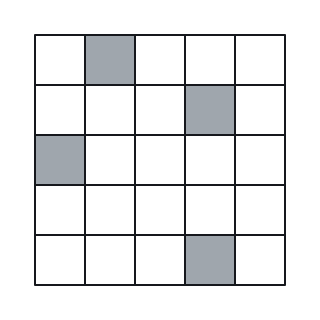
What is the smallest number of extra squares needed for the design to have a horizontal line of symmetry, a vertical line of symmetry and both diagonal lines of symmetry?
A. 3
B. 4
C. 6
D. 12
E. 16
Question 5
Of the books on a shelf, 2/5 are fiction. Half the remaining books are poetry; all the other books are information books.
A librarian adds 12 information books and no other books. There are then as many information books as fiction books.
How many books were on the shelf before the 12 books were added?
A. 30
B. 40
C. 80
D. 120
E. 132
Mathematical Reasoning Practice Set 2: read or print questions
40 minutes.
Mathematical Reasoning Practice Set 3: read or print questions
40 minutes.
Mathematical Reasoning Practice Set 4: read or print questions
40 minutes.
Mathematical Reasoning Practice Set 5: read or print questions
40 minutes.
Reading Practice Set 1 — free preview: read or print questions
45 minutes.
What an audience sees
Extract A
On the morning the harbour station closed, Leela arrived with a cardboard box large enough for the kettle and a notebook too small for everything else. The railway had promised that the timetable board would go to the museum. The benches would be auctioned. Nobody had mentioned the wall behind the ticket window, where forty years of pencil marks recorded the height of the water during exceptional tides.
Her grandfather had been the stationmaster. He had made the earliest marks with a carpenter’s pencil, carefully writing the date beside each one. Later workers had continued the custom, although official measurements were taken by an instrument on the pier. The marks were not part of anyone’s duties. They were the kind of thing people kept doing because someone before them had thought it worth doing.
Not all the dates were in the same handwriting. One worker had pressed so hard that the pencil left a groove; another had squeezed the year sideways into a crowded space. Leela could not put names to those hands. The wall made them neighbours nevertheless, separated by decades but meeting at the same rising water.
“We could cut that section out,” said the museum’s curator, Mr Duong. He placed his palm against the plaster as if testing the temperature of a sleeping animal. A builder waiting by the door gave a long, economical sigh.
Leela imagined the wall in a glass case. There would be a label, perhaps, explaining how the harbour sometimes entered a room designed to sell journeys. Visitors would nod and move on. Without the window behind them and the salt smell coming through it, would they understand why her grandfather had bothered?
She opened the notebook and copied each date, measuring the marks from the floor. The ruler trembled whenever she leaned too far. Beside the highest line she found a faint inscription she had never noticed: “N. brought tea”. Not a measurement at all. She copied it anyway.
Mr Duong watched. “A photograph would save you time.”
“I’m taking those too.”
“Then what is the notebook for?”
Leela looked at the words she had just written. The measurements were neat. The little sentence about tea was less so. “To make me stay long enough to notice what the photographs might miss.”
By noon the benches had gone. Sunlight reached a pale rectangle where the timetable had hung, and the station looked briefly like a drawing from which someone had rubbed out the important lines. Leela stood at the ticket window and recorded the view towards the pier: two orange mooring posts, a cracked blue bollard, the buoy that always appeared to be signalling a private disagreement with the water.
The builder returned with a cutting tool. Mr Duong raised a hand, asking him to wait. “If we take the plaster, we’ll need your account of where it stood.”
Leela held the ruler above a fresh page, then laid it beside the notebook. She began with the window. Behind her, the builder lowered his tool onto the empty bench brackets and waited.
Extract B
Our family attended my first piano concert with the equipment normally required for a rescue. Mum brought water, my aunt brought throat sweets, and Dad brought a camera whose strap had become entangled with his tie. None of them played the piano. This did not prevent them from giving advice. My aunt recommended breathing, which I had hoped to continue doing without supervision.
I was to play fourth. I had practised my piece until the passage with the crossed hands no longer looked like an accident. At home, I always glanced up at that moment to check whether anyone had noticed. Now, behind the curtain, I watched a boy bow to applause and realised that I had never practised standing up. The piano stool suddenly seemed a long way below the stage lights.
My cousin Nina was turning pages for the older pupils. She slipped through the curtain carrying a pile of music. I asked if she could sit beside me, although my piece occupied a single page. She looked at the sheet, then at my face, and placed it on top of her pile. When my name was called, she walked out with me. I kept my eyes on the small white square of music travelling ahead of us.
There was, I should explain, no shortage of courage in my family. We admired it tremendously in other people. Dad, for instance, had spent the interval before the concert advising me to forget the audience, while making sure his seat gave him an unobstructed view of it. From the stage I could see his camera rising above the third row like a periscope.
I played the first line too quickly. Nina moved one finger along the margin, slowly, though there was nothing for her to turn. At the crossed hands I looked up, as usual. Dad was still wrestling with the camera. For once I arrived at the next bar without waiting for anyone to be impressed.
Afterwards my aunt said she had scarcely breathed. I resisted pointing out that she had recommended the opposite. Dad showed us a photograph of the curtain and half a shoe. He explained that the lighting had been very difficult. Nina said nothing about the page. When Mum asked whether she had enjoyed the older pupils, Nina said she had missed one of her favourites. Only then did I remember hearing that piece through the curtain while I was waiting for my name. I offered to carry her music to the car. She gave me the heavier pile.
Question 1
What do both extracts suggest about what an audience sees?
A. An object or performance may conceal the support that made it possible.
B. Public attention gives private experiences their lasting importance.
C. People watching an event understand it better than those taking part.
D. A complete visual record removes the need for a personal account.
Question 2
In Extract A, the builder’s “long, economical sigh” most strongly suggests that he
A. understands more about the wall’s history than he says.
B. is relieved that the museum has agreed to take the wall.
C. has little patience for delaying practical work.
D. is too tired to use the cutting tool.
Question 3
Why does Leela copy “N. brought tea” into her notebook?
A. It proves which worker made the highest tide mark.
B. It preserves a human detail that does not fit the wall’s measuring purpose.
C. It gives the precise time of an exceptional tide.
D. It tells the curator how to cut out the plaster.
Question 4
What is suggested by Leela laying down the ruler at the end?
A. She no longer considers the height marks reliable enough to copy.
B. She accepts that the museum can explain the wall without her help.
C. She wants to delay the removal until the builder understands her objections.
D. She is extending her record from the marks to the setting that gives them meaning.
Question 5
Why does Nina look from the single sheet to the narrator’s face?
A. She realises that the request is about reassurance rather than turning pages.
B. She checks whether the narrator has brought the wrong piece of music.
C. She suspects that the narrator wants her to play the difficult passage.
D. She wants the narrator to admit that the piece has not been practised.
Reading Practice Set 2: read or print questions
45 minutes.
Reading Practice Set 3: read or print questions
45 minutes.
Reading Practice Set 4: read or print questions
45 minutes.
Reading Practice Set 5: read or print questions
45 minutes.
Thinking Skills Practice Set 1 — free preview: read or print questions
40 minutes.
Question 1
A tool library sells a one-day pass for $7, a flex pass for $15, and a six-consecutive-day pass for $24. A flex pass covers any three chosen days within a period of four consecutive calendar days. Passes may be combined.
Leila needs tools on days 1, 3, 4, 6, 9, 10 and 12 of one month.
What is the cheapest total cost of covering all seven days?
A. $37
B. $39
C. $45
D. $49
Question 2
A class tests whether quiet background music helps pupils spot errors in a paragraph. Half use music and half work in silence. The music group uses a paragraph with 12 spelling errors; the silence group uses a different paragraph with 12 punctuation errors. Both groups have five minutes. The music group finds more errors on average, so the teacher credits the music.
Which change would most directly address a competing explanation for this result?
A. Give both groups ten minutes instead of five.
B. Use the same paragraph for both groups, with pupils assigned to groups at random.
C. Use equal numbers of pupils in the two groups, keeping their original paragraphs.
D. Repeat the test with the same pupils, music and paragraphs a week later.
Question 3
A display can travel by road exactly when it is packed in a crate. It can travel by rail exactly when it is either crated or secured in a frame (or both). A frame may be used only after the display passes a balance check.
A display is refused road transport but accepted for rail transport.
Which statement must be true?
A. The display is uncrated and has passed the balance check.
B. The display is uncrated and has not passed the balance check.
C. The display is crated and has passed the balance check.
D. The information does not determine whether the display is crated.
Question 4
Two square stencils have holes in the dark cells. Turn the left stencil one quarter-turn clockwise, then place it exactly over the fixed stencil. Light passes through a cell only when both stencils have a hole there.
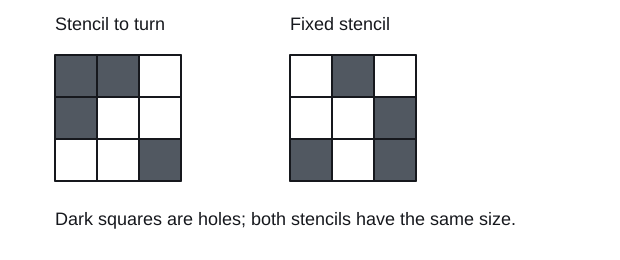
Through how many cells will light pass?
A. 0
B. 1
C. 2
D. 3
Question 5
Visitors can book one seat in each of two workshops. There are 24 bookings for the morning workshop and 18 for the afternoon workshop. Exactly 10 visitors have booked both.
Imran says, "There are 32 different visitors with bookings." Keiko says, "More than half of the morning visitors have also booked the afternoon workshop."
Whose reasoning is correct?
A. Imran only
B. Keiko only
C. Both Imran and Keiko
D. Neither Imran nor Keiko
Thinking Skills Practice Set 2: read or print questions
40 minutes.
Thinking Skills Practice Set 3: read or print questions
40 minutes.
Thinking Skills Practice Set 4: read or print questions
40 minutes.
Thinking Skills Practice Set 5: read or print questions
40 minutes.
Writing Practice Set 1: read or print questions
30 minutes.
An unexpected audience
Passengers at a local railway station heard a youth theatre group's rehearsal through the platform speakers instead of the usual announcements. The group was rehearsing in a nearby hall.
Write a newspaper report about this incident for the local paper.
You could include how people reacted, what happened next, and comments from people involved.
Writing Practice Set 2: read or print questions
30 minutes.
Writing Practice Set 3: read or print questions
30 minutes.
Writing Practice Set 4: read or print questions
30 minutes.
Writing Practice Set 5: read or print questions
30 minutes.