A photograph lands on the exam paper, or a political cartoon, or an advertisement clipped from a newspaper, and something changes in the room. Students who can rattle off metaphor and imagery in a poem go quiet in front of a picture, because nobody taught them that a visual text is analysed with the same rigour, just a different toolkit.
The Common Module: Texts and Human Experiences tests visual texts in Paper 1 Section I alongside prose and poetry, and NESA expects the same standard of technique-to-effect analysis regardless of the text type. The good news is that visual texts only need five techniques to cover almost anything the exam presents, and a simple mnemonic makes them hard to forget under pressure.
This guide works through those five techniques, how to describe what you see without a quotation to lean on, how to link a visual observation back to the rubric, and how the SPETE+L formula from our guide to answering HSC English short answer questions applies to a picture in exactly the same way it applies to a poem.
Key Takeaways
- Visual texts in Paper 1 Section I get the same technique-then-effect treatment as written texts, no separate skill set required.
- Five techniques cover almost any visual text: vectors, symbolism, body language, composition, and captions and text.
- The mnemonic Victor Sells Big Crappy Carrots locks in that order: Vectors, Symbolism, Body language, Composition, Captions.
- Naming a technique earns almost no marks on its own. You must describe specifically how it is used in that text.
- Every response should link back to Common Module rubric phrases such as “human experience” and “isolation.”
- The SPETE+L formula for short answer questions applies to visual texts exactly as it applies to a poem or a prose passage.
What Visual Texts Appear in HSC English Paper 1?
Paper 1 Section I regularly includes a visual text among the unseen prose and poetry: a photograph, an illustration, an advertisement, a political cartoon, or a composite image built from more than one source. NESA does not test these separately from written texts. They sit in the same short answer section, worth the same marks, and marked against the same criteria.
What changes is the kind of evidence available. A written text gives you a quotable line. A visual text gives you a composition: where the composer has placed each element, what the viewer’s eye is drawn to first, and how figures within the image are positioned and posed. The analysis skill is identical to a written text: spot a deliberate choice, name the technique, and explain what it does to the viewer’s understanding of the human experience the image represents.
For the prose and poetry equivalents, see our unseen prose analysis guide.
Did You Know? The Common Module rubric expects students to examine “texts in a variety of forms, modes and media,” which explicitly includes visual and multimodal texts alongside written ones. Source: NESA, English Standard Syllabus
What Five Techniques Cover Any Visual Text?
You only need to be confident with five techniques to analyse almost any visual text the exam presents: vectors, symbolism, body language, composition, and captions and text.
- Vectors: lines that direct the viewer’s gaze, whether from an arm gesturing across the frame, a road receding into the distance, or the direction a subject is looking.
- Symbolism: objects, colours or motifs representing broader meanings, a wilting plant standing in for isolation, a closed door for exclusion.
- Body language: physical expressions conveying emotion, posture, gesture, and the way a figure holds itself in the frame.
- Composition: the arrangement of elements in the frame, what is placed centrally, what is pushed to the margins, what is left empty.
- Captions and text: the words accompanying the visual, a headline, a caption beneath a cartoon, or text embedded inside the image itself.
The mnemonic Victor Sells Big Crappy Carrots locks the order into memory: Vectors, Symbolism, Body language, Composition, Captions.
Learning five techniques is not the hard part. The part that actually costs students marks is described in the principle behind this whole guide:
When analysing texts, you must make sure you don’t just state the technique, but also describe specifically how it is used in that text.
How to Describe Visual Evidence Without Quoting
A written short answer question gives you an embedded quotation to lean on. A visual text does not. Your evidence for a visual text is a precise description of what you can see, and the accuracy of that description is often what separates a Band 5 response from a Band 6 one.
This is the exact gap the principle above is built to close. It is not enough to state that a text uses a technique. You have to describe specifically how that technique appears in that particular image, because a marker cannot verify a vague claim against a text they cannot quote back to you.
Consider the following example, built around a painting of an isolated figure:
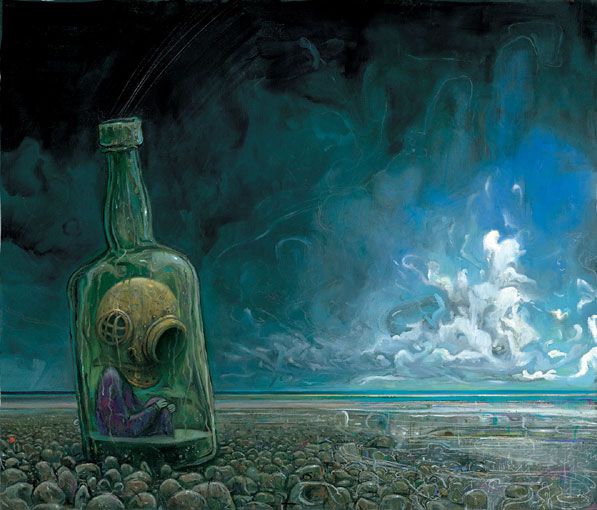
The weak version tells the marker a technique exists. The strong version tells the marker exactly what the composer did and lets the effect (loneliness, defeat, isolation) follow naturally from a detail the marker can actually picture. That single word is the entire skill of visual analysis. General claims cost marks. Specific description earns them.
Our guide to how to memorise English quotes easily covers the same evidence-first instinct for written texts. Both skills start from the same habit: point to something exact before you explain what it does.
How to Link Visual Analysis to the Common Module Rubric
Every response, visual or written, must link back to the Common Module rubric. The rubric centres on how texts represent, explore or challenge the individual and collective human experience, and a response that never uses that language leaves the connection for the marker to work out alone.
Here is what a fully linked sentence looks like. Notice how each one moves from the specific visual detail straight into rubric phrasing, human experience, isolation, the individual, without a separate closing sentence:
The composition with the figure alone in the foreground, highlights the emotions of loneliness and sadness provoked by human experiences of isolation.
The hunched body language of the sole figure emphasises the individual human experience of loneliness and sadness which can arise within restrictive circumstances.
Both sentences do three things in one breath: name the technique (composition, body language), describe how it appears (alone in the foreground, hunched), and land on rubric language (human experiences of isolation, individual human experience). That is the Specification, Technique, Effect and Link elements of SPETE+L compressed into a single sentence, which is exactly how a strong response should read under exam time pressure.
For a worked example of the same rubric-linking skill applied across a full prescribed text essay rather than an unseen image, our Curious Incident Module B guide walks through how rubric phrasing anchors an entire essay. Module B has its own rubric rather than the Common Module one, but the habit of linking every piece of analysis back to it is identical.
How to Apply SPETE+L to a Visual Text Question
The SPETE+L formula covers Specification, Point, Evidence, Technique, Effect and Link, and it applies to a visual text exactly as it applies to a poem or a prose passage. Only the Evidence element changes shape.
Specification and Point still open the response by directly addressing the question’s key phrase. Evidence becomes a precise visual description instead of a quotation, “the figure alone in the foreground” rather than a line lifted from the text. Technique is one of the five from this guide: vectors, symbolism, body language, composition, or captions and text. Effect explains what that technique does to the viewer, and Link closes by returning to the question or the rubric.
A two-mark visual question still needs two explained examples. A four-mark question still needs four. The marks-to-techniques rule does not change because the text is a picture instead of a paragraph. If you can run through Specification, Point, Evidence, Technique, Effect and Link on a photograph in the same three or four sentences you would use for a poem, the visual text section is solved.
The Bottom Line
Visual texts use the same six-step process, specify, point, evidence, technique, effect, link, aimed at a different kind of evidence. Learn the five techniques, the mnemonic, and the habit of describing exactly what you see, and a photograph or a political cartoon becomes as predictable as a poem.
If you want structured practice with unseen visual texts, our HSC English Advanced tutoring in Blacktown and HSC English Standard tutoring both drill Paper 1 short answer questions, written and visual, in classes of 1 to 5 students, minutes from Blacktown Station. Check our pricing, or book a free trial with no obligations.
Frequently Asked Questions
What are the five techniques for analysing visual texts in HSC English?
Vectors, symbolism, body language, composition, and captions and text. The mnemonic Victor Sells Big Crappy Carrots keeps them in order. Together they cover almost any photograph, illustration, advertisement, or cartoon that appears in Paper 1 Section I.
Does the SPETE+L formula work for visual texts as well as written texts?
Yes. Specification, Point, Evidence, Technique, Effect and Link apply to a visual text exactly as they apply to a poem or prose passage. The only change is that Evidence becomes a precise description of what you see rather than a quoted line.
How do I find evidence in a visual text if I can't quote it?
Describe precisely what is in the image instead of quoting it. "The figure alone in the foreground" or "hunched body language" gives the marker something exact to picture, while a vague claim like "the picture shows someone sad" gives them nothing to verify your analysis against.
How many visual technique examples do I need for a 3-mark question?
Three. The same marks-to-techniques rule that applies to written short answer questions applies to visual ones: match the number of explained examples, each with a named technique and its effect, to the number of marks on offer.
What's the difference between vectors and composition in a visual text?
Vectors are the lines within an image that direct the viewer's gaze, such as a subject's line of sight or an outstretched arm. Composition is the broader arrangement of every element in the frame, including what is central, what is marginal, and what is left empty. Vectors are one part of a text's overall composition.
Do visual texts appear in both English Standard and English Advanced Paper 1?
Yes. Both courses share the Common Module: Texts and Human Experiences and are examined on it in Paper 1, so a visual text can appear in either exam. The five techniques and the SPETE+L formula in this guide apply equally to both courses.
Learn it properly with a specialist tutor in small Blacktown classes. Enquire about a free trial — no cost, no obligation.
Realistic study tips to help you prepare better for assessments with less stress, plus a printable study planner