Lux Tuition
Menu

Free online OC practice tests

Help your child practise for the NSW OC test in Year 4.

Start free practice
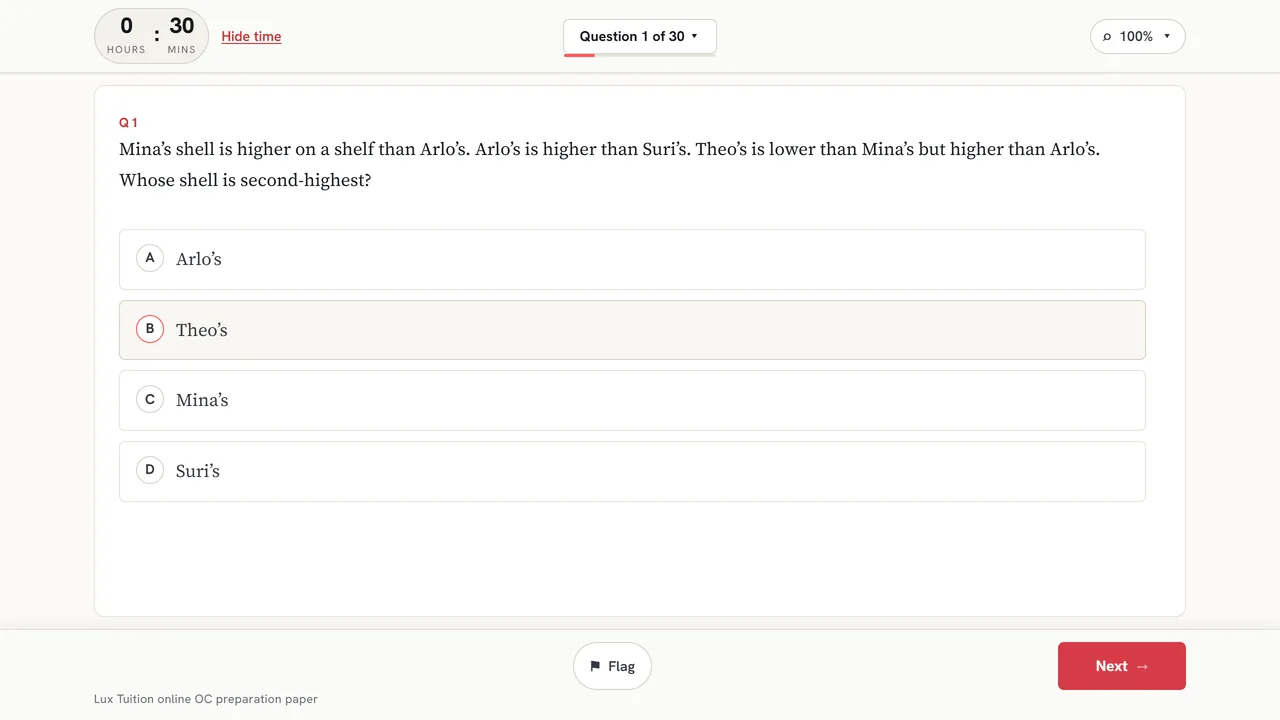
OC Thinking Skills free preview showing a shell-ordering question, answer choices, timer, flag and question grid.
The Lux practice player · Answer, flag and move between questions View larger (opens in a new tab)

See where to focus next.

See the score and the skill areas to practise after each attempt.
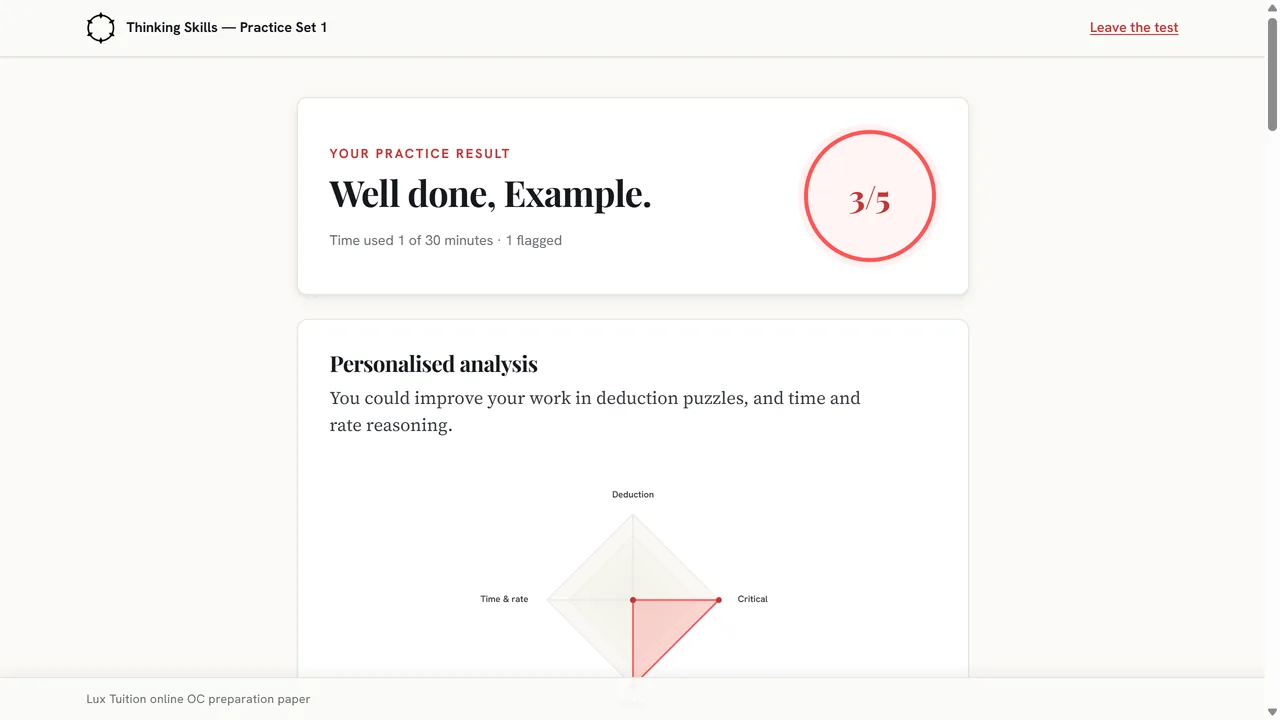
Example preview result: 3 of 5 correct in OC Thinking Skills, with the real skill radar and deduction question to review.
Example five-question preview result · Explore the result and select a skill View larger (opens in a new tab)

Understand every answer.

Read a worked explanation, then use it to work through the next question.
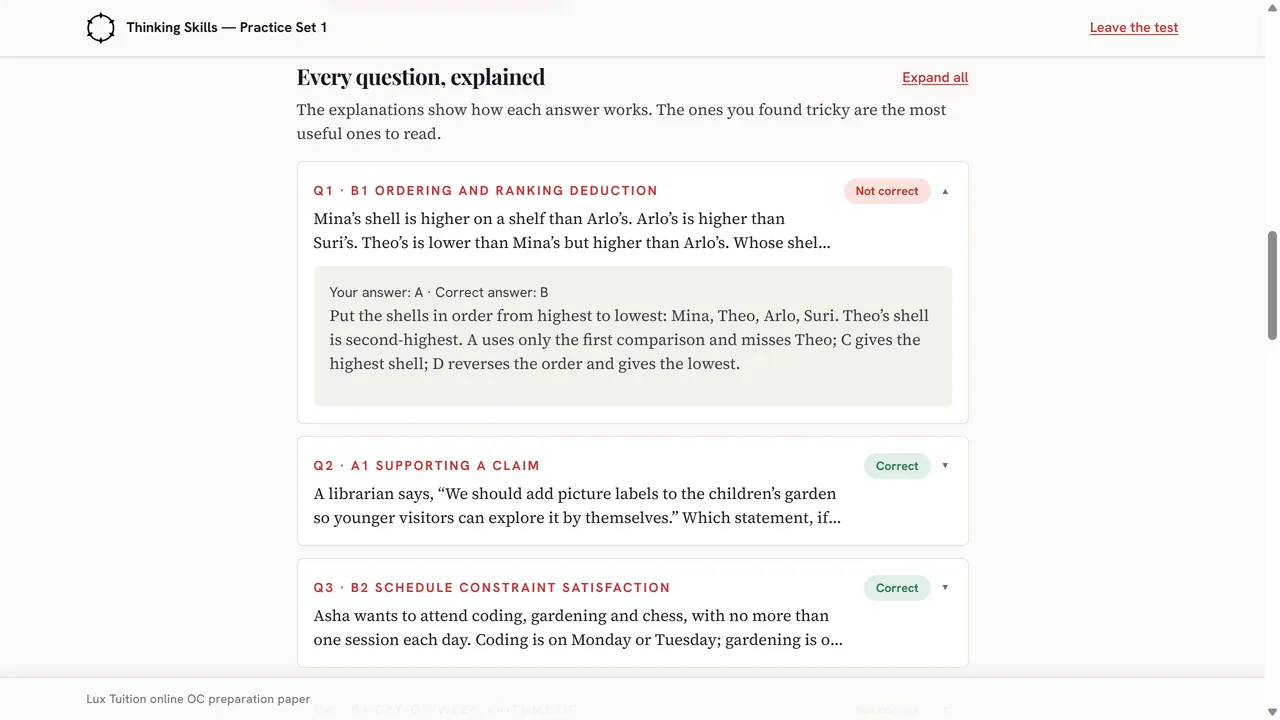
Free-preview Question 1 review showing answer A, correct answer B and the worked shell-ordering explanation.
Example five-question preview result · Read the worked explanation View larger (opens in a new tab)

Free OC practice for NSW Year 4

553 original practice questions across 7 sets. Start with a Set 1 paper below. More sets are available inside the player.

Try the first 5 questions of each Set 1 paper immediately. A free access link sent to a parent or carer’s email unlocks the rest. Reading has 25 answers and does not yet include choose-the-missing-word tasks.

OC practice questions by type

Explore OC question types

The NSW Opportunity Class Placement Test has three components: Reading, Mathematical Reasoning and Thinking Skills. We sorted the 294 numbered questions in the Department of Education’s three official OC practice test PDFs into 21 question types (by our count) and charted how often each one appears. Each explanation shows what the type looks like, the skill it tests and one tip.

Reading

OC Reading test questions: the 5 question types

Every official practice test has the same five tasks in the same order. The PDFs number every part as its own question, 1 to 33. Counting the missing-word, missing-sentence and matching tasks as one question each gives 14, which fits the Department’s description of the computer test as 14 questions, 3 of them with several parts. The Department does not say which three are multi-part. The chart follows the PDFs’ numbering.

questions on the computer test, 3 with several parts (DoE)
14
numbered questions in each PDF
33
minutes
40
Official Reading practice-paper counts and sources
How often each Reading question type appears across the three official practice tests (counted as the PDFs number them)
Question type Total of 99
Story extract questions Tests 1 to 3: 6, 6, 6 18
Choose the missing word One 8-part task per test Tests 1 to 3: 8, 8, 8 24
Poetry questions Tests 1 to 3: 5, 5, 5 15
Missing sentences One 6-part task per test Tests 1 to 3: 6, 6, 6 18
Matching across texts One 8-part task per test Tests 1 to 3: 8, 8, 8 24
Source: the Department’s explained answers (PDFs) Test 1 Test 2 Test 3
Story extract questions 18 of 99
What it looks like
A page or so of fiction with dialogue, followed by six multiple-choice questions. One might ask why Mei slips a letter under her pillow instead of opening it; another might ask which single word best sums up the way Grandad treats the new puppy from beginning to end.
Skill tested
Inference about feelings, motives and character; close reading of a quick sequence of events; noticing how a writer uses language across a whole text.
Tip
The early questions follow the story in order, so answer each one from the part of the text it points to. For “throughout the extract” questions, pick the option you can back with at least two separate moments, not one striking line.
Choose the missing word 24 of 99
What it looks like
A short text with eight single words taken out. For each gap your child chooses the word that fits best from a set of options, all of them real words and several close in meaning.
Skill tested
Vocabulary in context: what a word means, whether it fits the grammar of the sentence, and which word naturally goes with the words around it.
Tip
Read the whole sentence, and the one after it, before choosing. Then say the sentence in your head with each option in the gap: the wrong ones usually mean nearly the right thing but sound wrong with the words around them.

Not in our Reading papers yet. The Department’s Practice Test 1 Reading paper (PDF) has one.

Poetry questions 15 of 99
What it looks like
A poem of roughly 20 to 35 lines, often with numbered lines or verses, followed by five questions. One might quote a phrase like “the rain taps with impatient fingers” and ask what mood it sets; another might check which earlier word a pronoun is standing in for.
Skill tested
Similes, metaphors and personification; pronoun reference across lines; the purpose of a verse; the mood of a person in the poem; where the scene is viewed from.
Tip
In comparison questions, one option is often a word lifted straight from the line that is not the thing being compared. Ask two questions: what is being described, and what is it being likened to?
Missing sentences 18 of 99
What it looks like
An information text, usually on a nature, science or history topic, with six sentences removed. Your child places the right sentence in each gap from a list that includes one spare.
Skill tested
How a text holds together: words that point back (this, they, here), linking words (however, for comparison) and the topic of each paragraph.
Tip
Check both sides of the gap. The right sentence links back to the sentence before it and sets up the one after. Fill the gaps you are sure of first, and expect the spare sentence to match a paragraph’s topic while breaking one of its links.
Matching across texts 24 of 99
What it looks like
Four short extracts on one theme, each written in a different style, then eight statements to match to them, such as “Which extract suggests the writer found a new job harder than expected?” Our practice sets split the eight statements into two questions of four.
Skill tested
Reading for meaning across several texts at once, and recognising the same idea when it is put in different words.
Tip
The statements paraphrase the extracts rather than repeating their words, so be suspicious of an extract that simply shares a keyword. One extract can answer three statements and another only one, so do not answer by elimination.
Mathematical Reasoning

OC maths questions: the 7 Mathematical Reasoning question types

Mathematical Reasoning stays within Year 4 content, but most questions need two or more steps and a good share are visual.

questions
35
minutes
40
options per question (A to E)
5
Official Mathematical Reasoning practice-paper counts and sources
How often each Mathematical Reasoning question type appears across the three official practice tests
Question type Total of 105
Measurement and time Tests 1 to 3: 7, 10, 10 27
Multi-step word problems and number puzzles Tests 1 to 3: 7, 5, 9 21
Geometry and spatial reasoning Tests 1 to 3: 8, 5, 6 19
Fractions, decimals and money Tests 1 to 3: 5, 4, 2 11
Data, graphs and probability Tests 1 to 3: 3, 5, 3 11
Number and place value Tests 1 to 3: 3, 3, 2 8
Patterns, sequences and counting Tests 1 to 3: 2, 3, 3 8
Source: the Department’s explained answers (PDFs) Test 1 Test 2 Test 3
Measurement and time 27 of 105
What it looks like
Elapsed time across midday or midnight, days between two dates, reading a scale whose marks are not all labelled, perimeter and area on a grid, balancing masses and reading a timetable.
Skill tested
Converting between units, reading unusual scales and timetables, and choosing the right measure (perimeter or area, mass or capacity) for the question.
Tip
On any scale, work out what one small mark is worth before reading the arrow. For time, jump to the next whole hour first, then count on in hours and minutes.
Multi-step word problems and number puzzles 21 of 105
What it looks like
Everyday problems that need two or three steps, such as “Ravi reads 18 pages a day and Ella reads 6 fewer. How many more pages has Ravi read after a week?”, plus missing-number grids and working backwards from a result.
Skill tested
Deciding which operations a situation needs before calculating, keeping track of a middle result, reasoning with rates and simple ratios, and working backwards.
Tip
Write down what each number stands for before calculating. Several wrong options are the answer to the first step only, or the answer with one condition forgotten.
Geometry and spatial reasoning 19 of 105
What it looks like
Turning a shape a quarter-turn, counting the faces you can see on a stack of cubes, following compass directions on a grid map, folding and cutting paper, and completing a symmetrical pattern.
Skill tested
Visualising shapes as they turn, fold or join; properties of 2D and 3D shapes; angles; grid position and direction.
Tip
Follow one distinctive corner or edge through a turn instead of the whole shape. For cube stacks, count where cubes touch: each join hides two faces.
Fractions, decimals and money 11 of 105
What it looks like
Shading a fraction of a shape, finding a fraction of what is left, comparing fractions on a number line, the cheapest way to buy an amount, and making change with coins.
Skill tested
Fractions as parts of a shape, a quantity and a number line; money calculations with more than one step.
Tip
Watch for a fraction taken of a remainder: half of the leftover part is not half of the whole. For money, list the combinations in order rather than guessing.
Data, graphs and probability 11 of 105
What it looks like
Column graphs, dot plots and picture graphs where one symbol stands for several items, often with three statements and the question “Which statements are correct?”, plus questions about how likely it is to pick a certain object from a bag.
Skill tested
Reading a graph’s scale or key accurately, combining values to meet a target, and describing chance with words like certain, likely and equally likely.
Tip
Read the key or the scale before reading any bar. With “which statements are correct?”, test every statement separately; do not stop at the first true one.
Number and place value 8 of 105
What it looks like
Numbers written in words or in unusual groupings, rounding to estimate, making the largest or smallest number from given digits, and odd and even totals.
Skill tested
Place value, rounding and estimation, and flexible mental calculation.
Tip
Rewrite any unusual form as an ordinary number before comparing or calculating. When estimating, round first and calculate second.
Patterns, sequences and counting 8 of 105
What it looks like
Number sequences with a doubling or two-step rule, repeating picture patterns on a grid, markers spaced evenly along a line, and counting every possible pairing or combination.
Skill tested
Finding and extending a rule, working a rule backwards, and counting systematically without missing or repeating a case.
Tip
Draw the smallest case first: three markers, two gaps. For combinations, make an ordered list or a table so nothing is counted twice.
Thinking Skills

OC Thinking Skills questions: the 9 question types

Thinking Skills mixes two kinds of question through one paper: critical thinking (judging arguments) and problem solving (puzzles, spatial reasoning and tables). They alternate rather than coming in blocks.

questions
30
minutes
30
options per question (A to D)
4
Official Thinking Skills practice-paper counts and sources
How often each Thinking Skills question type appears across the three official practice tests
Question type Total of 90
Logic and deduction puzzles Problem solving Tests 1 to 3: 5, 7, 6 18
Spatial and visual reasoning Problem solving Tests 1 to 3: 6, 4, 6 16
Spot the mistake in the reasoning Critical thinking Tests 1 to 3: 3, 4, 6 13
Strengthen the claim Critical thinking Tests 1 to 3: 4, 4, 4 12
Tables, timetables and lists Problem solving Tests 1 to 3: 4, 4, 3 11
Whose reasoning is correct? Critical thinking Tests 1 to 3: 4, 3, 2 9
Rules and chains Problem solving Tests 1 to 3: 2, 2, 1 5
Time, dates and rates Problem solving Tests 1 to 3: 1, 2, 1 4
Which must be true? Critical thinking Tests 1 to 3: 1, 0, 1 2
Source: the Department’s explained answers (PDFs) Test 1 Test 2 Test 3
Logic and deduction puzzles 18 of 90

Problem solving

What it looks like
A handful of clues about the order of runners, who sits where, the value of letters or who is telling the truth, followed by a question that only one arrangement answers.
Skill tested
Combining several constraints, testing cases, and ruling options out systematically.
Tip
Draw a line or a small grid and place the fixed facts first. Then test each remaining option against every clue, not just the first one it satisfies.
Spatial and visual reasoning 16 of 90

Problem solving

What it looks like
Nets that fold into dice, a model seen from above or from one side, tile patterns, pieces that fit together to fill a shape, and comparing sizes in pictures drawn to different scales.
Skill tested
Mental rotation and folding, viewpoint, and reasoning about size and position.
Tip
Mark one feature, such as a single dot or the tallest block, and track only that. With dice, work out which faces end up opposite each other first.
Spot the mistake in the reasoning 13 of 90

Critical thinking

What it looks like
A short argument such as: “Since the canteen started selling fruit cups, more students have been late to class, so the fruit cups must be making them late.” Your child picks the option that exposes the weak step.
Skill tested
Recognising flawed reasoning: treating two things that happen together as cause and effect, relying on a small or unfair sample, or assuming the only possible explanation.
Tip
Before reading the options, say in one sentence what the person has assumed. The right answer names that gap; the wrong ones attack something the person never claimed.
Strengthen the claim 12 of 90

Critical thinking

What it looks like
Someone argues, for example, that every class should have ten minutes of silent reading after lunch. Your child picks the one extra fact that would do most to back that argument up.
Skill tested
Telling a reason that supports a conclusion apart from one that is merely on the same topic.
Tip
Find the claim’s actual conclusion, then ask of each option: if this were true, would it make the conclusion more likely? Options that are true and on topic but do not help are the traps.
Tables, timetables and lists 11 of 90

Problem solving

What it looks like
A timetable, price list or table of results with a set of conditions: which choice meets every condition, or how many sessions happen in a given week.
Skill tested
Reading structured information carefully and applying several conditions at once.
Tip
Apply one condition at a time and cross out every row it rules out before moving to the next. Then reread the question, because the same table can be asked about in several ways.
Whose reasoning is correct? 9 of 90

Critical thinking

What it looks like
A rule, such as “if it rains at lunch, the library opens”, followed by two people who each draw a conclusion from it. Your child decides whether one, both or neither of them has reasoned soundly.
Skill tested
Conditional logic: what “if”, “only if” and “always” do and do not allow you to conclude.
Tip
Judge each person separately against the rule. The classic mistake is running a rule backwards: the library being open does not mean it rained.
Rules and chains 5 of 90

Problem solving

What it looks like
If-then rules for choosing a team, a pattern rule to check a sequence against, or a chain of events where each step sets off the next, followed through to what must happen.
Skill tested
Applying rules step by step and following a chain of consequences to the end.
Tip
Write down the situation after every step rather than holding it in your head. Most wrong answers come from one skipped link in the chain.
Time, dates and rates 4 of 90

Problem solving

What it looks like
Counting forward from a known weekday to a later date, finding when two club sessions overlap, or comparing how long two walkers take over the same distance.
Skill tested
Date and day-of-week arithmetic, overlapping time intervals, and speed and rate.
Tip
Use sevens for days of the week: 21 days later is the same weekday. For overlaps, draw both intervals on one time line.
Which must be true? 2 of 90

Critical thinking

What it looks like
A few facts, such as “everyone in the choir also plays an instrument”, and four conclusions. Just one follows for certain from the facts given.
Skill tested
Drawing only the conclusions the information forces, and nothing more.
Tip
“Must” means there is no possible exception. Rule out options that could be true, or are probably true, but are not forced by what you were told.

Try a free OC practice paper.

Open the practice test

How we counted

The counts come from the explained answers the NSW Department of Education publishes for its three OC practice tests (linked under each chart). Sorting questions into types is our own judgement: where a question could fit two types, we counted it once, under the skill its explained answer relies on. The test formats are the Department’s, from its OC practice tests page, checked in September 2026. The Department notes that its PDF papers come from older paper-based tests, so treat the counts as a guide to the mix of questions rather than a promise about any future test. The practice papers are copyright Cambridge University Press & Assessment, and none of their questions are reproduced here.

How we check each paper

Every question is original and reviewed by our tutoring team. We map each paper to the published test structure, check that the questions can be answered in the time allowed, and review every answer with a worked explanation. These are independent practice materials, not official NSW Department of Education papers.

Common questions about these opportunity class practice tests

What is the OC test?

The Opportunity Class Placement Test is the NSW Department of Education test that Year 4 students sit for entry into a Year 5 opportunity class. It is computer-based and has three papers: Reading, Mathematical Reasoning and Thinking Skills. Our guide to the computer-based OC test format walks through what the real screen looks like.

What types of questions are in the OC test?

By our count, the questions in the Department’s three official practice tests fall into 21 recurring types, although not every type appears in every test (none of Test 2’s Thinking Skills questions asks which statement must be true, for example). Reading has five tasks: questions on a story extract, choosing missing words, questions on a poem, placing missing sentences and matching statements to short texts. Mathematical Reasoning is led by measurement and time and by multi-step word problems, followed by geometry, fractions and money, data, number and patterns. Thinking Skills mixes critical thinking (strengthening a claim, spotting a mistake in reasoning, judging whose reasoning is correct) with logic puzzles, spatial reasoning, tables, rules and time problems. Every OC question type is explained above, with a chart of how often it appears.

Who makes these OC practice tests?

Lux Tuition’s tutoring team writes and reviews these original opportunity class practice tests and their worked explanations. Try the Department’s samples for its official software and question style, then use our papers for more practice.

OC past papers or practice tests: which should my child use?

Both, for different jobs. The Department of Education publishes three official OC practice tests, and they are the best guide to the exact style and wording of real questions, so work through those first. Our OC past papers page links every one of them, free. There are only three, though, and once your child has seen a paper it can never test them cold again. That is what these are for: original papers with the same number of questions and the same timing as the real test, added to over time, so your child can keep sitting fresh tests under real timing after the official ones run out. One difference to know about: our Reading papers do not yet include the choose-the-missing-word task, so they ask for fewer answers than the Department’s Reading practice tests.

How many OC test practice questions are there?

553 so far, across 7 complete practice sets, with more added over time. Each set has the same three papers as the real test, with the same number of questions and the same timing: Reading is 14 questions in 40 minutes, Mathematical Reasoning is 35 questions in 40 minutes, and Thinking Skills is 30 questions in 30 minutes. Some Reading questions have several parts, as in the official test, but the number of answers is not the same: our Reading papers ask for 25 answers, where each of the Department’s practice tests asks for 33, because ours do not yet include the choose-the-missing-word task. The Reading question types above show the difference.

Does it work on an iPad or a phone?

It works on a tablet or a phone, and the layout stacks so nothing is cut off. We still suggest a laptop or desktop with a mouse or trackpad, because that is what the real test runs on and part of the point is practising the mechanics.

What happens after the free questions?

The first 5 questions of each Set 1 paper are free with nothing to fill in. To keep going, a parent or carer enters their first name and email address and we send an access link to that address. The clock pauses while the form is on screen. If you would rather not, your child can finish there and still see their score, the skill analysis and worked explanations for those 5 questions.

How are scores shown?

As a plain count, such as "you answered 24 of 35 correctly". Under the score, the results screen sorts the questions your child got wrong by skill area, such as deduction puzzles, vocabulary and figurative language or measurement and time, and names the areas the wrong answers cluster in. Below that, every question your child answered is listed with a worked explanation of the right answer. All of it appears on screen as soon as the paper is submitted.

How much does it cost?

Nothing. All of the practice tests, the skill analysis, the worked explanations and the access link are free. There is no card, no trial that turns into a subscription and no cost at any point.

Ready for a first practice?

Start free practice

Prefer guided preparation? Explore our OC preparation classes or book a free trial.

Original Lux Tuition practice material. Independent of the NSW Department of Education. Official dates and applications.