
Module 1 is where Year 11 Chemistry lays its foundations. Everything you meet later (moles, reactions, energy, equilibrium) assumes you already know what matter is made of, why atoms of different elements behave differently, and what holds atoms together. If Module 1 is shaky, every module after it feels harder than it should. This page is part of our Year 11 Chemistry notes, which summarise all four modules in one place.
These Year 11 Chemistry Module 1 notes follow the four inquiry questions of Module 1: Properties and Structure of Matter in the NSW Chemistry Stage 6 Syllabus. They’re written from the lessons our tutors teach in class, reorganised into syllabus order. Each topic opens with the exact syllabus dot point it covers, so you can search this page for the wording your teacher uses.
These are theory and revision notes. We’ve left out worked examples and practice questions, and reading notes doesn’t replace the practical investigations the syllabus asks you to do in class.
Key Takeaways
- Module 1 has four inquiry questions: properties of matter, atomic structure and atomic mass, periodicity, and bonding.
- Mixtures can be separated using differences in physical properties such as particle size, volatility, boiling point and density.
- Isotopes of an element have the same number of protons but different numbers of neutrons; unstable isotopes decay by emitting radiation.
- Electron configuration moves from the Bohr model (2, 8, 8…) to the Schrödinger model’s spdf notation, filled by the Aufbau principle and Hund’s rule.
- Atomic radius decreases across a period and increases down a group; first ionisation energy and electronegativity do the opposite.
- The size of the electronegativity difference decides whether a bond is non-polar covalent, polar covalent or ionic. It’s a spectrum.
- Intermolecular forces (dispersion, dipole-dipole, hydrogen bonding) are weaker than intramolecular bonds and explain melting points, boiling points and solubility.
For how to study all this effectively, see how to actually understand HSC Chemistry.
What Does Year 11 Chemistry Module 1 Cover?
Module 1 is the first of four Year 11 modules in the NESA Chemistry Stage 6 Syllabus (2017). The four modules are:
- Module 1: Properties and Structure of Matter
- Module 2: Introduction to Quantitative Chemistry
- Module 3: Reactive Chemistry
- Module 4: Drivers of Reactions
Module 1 is organised around four inquiry questions, and these notes use the same order:
| Syllabus section | Inquiry question |
|---|---|
| Properties of Matter | How do the properties of substances help us to classify and separate them? |
| Atomic Structure and Atomic Mass | Why are atoms of elements different from one another? |
| Periodicity | Are there patterns in the properties of elements? |
| Bonding | What binds atoms together in elements and compounds? |
Did You Know? NESA’s new Chemistry 11–12 Syllabus (2025) starts for Year 11 in Term 1 2028. Until then, Year 11 students are taught the 2017 syllabus these notes follow. Source: NESA Chemistry Stage 6 Syllabus (2017) page
How Do the Properties of Substances Help Us to Classify and Separate Them?
Pure substances and mixtures
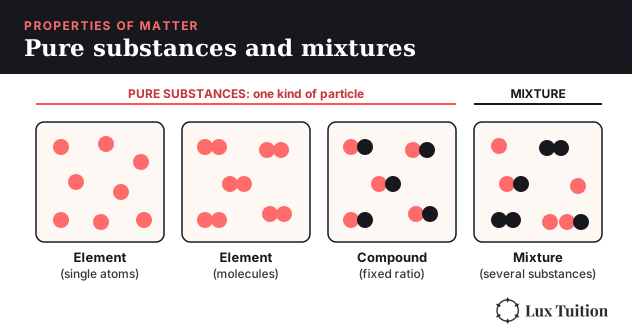
A pure substance has no other substances in it. This means that it will not change even if more purification procedures are performed, for example purified metals and purified water. A pure substance can’t be separated into any further substances, and a sample of a pure substance has constant physical properties throughout, such as colour, density and melting point.
A mixture has multiple substances in it, so a mixture is impure. Most substances in the world are mixtures, for example milk, rocks, apples and pencil lead. A mixture can be separated into more substances using separation processes such as filtering and distillation. It has properties dependent on the substances that make it up, and different parts of the mixture may have different properties. Therefore a mixture may have a range of properties, such as a range of boiling points, rather than a fixed single melting point.
What is the difference between homogeneous and heterogeneous mixtures?
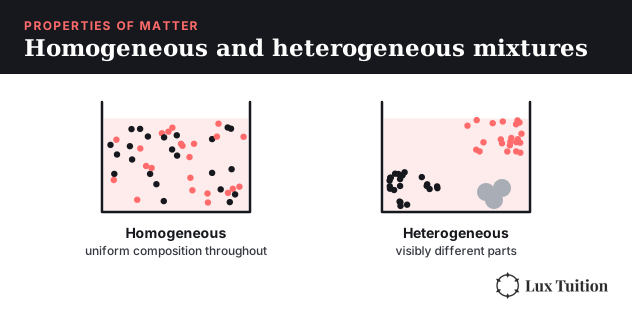
A homogeneous substance has a uniform composition, for example salt water, apple juice, wine and tea. In other words, it looks the same and has no visible “chunks” of different substances in it. “Homo” comes from the Greek word homos, meaning “same”.
A heterogeneous substance has a non-uniform composition, for example a fruit smoothie, pizza or rocks. It looks like there are different parts in it. “Hetero” comes from the Greek word heteros, meaning “different”.
Elements, compounds and atomic theory
Atomic theory is the idea that matter is composed of small particles called atoms. In the early 1800s, John Dalton theorised that all matter is made up of tiny spherical particles.
- Elements are made up of just one type of atom, for example gold, diamond, oxygen and hydrogen. Elements are found in the periodic table.
- Compounds are made up of multiple types of atoms, which are always present in the same ratio, for example sugar, salt and water.
Tap water puts these ideas together. It’s a homogeneous mixture: it includes water and also trace mineral elements (such as copper, iron and magnesium), fluoride and other trace compounds. If we purified it to pure water, that water is a compound, H2O, and H2O is itself made up of two elements, hydrogen (H) and oxygen (O).
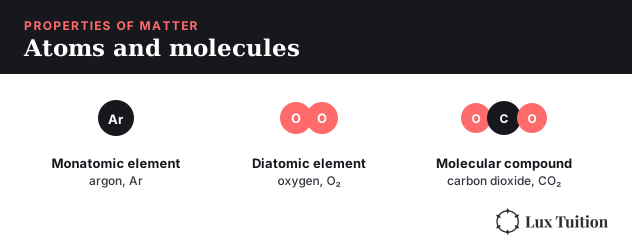
Atoms are the smallest particle of an element that is still that element. A molecule is two or more atoms bonded together. Some elements, such as argon, exist as separate single atoms, so they are called monatomic. Other elements exist as molecules: oxygen exists in the atmosphere as O2, and because O2 has two atoms it’s a diatomic molecule. Molecules can also be compounds, for example CO (carbon monoxide) and CO2 (carbon dioxide).
Solutions, suspensions and colloids
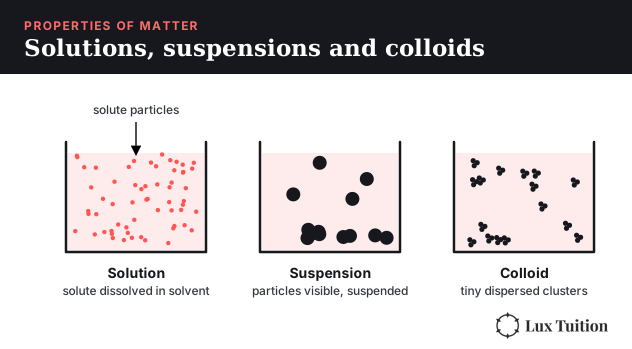
A solution is a homogeneous mixture where a substance (or substances) is dissolved in a solvent. The substance being dissolved is called the solute, and the solvent is the substance present in the greater amount. Salt water is sodium chloride (the solute) dissolved in water (the solvent), and vinegar is a solution composed primarily of acetic acid (4–18%) dissolved in water.
Water has chemical properties that make it a good solvent, which is why it’s useful for so many cleaning purposes. Solutions where water is the solvent are known as aqueous solutions. There are also non-aqueous solutions that don’t use water as a solvent, for example petrol and ethanol.
Sometimes mixtures with water don’t dissolve to form a solution, as with milk.
- A suspension is a liquid mixture where the parts are visually distinguishable, because the particles are only “suspended” in the mixture, for example red blood cells in plasma.
- A colloid is a liquid mixture where the particles are very finely dispersed into very small clusters and can’t be seen individually, for example milk and mayonnaise.
States of matter and particle theory
The physical state of matter refers to whether it’s a solid, liquid or gas. These are sometimes known as phases, and there are various ways for matter to transfer between each state.
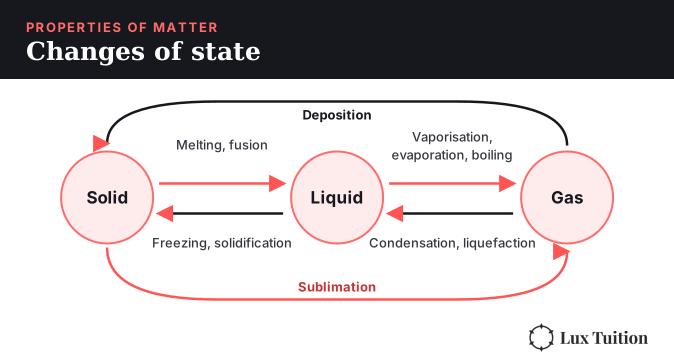
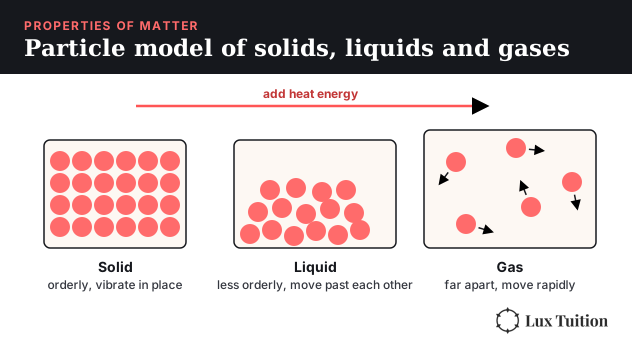
Particle theory explains some of these physical state changes. In particle theory, substances are made up of particles that possess attractive forces towards one another. There are also forces that move particles away from each other, namely heat.
- When a substance is cold, the attractive forces dominate, so it remains a solid. Its particles are in a very orderly arrangement and vibrate in place.
- As it heats up, the heat energy causes the particles to move around, causing a phase change to a liquid. The particles are less orderly and have translational as well as vibrational motion.
- As the liquid heats up, the particles move faster until they start bouncing away from each other and the phase becomes gaseous. Gas particles are well separated in space and move rapidly.
What is the difference between a physical and a chemical change?
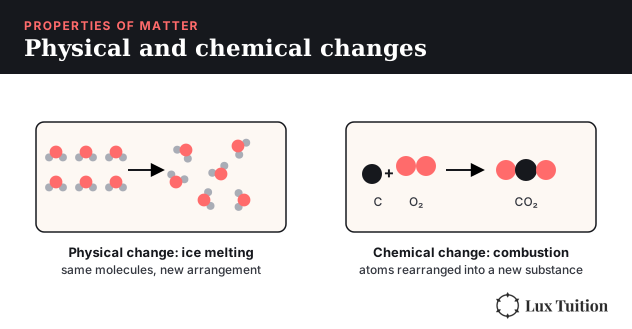
A change in matter that forms no new substance is called a physical change, for example ice melting. A change in matter that forms at least one new substance is called a chemical change, also known as a chemical reaction, for example wood combusting to produce carbon dioxide and water vapour.
Evidence that a chemical reaction has occurred includes:
- release of gas (bubbling)
- a solid precipitate forming when two solutions are mixed
- a change in colour
- a change in temperature
- a solid disappearing
- an odour being produced.
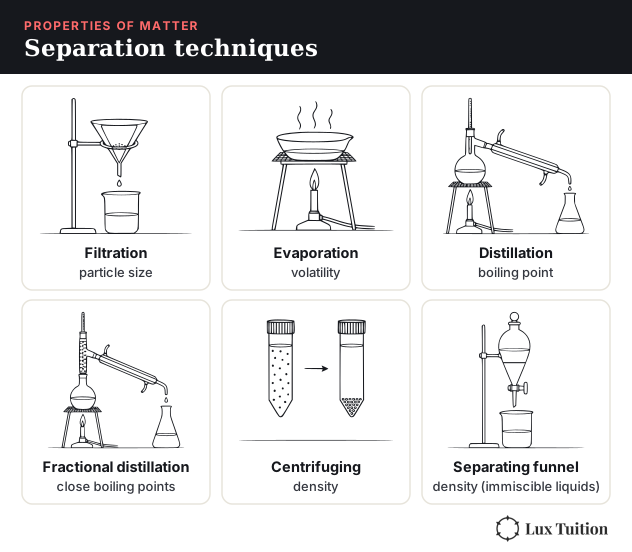
Separation techniques based on physical properties
All separation techniques are based on either the physical properties or the chemical properties of substances in a mixture. The syllabus only covers physical methods. Each technique works because the components of the mixture differ in one physical property.
- Filtration separates based on particle size. A barrier is used to allow certain sized particles to pass through while keeping others back, for example filter paper or reverse osmosis filters.
- Evaporation separates based on volatility, which is the tendency for a substance to become a gas. A high-volatility substance very easily becomes gaseous and has a low boiling point (for example petrol). A low-volatility substance is harder to make gaseous and has a high boiling point (for example gold). Salt (NaCl) can be separated from seawater by evaporation because NaCl has a much lower volatility than water.
- Distillation is used when you want to keep the liquid as well. The sample is boiled and the gas is collected and condensed back into a liquid, so it separates based on boiling point. The collected liquid is called the distillate. Distillation is used to produce alcohol-free beer and wine, or to increase alcohol content.
- Fractional distillation is used for substances whose boiling points are too close for simple distillation to separate cleanly, such as water and ethanol. It adds multiple steps to the distillation and condensation process, so there are many distillations happening simultaneously rather than one. It’s used to separate crude oil into different products, such as petrol and diesel, which condense at different heights (and temperatures) up the fractionating column.
- Centrifuging involves spinning a substance very fast so that denser substances are pushed to the bottom of the tube while less dense substances stay higher. It separates based on density, and is used to separate blood into plasma and red blood cells.
- Decanting is the process of waiting for sedimentation to take place and then carefully pouring off the liquid. Sedimentation is the process of solids settling to the bottom of a container. Decanting also separates based on density.
- A separating funnel separates immiscible liquids (liquids that don’t dissolve together, such as oil and water) based on density.
How do you calculate percentage composition by weight?
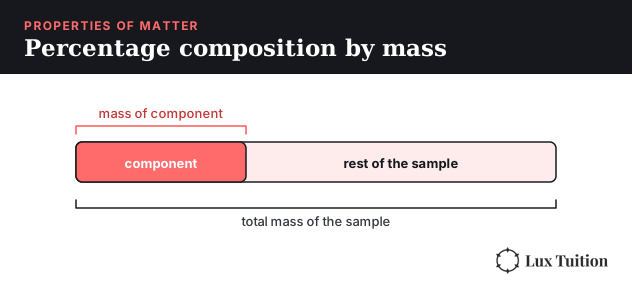
Analysing a substance by mass is called gravimetric analysis. The percentage of a component in a substance is calculated by dividing the mass of the component by the total mass of the substance:
% composition = (mass of component ÷ total mass of substance) × 100
In gravimetric analysis, samples are often heated so that volatile compounds (such as water) evaporate. If you weighed salt in humid weather, it would weigh more than in a dry atmosphere, because water vapour in the air is absorbed by the salt. Heating the sample until its mass is constant controls for this. Percentage composition returns in Module 2, where it’s used to work out empirical formulae.
How are elements classified by their properties and position in the periodic table?
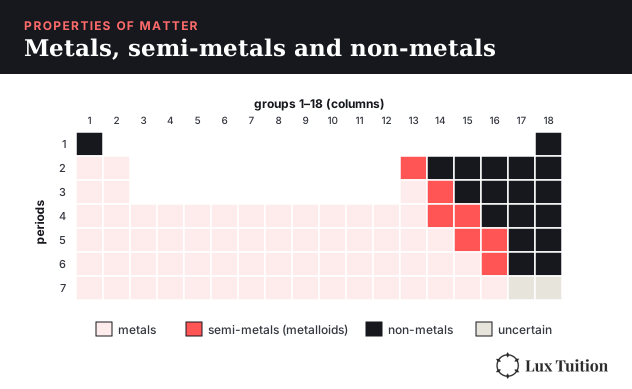
There are three main types of elements:
- Metals are typically shiny, have high melting and boiling points, and are good conductors of heat and electricity. They sit on the left and in the middle of the periodic table.
- Non-metals are typically dull, have low melting and boiling points, and are poor conductors of heat and electricity. They sit at the top right (plus hydrogen).
- Semi-metals (also called metalloids, such as boron, silicon, germanium, arsenic, antimony and tellurium) have no strict definition, but their properties are in between those of the metals and non-metals. They sit along the staircase between the two. Selenium, for example, is commonly classified as a non-metal but sometimes as a metalloid, and its two forms (allotropes) look very different: one far more metallic than the other.
Metals have additional physical properties:
- Malleable: they can be hammered into new shapes. Gold is highly malleable, which makes it suitable for jewellery.
- Ductile: they can be drawn into a wire.
- Dense: they’re heavy for their volume.
- High tensile strength: they can be stretched without breaking.
- Alloying: metals can be mixed with other elements to produce alloys with particular properties. Brass, for example, is made from zinc and copper.
All of these are physical properties. Chemical properties describe the way an element chemically reacts. For example, magnesium combusts very strongly in the presence of oxygen and produces a bright white light, so a chemical property of magnesium is its high combustibility. There isn’t a straightforward “list” of chemical properties, but chemicals that react similarly are grouped together in the periodic table.
The periodic table groups elements with similar properties together:
- Periods are the horizontal rows. There are 7 periods.
- Groups are the vertical columns. There are 18 groups. Some tables use an older numbering that omits the transition metal groups (Sc to Zn), so that helium’s group would be group 8.
Elements in the same group have similar physical and chemical properties. Group 11 metals copper (Cu), silver (Ag) and gold (Au) are all found in the ground and are malleable, highly conductive metals. Group 18, the noble gases, are all colourless, odourless and unreactive gases made of single (monatomic) atoms. Knowing the properties of one element in a group therefore lets you make predictions about the others: lithium reacts readily with water, like sodium, though less vigorously. However, non-metal elements in the same group often vary significantly. At room temperature fluorine is a gas while iodine is a solid.
Naming inorganic substances with IUPAC conventions is also part of this inquiry question in the syllabus. Because it builds directly on ions and bonding, it’s covered in the bonding section below, under ionic compounds and covalent compounds.
Why Are Atoms of Elements Different From One Another?
Protons, neutrons and electrons
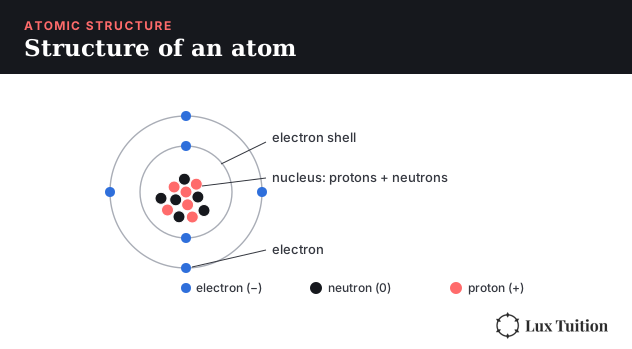
Atoms are composed of three types of subatomic particle:
- Electrons are tiny, negatively charged particles with a very low mass (about 1/1840 of the mass of a proton).
- Protons are positively charged particles.
- Neutrons are neutral particles with a similar mass to protons.
The nucleus of an atom is composed of protons and neutrons, which is why protons and neutrons are sometimes called nucleons. The nucleus is extremely small and dense, making up about 99.97% of the atom’s mass. Electrons make up most of the volume of an atom, as they exist in multiple “shells” around the nucleus, and they’re held in place by electrostatic attraction to the protons in the nucleus.
An ion is an atom with an electric charge due to the transfer of electrons. A negatively charged ion is called an anion, and a positively charged ion is called a cation.
Atomic number, mass number and nuclide notation
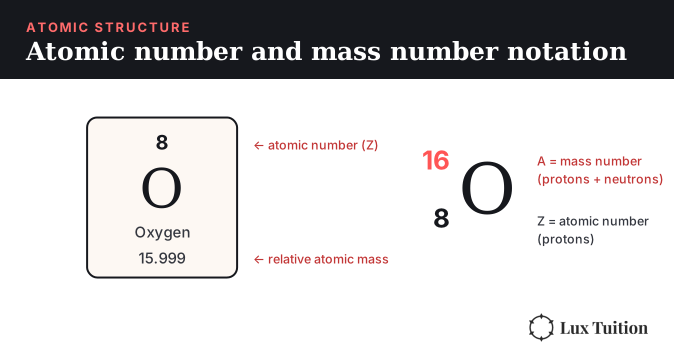
Out of the three subatomic particles, it’s the number of protons that determines which element an atom is.
- Atomic number (Z) = number of protons
- Mass number (A) = number of protons + number of neutrons
- In a neutral atom, the number of electrons equals the number of protons.
So the number of neutrons is the mass number minus the atomic number.
What are isotopes?
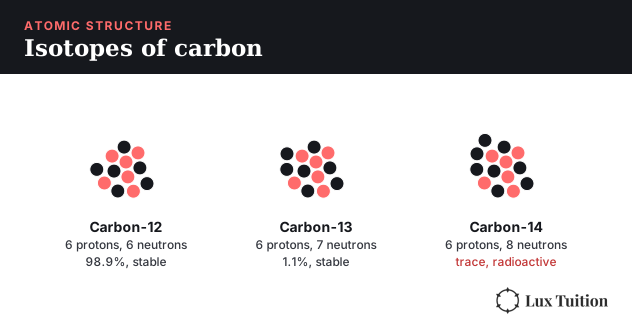
An isotope is a form of an element that has the same atomic number but a different mass number. This means it has a different number of neutrons but the same number of protons. Isotopes have the same chemical properties but different physical or radioactive properties. For example, heavy water is a version of water that uses deuterium (hydrogen-2) instead of ordinary hydrogen. It’s called heavy water because deuterium makes it denser, and so heavier, than normal water.
In nature, elements exist as a mixture of isotopes. Carbon exists as 98.9% carbon-12 and 1.1% carbon-13, with trace amounts of carbon-14 (about 1 × 10⁻¹² of carbon atoms). Carbon-12 and carbon-13 are stable isotopes. Radioactive isotopes are called radioisotopes, and they naturally break down by spontaneously releasing radiation. Carbon-14 is an unstable radioisotope with a half-life of about 5700 years, so it can be used to date carbon-containing objects.
How do you calculate relative atomic mass from isotopic abundance?
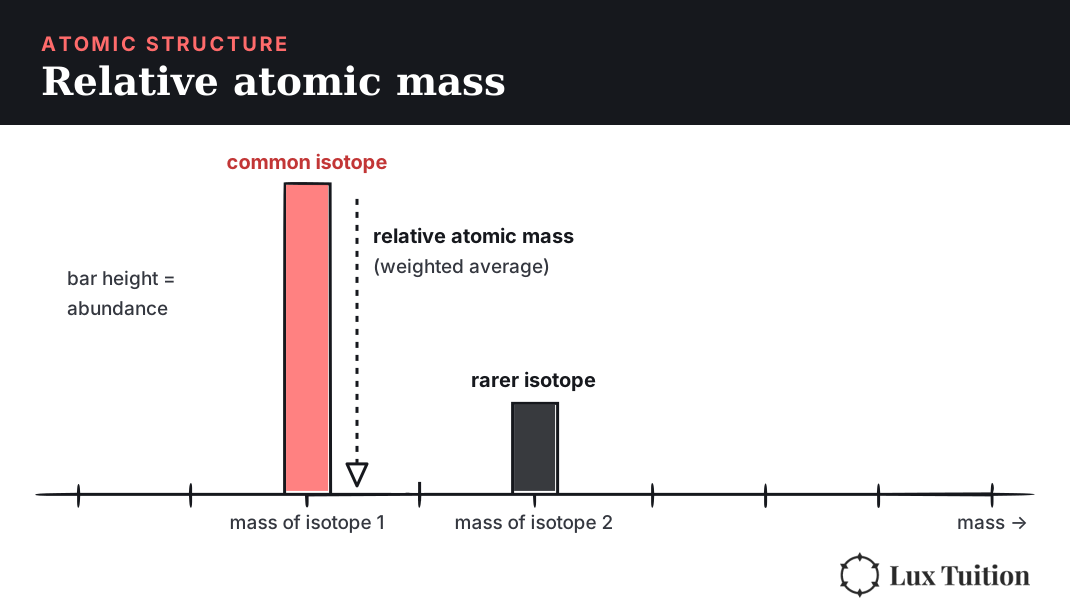
Isotopic abundance is the relative abundance of the different isotopes of an element in nature. The relative atomic mass is the average atomic mass of a given sample of an element, and it’s calculated from the isotopic abundances:
RMelement = AM1 × I1 + AM2 × I2 + … + AMn × In
where RMelement is the relative atomic mass, AM1 is the atomic mass of isotope 1, and I1 is the isotopic abundance of isotope 1 (as a decimal fraction). Atomic mass units (amu) are defined relative to carbon-12: 1 amu is 1/12 of the mass of a carbon-12 atom. The periodic table shows 15.999 for oxygen rather than a whole number because it’s an abundance-weighted average of oxygen’s isotopes.
Why are some isotopes radioactive?
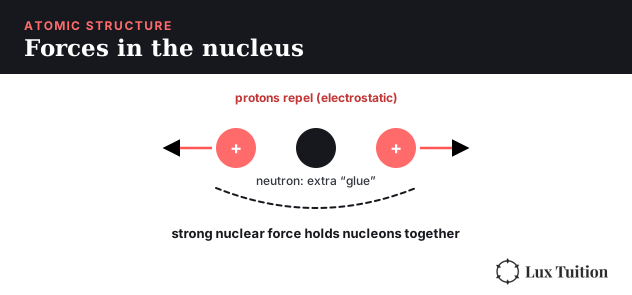
Nuclei need an optimum ratio of neutrons to protons to be stable. If we only considered electrostatic forces, every nucleus would be unstable, because its protons repel each other. However, there are also attractive forces in the nucleus, known as the strong nuclear force. Neutrons act as a “glue” that sticks the nucleus together, but too many neutrons also make a nucleus unstable. In an unstable nucleus these forces are imbalanced, which leads to radiation being emitted. Think of unstable nuclei as hyperactive children that need to expend their energy.
For low atomic number elements, the ideal neutron-to-proton (n:p) ratio is about 1:1. For heavier elements the ratio rises to about 1.5:1 (lead-208 has 126 neutrons and 82 protons). Plotting stable nuclei on a graph of neutrons against protons gives a narrow band of stability.
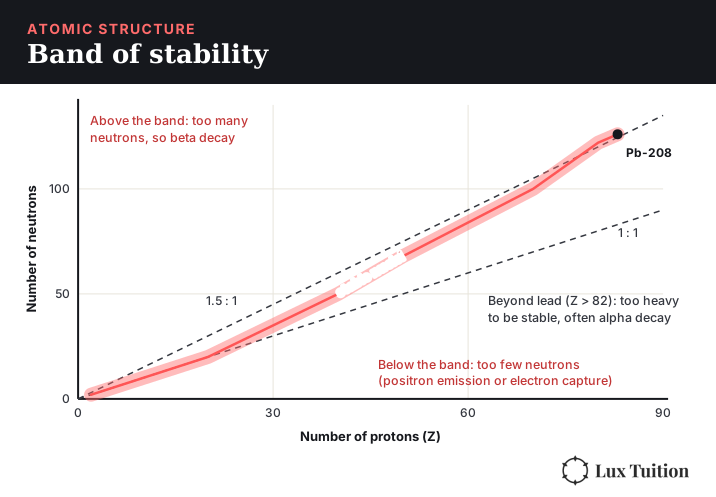
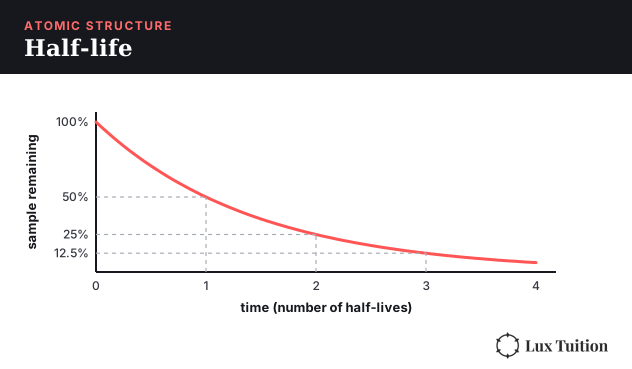
Lead (atomic number 82) is the heaviest stable element. All elements after lead are unstable and therefore radioactive. The half-life of a radioisotope is how long it takes for half of a given sample to decay by radioactive emission, and the longer the half-life, the more stable the isotope. Bismuth-209 has a half-life of about 2 × 10¹⁹ years, while technetium-99m (a human-made isotope and the most commonly used medical radioisotope) has a half-life of about 6 hours.
What are the types of radiation?
There are four main types of radiation you need to know:
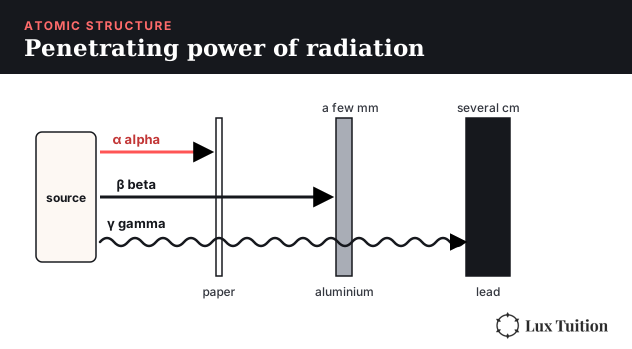
- Alpha particles (α) consist of 2 protons and 2 neutrons bound together, the same as a helium nucleus. They’re the least penetrating form of radiation and can be stopped by a piece of paper. Alpha emission is typical of heavy nuclei (beyond lead) that are too large to be stable. Alpha particles are highly ionising, which makes alpha emitters especially dangerous if they get inside the body.
- Beta particles (β) are high-energy electrons. They’re emitted by nuclei with too many neutrons (a high n:p ratio): a neutron changes into a proton and emits an electron, so the atomic number increases by 1. Beta particles have moderate penetrating power: they go through paper but are stopped by a few millimetres of aluminium plate. They have moderate ionising power.
- Gamma radiation (γ) is high-energy electromagnetic radiation. It’s the same kind of radiation as X-rays but higher in energy, and it’s released when a nucleus is left with excess energy after an earlier decay. It has high penetrating power and can only be stopped by several centimetres of a dense material such as lead plate, but it has low ionising power.
- Neutron radiation consists of high-energy neutrons, often released during nuclear fission or fusion. Because neutrons are neutral they’re highly penetrating, and they cause significant damage because they can convert stable atoms into radioisotopes.
There are also other kinds of radiation, such as antimatter particles (positrons and antiprotons).
How do you balance nuclear equations?
Balancing a nuclear reaction means balancing the mass numbers and atomic numbers of the nuclei: the total mass number and the total atomic number must be the same on both sides. In nuclear equations, γ represents gamma radiation, β represents beta radiation, and α (or He) represents alpha radiation.
What is the Bohr model of the atom?
The 1913 Bohr model of the hydrogen atom says:
- Electrons exist in fixed orbits around the atom.
- Each orbit corresponds to a specific energy level, and electrons can only exist in a specific orbit.
- The distance between orbits corresponds to the difference in energy levels between them.
- Higher orbits have higher energy levels.
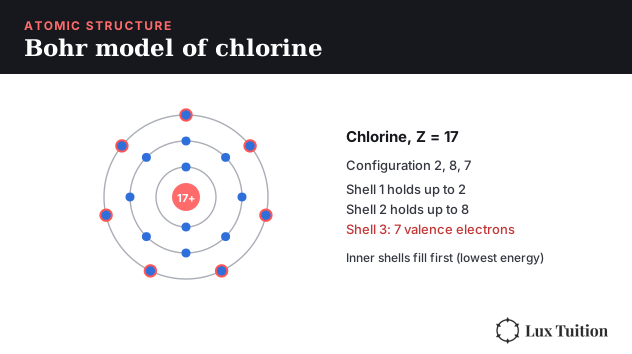
Electron configuration is the arrangement of electrons within an atom. In the Bohr model, only 2n2 electrons can fit into orbit n: 2 electrons in orbit 1, 8 in orbit 2 and 18 in orbit 3. Lower-energy orbits (closer to the nucleus) are filled first. Outer orbits containing 8 electrons tend to be stable, which is known as the octet rule. Chlorine (Z = 17), for example, has the configuration 2, 8, 7.
How do flame tests and emission spectra support the Bohr model?
Scientists noticed that when elements were heated in a flame, they gave off an emission spectrum made of specific wavelengths of light. Each element gave off a different spectrum, which could be used to “fingerprint” the element. Sodium, for example, gives a single bright yellow line, while potassium, copper and boron each give their own distinctive pattern of lines.
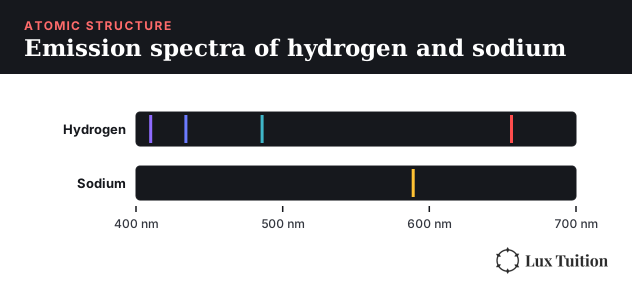
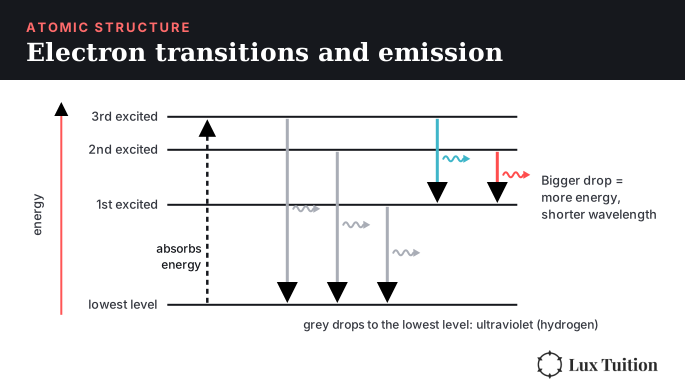
The specific wavelengths in an emission spectrum are caused by electrons jumping between orbits:
- Heating an element causes its electrons to absorb energy and become excited to a higher-energy orbit (energy level).
- Shortly afterwards the electrons “relax” back to a lower energy level.
- The energy the electrons absorbed is released as photons (light).
- The wavelength of each photon corresponds to the energy difference between the two orbits.
An electron can jump to different energy levels and relax in different ways, and each different way produces a different wavelength of light. That’s why a spectrum has several lines rather than one.
The flame test itself is a practical investigation. The syllabus wants you to collect your own primary data from flame tests of metal ion solutions, and these notes cover only the theory behind what you’ll observe.
The Bohr model has limitations:
- It only explains the emission spectrum of hydrogen, and not of other elements with more than one electron.
- It doesn’t explain why the electron doesn’t spiral into the nucleus due to electrostatic attraction.
- It doesn’t explain complicated spectral details such as spectral splitting.
What is the Schrödinger model of the atom?
The Schrödinger model replaced fixed orbits with a probability picture:
- Electrons are particles that also behave like waves.
- According to the uncertainty principle, it’s impossible to know exactly where these wave-particles are.
- Schrödinger developed mathematical equations that formed his model.
- There’s an electron cloud around the nucleus showing where electrons are likely to be.
- An orbital is a region of space where there is a high (about 90%) probability of finding an electron. Each orbital holds at most two electrons, with opposite spins. s orbitals are spheres; p orbitals are dumbbells, three to a set, at right angles.
- A shell (energy level n = 1, 2, 3…) is a group of orbitals with similar energies, divided into subshells (s, p, d, f). Shell n contains n² orbitals, so it holds up to 2n² electrons: shell 1 has one 1s orbital (2 electrons), and shell 2 has one 2s and three 2p orbitals (8 electrons).
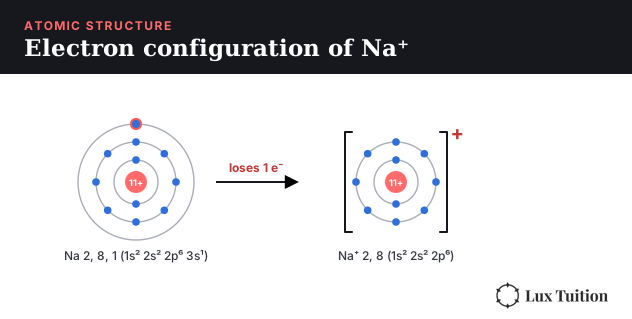
- So a Bohr shell is really a set of orbitals: the Bohr configuration 2,8,1 for sodium becomes 1s² 2s² 2p⁶ 3s¹.
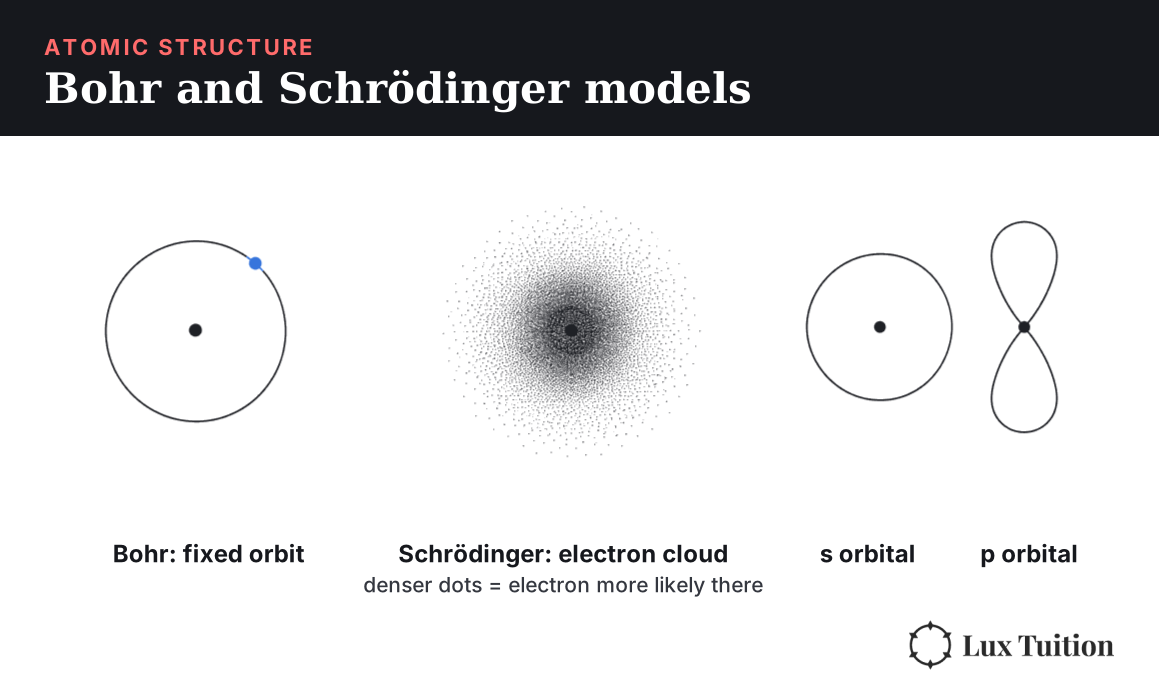
Electron configuration using spdf notation
Each shell contains subshells with different energy levels, and each subshell contains orbitals, each holding up to 2 electrons.
- Shell n = 1 has an s subshell.
- Shell n = 2 has s and p subshells.
- Shell n = 3 has s, p and d subshells.
- Shell n = 4 has s, p, d and f subshells.
The s orbital is spherical, the three p orbitals are dumbbell-shaped and point along the x, y and z axes, and the d and f orbitals have more complex shapes.
The Aufbau principle and the 4s/3d rule
The Aufbau principle says the lowest-energy orbitals are always filled first. The filling order is easiest to remember with the diagonal diagram below.
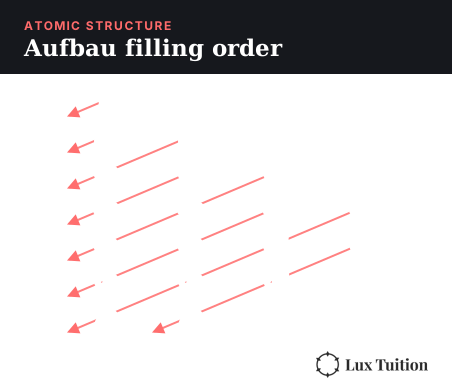
A few rules sit on top of the filling order:
- The 4s orbital is filled before the 3d orbital, but it’s also ionised first. When atoms are ionised, the outermost electrons (highest shell number) are removed first, so 4s electrons go before 3d electrons.
- When writing a configuration, subshells of the same shell are grouped together.
- A noble gas can be used as shorthand for the inner electrons. Neon’s configuration is 1s2 2s2 2p6, so those orbitals can be written as [Ne], and sodium’s configuration 1s2 2s2 2p6 3s1 becomes [Ne] 3s1.
What is Hund’s rule?
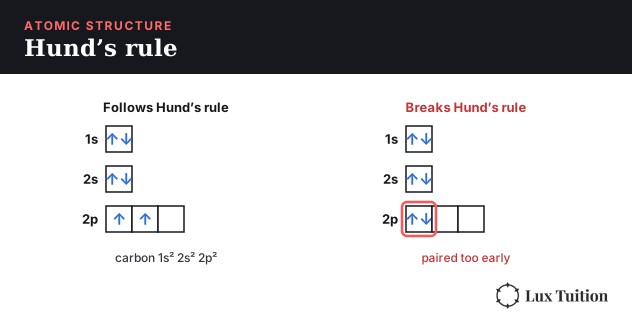
Hund’s rule says that the orbitals in a subshell must each be filled with one electron of the same spin before any orbital receives a second electron. Spin is a quantum mechanical property of an electron, shown as either up or down. Electrons repel each other, so they prefer their own orbital to sharing one.
In box diagrams, boxes represent orbitals, and up and down arrows represent electrons with opposite spins. For carbon (1s2 2s2 2p2), the 1s and 2s boxes each hold a pair of opposite-spin electrons, while the two 2p electrons sit in separate 2p boxes with the same spin, leaving the third 2p box empty.
Exceptions: chromium and copper
Filling 4s before 3d works in most cases, but there are two major exceptions in period 4:
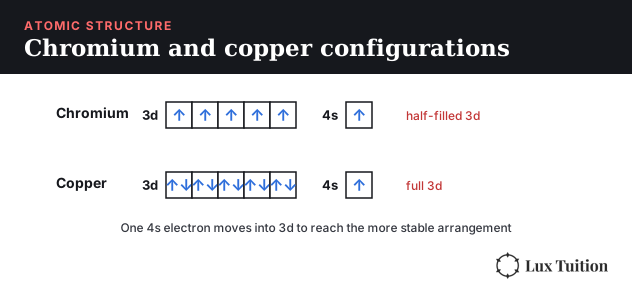
- Chromium has the configuration 1s2 2s2 2p6 3s2 3p6 3d5 4s1, instead of [Ar] 3d4 4s2.
- Copper has the configuration 1s2 2s2 2p6 3s2 3p6 3d10 4s1.
These are special cases where half-filling the d orbitals (chromium) or completely filling them (copper) is a lower-energy, more stable arrangement than filling the 4s orbital.
Electron configuration of ions
For atoms that have lost electrons (cations) or gained electrons (anions), follow the same rules but adjust for the number of electrons. Neutral sodium has 11 electrons and the configuration 1s2 2s2 2p6 3s1. A Na+ cation has only 10, giving 1s2 2s2 2p6. For transition metal ions, remember that the 4s electrons are removed before the 3d electrons.
Are There Patterns in the Properties of Elements?
How does electron configuration relate to groups?
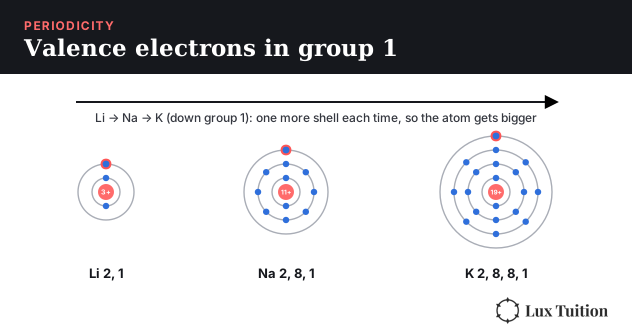
Valence electrons are the electrons in the outer shell, and they’re the ones most involved in chemical reactions. Elements in the same group have the same number of valence electrons, which is why they tend to have similar properties. For groups 1 and 2, the number of valence electrons equals the group number. For groups 13 to 18 it’s the group number minus 10 (helium, with only 2, is the exception). In the older 1–8 group numbering, the group number simply equals the number of valence electrons.
- Group 1 metals: Li 1s2 2s1; Na 1s2 2s2 2p6 3s1; K 1s2 2s2 2p6 3s2 3p6 4s1. Each has one valence electron.
- Group 17 halogens: F 1s2 2s2 2p5; Cl 1s2 2s2 2p6 3s2 3p5; Br 1s2 2s2 2p6 3s2 3p6 3d10 4s2 4p5. Each has seven valence electrons.
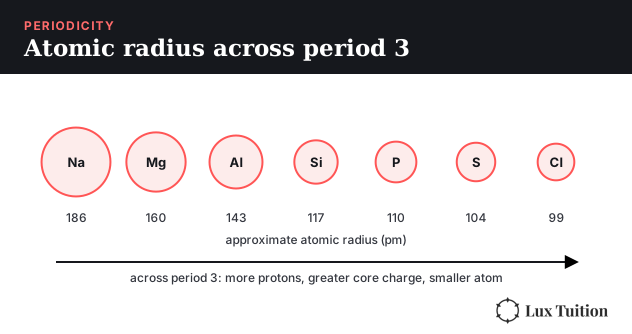
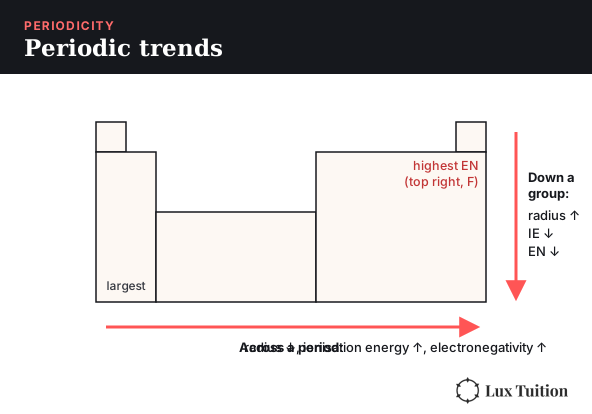
Why does atomic radius change across a period and down a group?
- Atomic radius increases down a group because each element has an extra electron shell. Inner electron shells also shield the outer electrons from the attraction of the protons.
- Atomic radius decreases across a period (left to right). The number of protons in the nucleus increases, which increases the nucleus’s core charge. A greater core charge attracts the electrons more strongly towards the nucleus, decreasing the radius.
What are the trends in electronegativity?
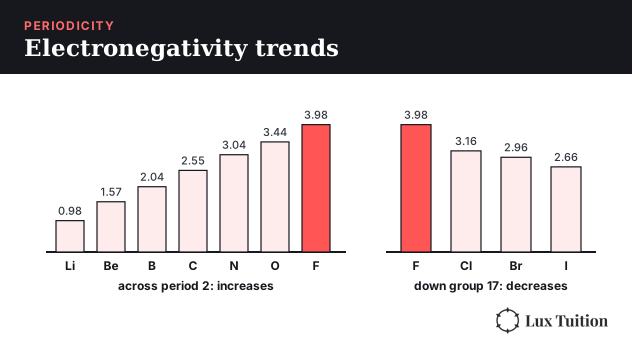
Electronegativity is the ability of an atom to attract electrons into a bond. It increases with core charge, because electrons are attracted towards positive charges.
- Electronegativity increases across a period.
- Electronegativity decreases down a group, as the radius of the atom is larger.
Electronegativity is a chemical property, since it influences reactivity. The group 17 halogens (fluorine, chlorine, bromine) are highly electronegative and tend to react by taking an electron from a less electronegative atom. Metals in general, and especially the group 1 alkali metals (lithium, sodium, potassium), have low electronegativity and tend to react by giving away an electron. The group 2 alkaline earth metals (such as beryllium and magnesium) tend to react by giving away two electrons.
What are the trends in first ionisation energy?
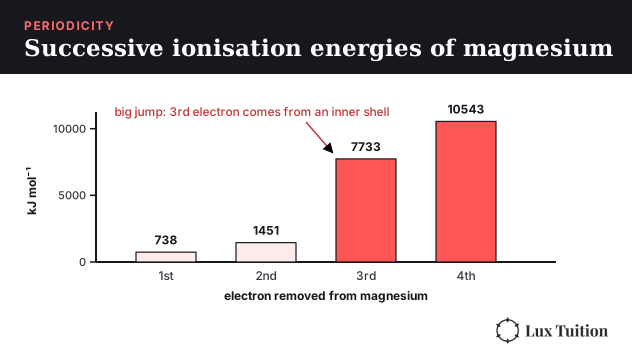
Ionisation energy is the amount of energy required to remove an electron from a gaseous atom. First ionisation energy is the energy needed to remove one electron from each atom in one mole of gaseous atoms. As more electrons are removed, each successive ionisation energy is larger, because the ion becomes more positively charged.
First ionisation energy correlates with electronegativity: it increases across a period and decreases down a group.
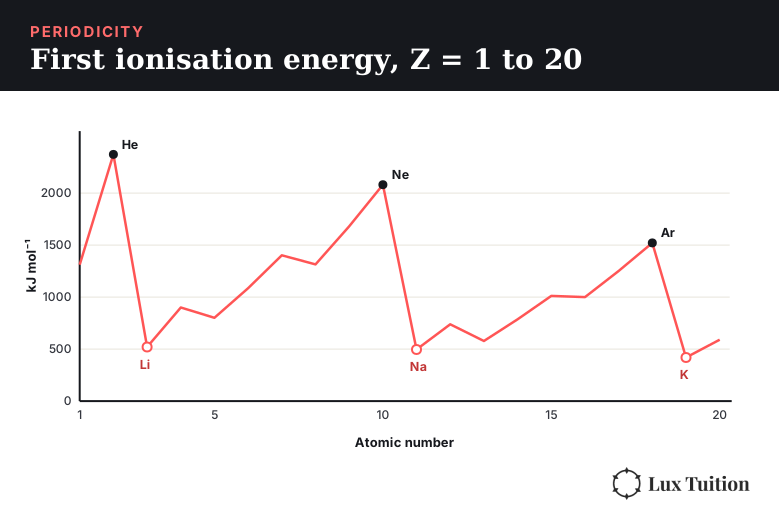
Ionisation energy also reflects subshells. Be, Mg and Ca all have 2 electrons in their outermost s subshell. All three have low ionisation energies for the first two electrons and then a big jump for the third, because the third electron has to come from a full inner shell. The same pattern appears in B, Al and Ga, with a big jump after the third electron.
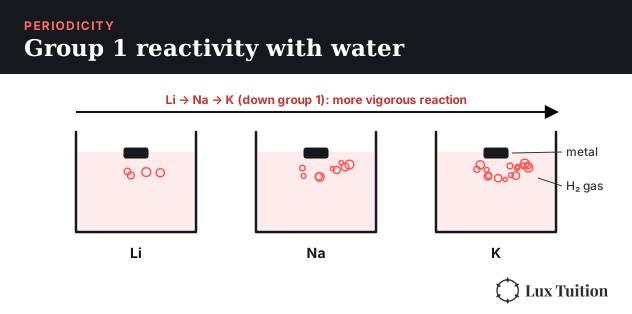
How does reactivity with water change down a group?
Metals tend to react by losing electrons, so metals with a lower first ionisation energy tend to react more vigorously. Potassium (K) reacts strongly with water, and rubidium (Rb), further down group 1, reacts even more violently. Lithium also reacts with water, but less vigorously than sodium. Our lesson notes cover this trend for group 1 only; they don’t compare reactivity with water across a whole period.
State of matter at room temperature
Our lesson notes illustrate this trend with examples rather than a full period-by-period survey. Group 18 elements are all gases at room temperature. Down group 17, the halogens change from gases to a solid: fluorine and chlorine are gases, bromine is a liquid and iodine is a solid, because their boiling points rise as the molecules get bigger (see dispersion forces below). Most metals are solids at room temperature because of their strong metallic bonding.
What Binds Atoms Together in Elements and Compounds?
Why do atoms form chemical bonds?
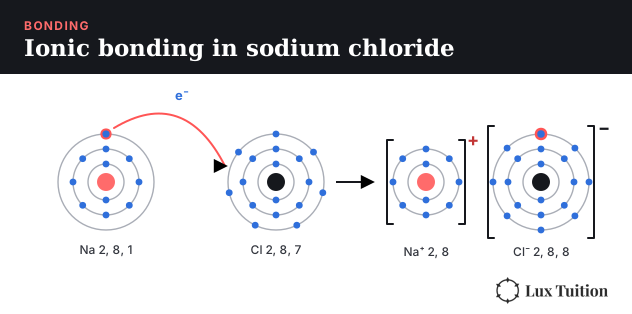
Elements form chemical bonds to become more stable, by filling or emptying their outer electron shells. Stable electron configurations mimic the configuration of the closest noble gas. Chemical bonds therefore involve the movement of electrons. When sodium (2, 8, 1) reacts with chlorine (2, 8, 7), sodium gives one electron to chlorine, forming Na+ (2, 8) and Cl− (2, 8, 8), which both have more stable configurations.
Which kind of bond forms depends on electronegativity:
- Between an atom with low electronegativity (a metal) and an atom with high electronegativity (a non-metal such as a halogen), electrons are transferred, forming an ionic bond.
- Between two atoms that both have high electronegativity (non-metals), electrons are shared, forming a covalent bond.
Ionic bonding and the properties of ionic compounds
In an ionic bond, one or more electrons are donated from one atom to another. The atom losing electrons becomes a positively charged cation, and the atom gaining electrons becomes a negatively charged anion. An ionic bond is a chemical bond based on the electrostatic attraction between these oppositely charged ions.
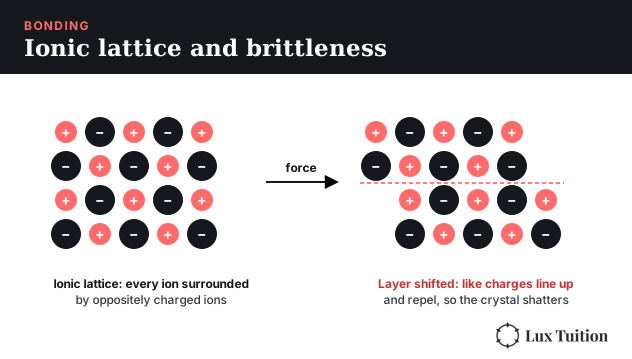
These electrostatic attractions act in all directions, so 3D layers form, creating a crystal lattice in which each ion is surrounded by oppositely charged ions. This is an ionic network. Ionic bonds are strong, and a lot of energy tends to be released when they form. Their strength shapes the properties of ionic compounds:
- High melting points, as it takes lots of energy to loosen the ions from the lattice.
- Hard.
- Brittle: they shatter easily, because shifting the crystal lattice lines up ions of the same charge, which then repel each other.
- Not electrically conductive as solids, because the charged ions can’t move.
- Highly conductive when dissolved or molten, because the ions are free to move. Molten ionic compounds and solutions of ionic compounds are called electrolytes, as they contain charge carriers that can move.
How do you write the formula of an ionic compound?
Metals transfer their valence (outer shell) electrons to non-metals to form ionic bonds. So:
- Group 1 metals (e.g. sodium, potassium) form cations with a charge of +1.
- Group 2 metals (e.g. calcium, magnesium) have 2 valence electrons and form cations with a charge of +2.
- Transition metals can transfer different numbers of electrons: iron, for example, forms Fe2+ or Fe3+.
Ionic compounds have an overall neutral charge: the positive charges must equal the negative charges. Sodium chloride is made of a Na+ cation and a Cl− anion. Magnesium is in group 2, so it loses two electrons to form Mg2+, which means two Cl− ions are needed to balance the charge, giving MgCl2. Aluminium is in group 13 (group 3 in the older numbering) and forms Al3+, so aluminium chloride is AlCl3.
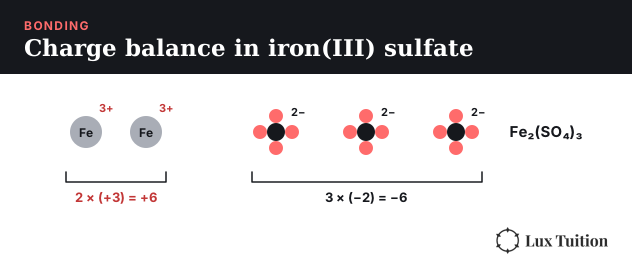
Polyatomic ions are ions made up of several covalently bonded atoms. They’re treated as a fixed unit with a specific charge, and they always combine in a fixed ratio, so a formula uses brackets around them when there’s more than one. Sodium sulfate is Na2SO4, while iron(III) sulfate is Fe2(SO4)3: two Fe3+ ions give six positive charges, balanced by three SO42− ions with six negative charges.
How are ionic compounds named?
Ionic compounds are named with the cation first, which is just the element name. If the cation can form more than one ion (common with transition metals such as iron), the charge of the ion is added in Roman numerals: Fe2+ is iron(II) and Fe3+ is iron(III). The name of the anion goes afterwards. Simple anions take the ending “-ide” (chloride, oxide), while polyatomic ions have their own names, which are worth memorising.
What is a covalent bond?
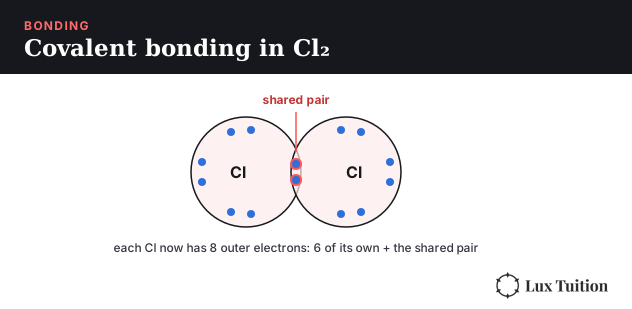
Covalent bonds are bonds in which electrons are shared. Each atom shares at least one electron, which results in a shared pair of electrons. The shared electrons then move around the nuclei of both atoms. Examples of covalent substances include water, cotton, paracetamol (Panadol), carbon dioxide and diamond.
Chlorine has the configuration 2, 8, 7 and needs to gain one electron to mimic argon (2, 8, 8). Two chlorine atoms can each share one electron, so both have a stable configuration, forming a Cl2 molecule. Another way of remembering this is the octet rule: atoms with 8 electrons in their outer shell tend to be stable.
Covalent molecular substances (made of separate molecules) tend to have low melting points, low boiling points and don’t conduct electricity. Covalent networks such as diamond are the exception, as explained further down.
How do you draw Lewis dot diagrams?
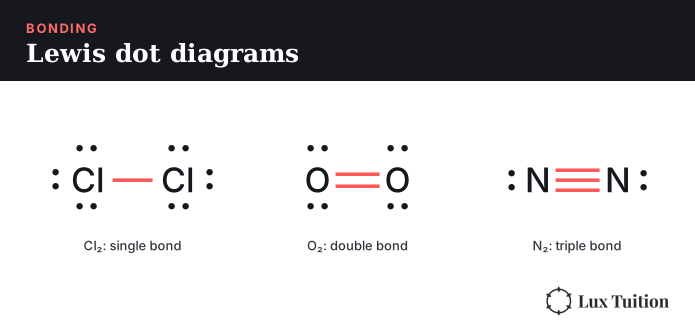
Lewis dot diagrams are a simple way of showing electron configuration in bonding. The element symbol sits in the middle, and valence shell electrons are shown as dots (or crosses). Electrons involved in bonding are shown either as a line or as dots drawn between the atoms.
To draw a Lewis dot diagram:
- Work out how many valence electrons each element has.
- Draw each atom with a dot for each valence electron.
- Work out how many electrons each atom needs to gain or lose to reach a noble gas configuration.
- Pair electrons, by drawing a line or redrawing the electrons between the atoms, so that each atom has a noble gas configuration.
A double covalent bond has two shared pairs of electrons. Oxygen has 6 valence electrons and needs two more for a stable configuration, so two oxygen atoms share two electrons each to form O2. A triple covalent bond has three shared pairs. Nitrogen has 5 valence electrons and needs 3 more, so two nitrogen atoms share three electrons each to form N2. Pairs of valence electrons that aren’t involved in bonding are called lone pairs.
How are covalent compounds named?
- Work out the molecular formula of the covalent compound.
- Name the less electronegative element first (the one further to the left of the periodic table).
- Name the second element with its ending changed to “-ide”.
- Add prefixes to show the number of atoms of each element in the molecule: mono (1), di (2), tri (3), tetra (4), penta (5), hexa (6).
For example, CO is carbon monoxide and CO2 is carbon dioxide. By these rules, water would be “dihydrogen monoxide”.
Bond polarity and the spectrum of bonding
Bonding is a battle royale: every atom is fighting over electrons.
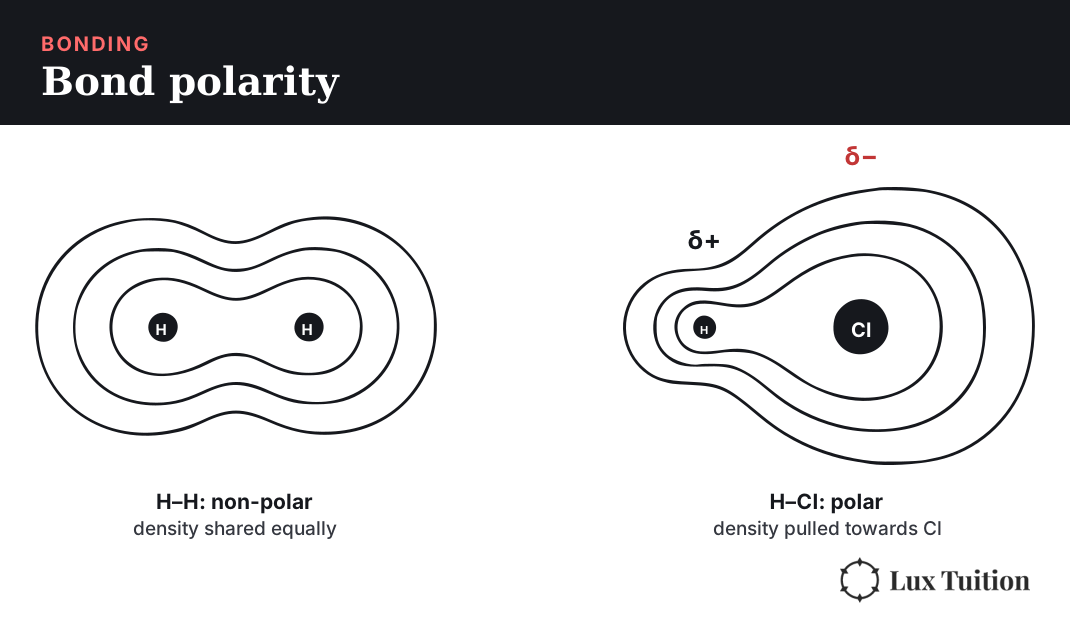
- If two covalently bonded atoms have the same electronegativity, the bond is non-polar.
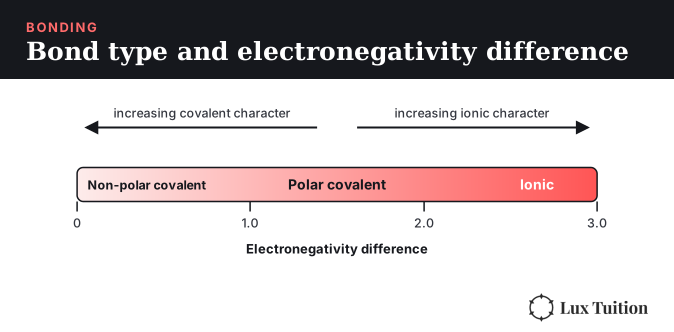
- If one atom is more electronegative than the other, it pulls the shared electrons more. The electrons spend more time around that atom, giving it a partial negative charge (δ−), while the other atom gains a partial positive charge (δ+). The bond is polarised.
Partial charges are much smaller than ionic charges (the atoms don’t become ions). This separation of charge is called a dipole, and the greater the difference in electronegativity, the greater the dipole. Because electronegativity follows the periodic trends above, atoms far apart on the periodic table (a group 1 metal and a halogen) form the most ionic bonds, while atoms that are close together form covalent bonds.
It’s all a spectrum at the end of the day. As the electronegativity difference increases, bonds move from non-polar covalent, through polar covalent, to ionic.
How does VSEPR theory predict molecular shape?
Molecular shapes can be predicted using valence-shell electron-pair repulsion (VSEPR) theory. Negatively charged electron pairs in the valence shell repel each other, so molecules take the shape that maximises the distance between electron pairs, including non-bonding lone pairs.
To apply VSEPR theory:
- Draw the Lewis dot diagram of the molecule.
- Count the “electron-dense areas” around the central atom (covalent bonds + lone pairs). A double or triple bond counts as one area.
- Find the shape that maximises the space between them.
Ammonia (NH3), for example, has 3 bonds and 1 lone pair, so 4 electron-dense areas. Its shape is trigonal pyramidal: the lone pair takes up one corner of a tetrahedron, but the shape is named from the atoms only.
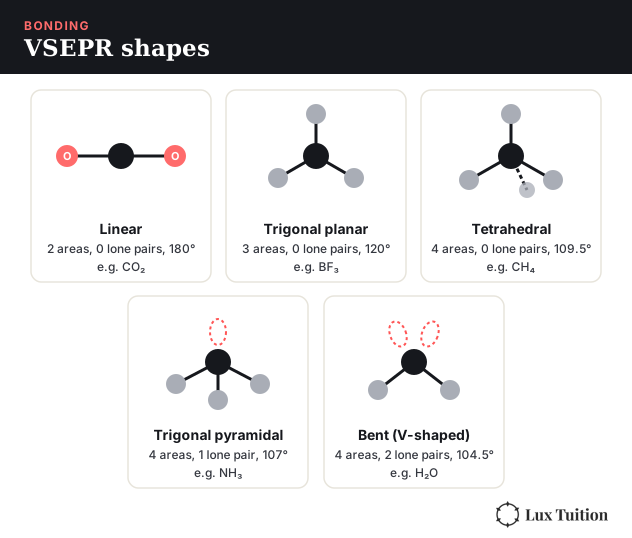
The full VSEPR chart extends to 5 and 6 electron-dense areas (trigonal bipyramidal and octahedral families), but the shapes above are the ones you’ll meet most often in Year 11.
When is a molecule polar?
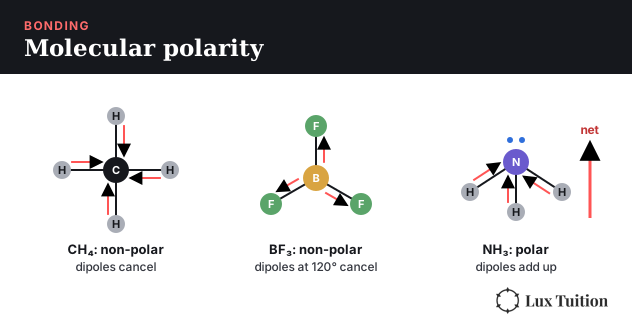
Having polar bonds isn’t enough to make a molecule polar. The molecule also needs a shape that leaves a net dipole. If the bond dipoles all cancel each other out (especially in symmetrical molecules), the molecule is non-polar.
- Methane (CH4) is non-polar. Carbon is more electronegative than hydrogen, so the C–H bonds are polarised, but its symmetrical tetrahedral shape means all the dipoles cancel.
- Boron trifluoride (BF3) is non-polar. Its three B–F dipoles are arranged symmetrically at 120° in a flat trigonal planar shape, so they cancel.
- Ammonia (NH3) is polar. Its trigonal pyramidal shape means the N–H dipoles add up to an overall dipole pointing towards the nitrogen.
What is the difference between intermolecular and intramolecular forces?
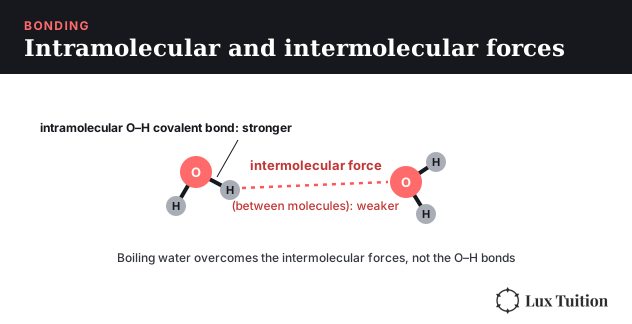
An intramolecular force is a force within a molecule, that is, a chemical bond. An intermolecular force is a force between two molecules. Molecules have both, and together they determine a substance’s properties.
Intramolecular forces are stronger than intermolecular forces. This is why boiling water is easier than breaking water molecules apart: when water boils, the weak intermolecular forces between molecules are broken, but the strong intramolecular covalent bonds between the hydrogen and oxygen atoms remain. It’s also why covalent substances can have such a wide range of properties: carbon dioxide is a gas, but carbon in the form of diamond is an extremely hard solid.
There are three types of intermolecular force taught in Year 11.
What are dispersion forces?
Non-polar molecules are held together by dispersion forces, which is why non-polar substances can still form liquids and solids.
Dispersion forces come from the random movement of electrons. Electrons may randomly move towards one side of a molecule, forming a temporary dipole. That temporary dipole then causes electrons to move in a neighbouring molecule, inducing another temporary dipole. In non-polar substances, temporary dipoles are constantly being created and disappearing, resulting in dispersion forces.
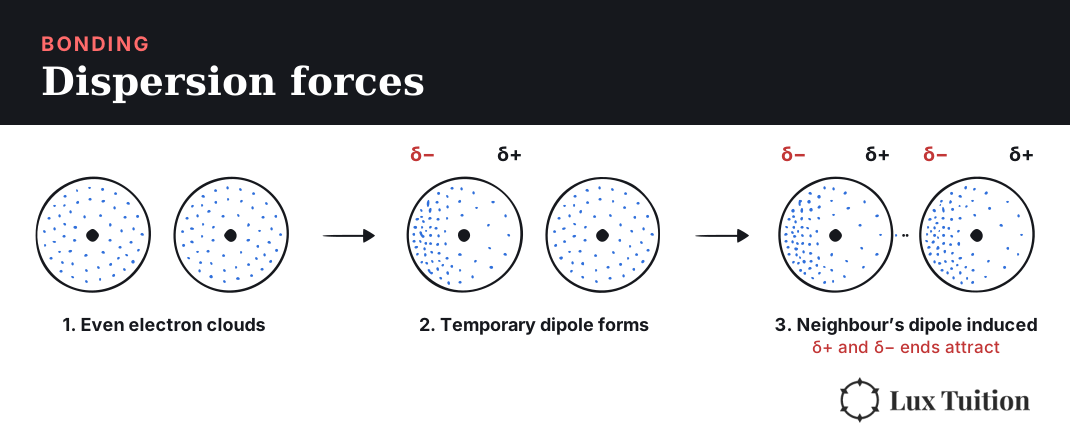
Dispersion forces actually occur in all covalent molecules, even polar ones, because all molecules have moving electrons. In polar molecules they’re overshadowed by the stronger dipole-dipole forces and hydrogen bonds.
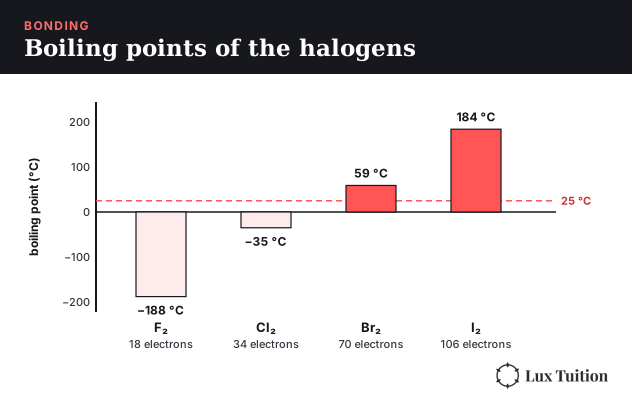
The bigger they are, the stronger they get:
- Larger molecules have stronger dispersion forces, because they have more electrons. Larger molecules therefore tend to have higher melting and boiling points. The halogens show this clearly: fluorine (F2, 18 electrons) boils at −188 °C, chlorine (Cl2, 34 electrons) at −35 °C, bromine (Br2, 70 electrons) at 59 °C and iodine (I2, 106 electrons) at 184 °C.
- Molecules with a larger surface area also have stronger dispersion forces, because they have more contact with surrounding molecules in which to induce temporary dipoles. A long, straight-chain molecule boils at a higher temperature than a compact, branched molecule with the same number of electrons.
What are dipole-dipole forces?
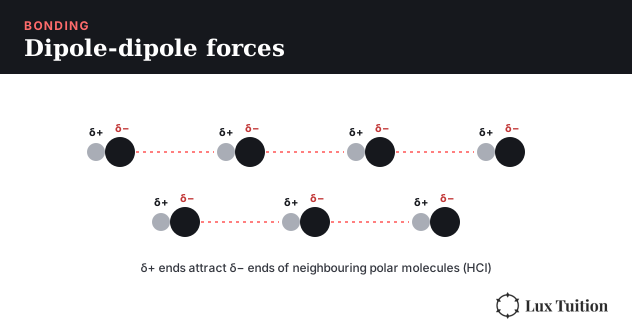
When two polar molecules interact, their oppositely charged ends are naturally attracted to each other. This attraction is an intermolecular force called a dipole-dipole interaction. Polar molecules with dipole-dipole interactions need more energy to overcome those intermolecular forces, so they tend to have higher melting and boiling points than non-polar substances of similar size.
What is hydrogen bonding?
Hydrogen bonds are the third type of intermolecular force. They can occur when a hydrogen atom is covalently bonded to oxygen, nitrogen or fluorine. Because oxygen, nitrogen and fluorine are so electronegative, they create a very strong partial positive charge on the hydrogen. That hydrogen is then attracted to a lone pair on an oxygen, nitrogen or fluorine atom in a neighbouring molecule.
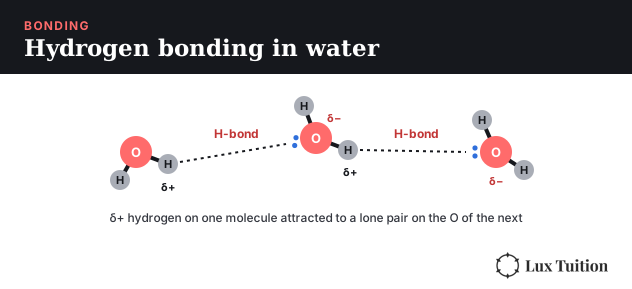
Hydrogen bonds are considerably stronger than typical dipole-dipole forces but still much weaker than ionic or covalent bonds. This gives substances that can hydrogen bond much higher melting and boiling points.
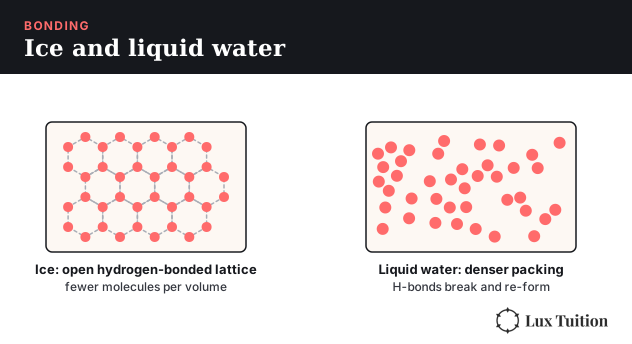
Hydrogen bonds are the reason ice floats on water. In ice, hydrogen bonds hold the water molecules in an open crystal lattice structure, while in liquid water the hydrogen bonds constantly break and re-form and the molecules are packed more densely. So ice is less dense than liquid water.
Metallic bonding and the properties of metals
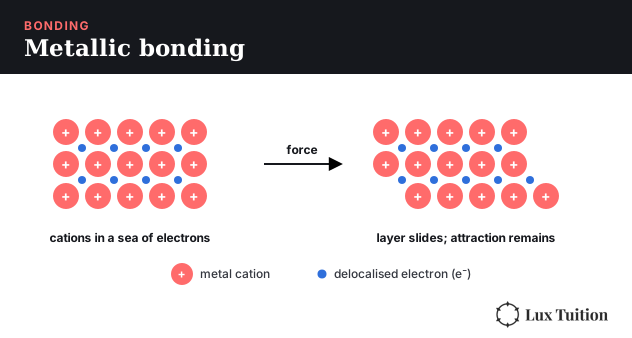
In the metallic bonding model, metal atoms lose their valence electrons and form a crystal lattice of positive cations. These delocalised electrons can move freely through the lattice, and the attraction between the positive cations and the delocalised electrons holds the cations together. This is sometimes described as a “sea of delocalised electrons”. The model explains the properties of metals:
- Hard, with high melting and boiling points: there are strong electrostatic forces between the cations and the delocalised electrons.
- Good conductors: the delocalised electrons are free to move when a voltage is applied, towards the positive electrode and away from the negative electrode.
- Malleable and ductile: even when layers of the lattice are shifted past one another, the electrostatic attraction between the cations and the delocalised electrons remains, so the metal bends instead of shattering.
Covalent network structures: diamond, silicon dioxide and graphite
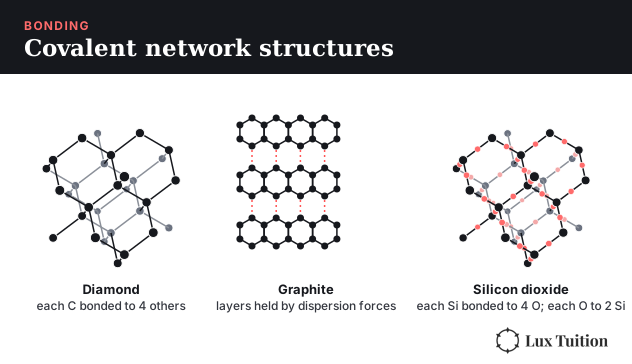
A covalent network structure is a covalent substance that has a lattice structure rather than individual molecules. Each atom is covalently bonded to the atoms around it. Covalent bonds are strong, so these substances have high melting points, high boiling points and great hardness.
- In diamond, each carbon atom is bonded to four other carbon atoms.
- Silicon dioxide (SiO2) is the main component of sand and glass. It’s hard and strongly resists dissolving because of the strong covalent bonds between its atoms throughout the network. There are no separate SiO2 molecules.
- Graphite is an allotrope of carbon made of many layers of covalently bonded carbon stacked on top of each other. There are strong covalent bonds within each layer but only weak dispersion forces between layers, so graphite is known as a covalent layer network. Each carbon is bonded to only three others, leaving one delocalised electron per atom that can carry charge, so graphite conducts electricity. These properties make it strong in one direction but soft in another, which is why it’s used in pencils, industrial lubricants and fibre materials.
What is allotropy?
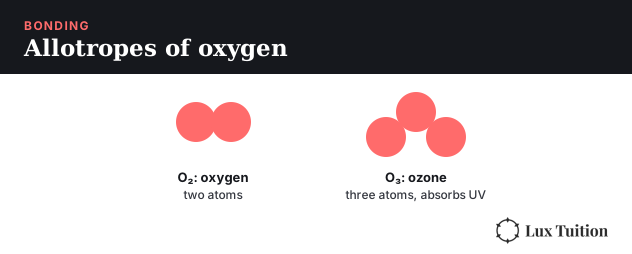
An allotrope is a different form of the same element caused by different bonding, and allotropes of the same element have different properties.
- Oxygen can exist as O2 but also as ozone (O3), which absorbs UV light.
- Selenium has a silvery, metallic-looking allotrope and a red allotrope.
- Carbon has diamond (a 3D covalent network, extremely hard) and graphite (a covalent layer network, soft and conductive).
Putting it all together: the strength of the intermolecular forces and intramolecular bonds determines a material’s properties. The stronger the forces and bonds, the harder the substance and the higher its melting and boiling points.
How do intermolecular forces explain solubility?
Intermolecular forces explain how substances dissolve. Dissolving happens when the solute molecules (the substance being dissolved) interact more strongly with the solvent molecules than with each other. A substance is insoluble if its molecules interact more strongly with each other than with the solvent.
Substances that can mix and dissolve in each other are described as miscible. Immiscible means the substances won’t dissolve in each other, as with oil and water. Generally, substances whose main intermolecular force is dispersion (such as oils and fats) won’t dissolve in substances whose main intermolecular forces are dipole-dipole forces or hydrogen bonds (such as water).
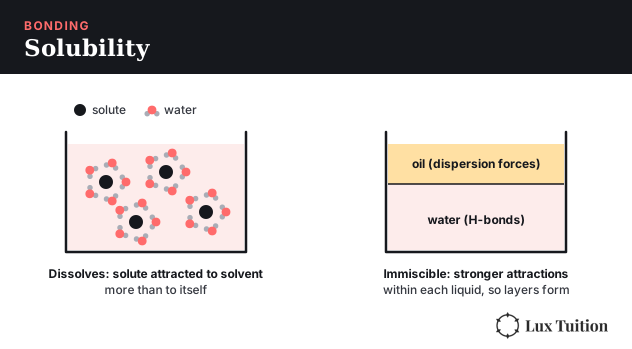
The stronger the forces and bonds you have to overcome, the harder the substance and the higher its melting and boiling points.
Working Scientifically Skills Taught With Module 1
These skills aren’t Module 1 content dot points. They belong to the Working Scientifically outcomes that apply across the whole course, but they’re usually taught early because every practical from here on relies on them.
Types of error: systematic and random
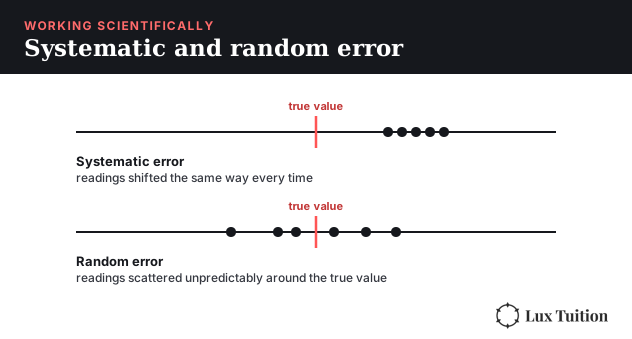
Error is the difference between a measured value and the true value. Your watch might run 11 seconds behind the actual time, or an uncalibrated lab thermometer might read 1 °C higher than the true temperature.
- Systematic errors are repeatable errors, which could be due to bias or faulty equipment. A thermometer that always reads 1 °C high, or a student who reads a measuring cylinder above the meniscus instead of at it, both cause systematic error.
- Random errors are inconsistent and unavoidable, caused by factors such as environmental fluctuations, equipment or human judgement. Random fluctuations in a measuring instrument due to electrical noise, or a person judging when a colour change happens, are random errors.
Uncertainty, accuracy and precision
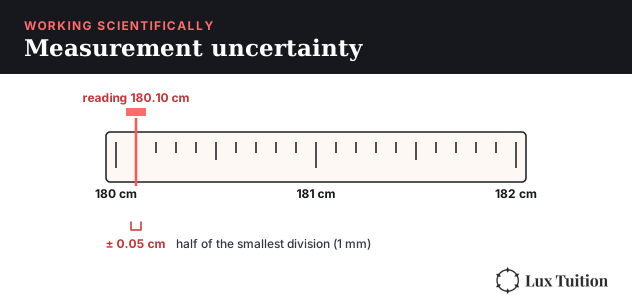
Uncertainty is the estimated degree of error, and all measurements have some. Generally, the uncertainty is taken as half the smallest division the instrument can read. A scale that measures to two decimal places of a kilogram has an uncertainty of ±0.005 kg, so a reading of 58.92 kg is reported as 58.920 ± 0.005 kg. A ruler with cm and mm markings would measure someone who is 180.1 cm tall as 180.10 ± 0.05 cm, because a reading and its uncertainty are written to the same decimal place.
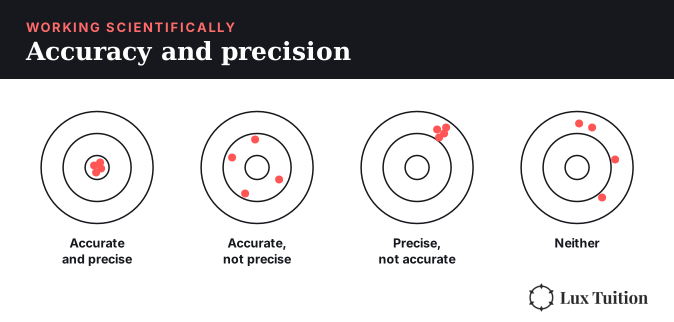
- Accuracy is how close the measured value is to the true value.
- Precision is how consistent the measurements are when repeated.
Significant figures
Significant figures reflect how finely an instrument can measure. A thermometer that only measures to the nearest degree would report water at 98.576 °C as 99 °C (2 significant figures).
Rules for counting significant figures:
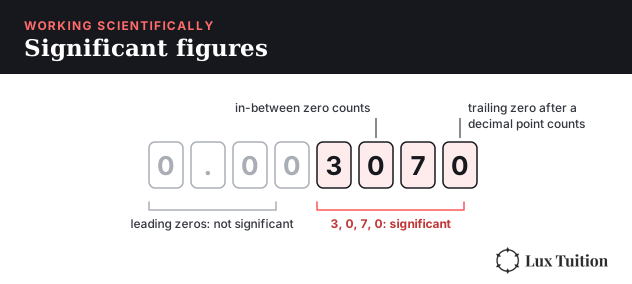
- All non-zero digits count, and so do zeros between non-zero digits (300042 has 6 significant figures).
- Leading zeros don’t count (0.000034 has 2).
- Trailing zeros count if there’s a decimal point (0.0002500 has 4).
- Trailing zeros without a decimal point are ambiguous, so take the most conservative reading (190000 is treated as 2, though it could be up to 6). Likewise, 1200 could have 2 or 4 significant figures.
Rules for calculating with significant figures:
- When adding or subtracting, round the answer to the least number of decimal places in the data.
- When multiplying or dividing, round the answer to the least number of significant figures in the data.
- Put the full values into your calculator and round only the final answer, so your answer doesn’t appear more certain than it actually is.
Scientific notation and SI units
Scientific notation writes a number as a single digit with decimals, multiplied by a power of 10. It lets you show the uncertainty of a measurement precisely: 1200 is 1.2 × 10³ (2 significant figures) or 1.200 × 10³ (4 significant figures), which removes the ambiguity of numbers ending in zero. It also condenses very small or large numbers: 0.0000123 is 1.23 × 10⁻⁵.
The International System of Units (SI) is the international standard for measurement. There are seven SI base units; the five you’ll use most in Year 11 Chemistry are:
| Quantity | Unit | Symbol |
|---|---|---|
| Mass | kilogram | kg |
| Length | metre | m |
| Time | second | s |
| Temperature | kelvin | K |
| Amount of substance | mole | mol |
SI prefixes standardise large and small quantities:
| Prefix | Symbol | Factor |
|---|---|---|
| giga | G | 109 |
| mega | M | 106 |
| kilo | k | 103 |
| hecto | h | 102 |
| deca | da | 101 |
| deci | d | 10−1 |
| centi | c | 10−2 |
| milli | m | 10−3 |
| micro | μ | 10−6 |
| nano | n | 10−9 |
Year 11 Chemistry Module 1 Revision Summary
What Comes After Module 1 in Year 11 Chemistry?
Module 1 feeds straight into the rest of the Year 11 course:
- Module 2: Introduction to Quantitative Chemistry builds on percentage composition, relative atomic mass and formulae to introduce the mole, concentration and the gas laws.
- Module 3: Reactive Chemistry uses ions, formulae and electronegativity to predict the products of reactions, including precipitation and metal reactivity.
- Module 4: Drivers of Reactions uses your understanding of bonds to explain the energy changes in reactions.
For the bigger picture of where Year 11 leads, our ultimate guide to scoring Band 6 in Chemistry covers the HSC course and how to study it, and a spaced-repetition guide to Anki is a good way to lock in ion names and periodic trends.
Year 11 Chemistry Tutoring in Blacktown
Each chemistry module builds on the last, and Module 1 is where that building starts. In our Year 11 Chemistry tutoring in Blacktown, theory is broken down by our tutors into the smallest possible parts and taught with simple, consistent language, then practised in classes of 1 to 5 students, a few minutes from Blacktown Station. Check our pricing page, or book a free trial with no obligations.
Frequently Asked Questions
What is Module 1 in Year 11 Chemistry?
Module 1 is Properties and Structure of Matter, the first of four Year 11 modules in the NSW Chemistry Stage 6 Syllabus. It covers mixtures and separation, atomic structure and isotopes, periodic trends, and bonding, organised around four inquiry questions.
What is the difference between intermolecular and intramolecular forces?
Intramolecular forces are the chemical bonds within a molecule, such as the covalent O–H bonds in water. Intermolecular forces act between molecules: dispersion forces, dipole-dipole forces and hydrogen bonds. Intramolecular bonds are much stronger, which is why boiling water separates the molecules without breaking them apart.
Why do chromium and copper not follow the normal electron configuration rules?
For chromium and copper, moving one electron from the 4s orbital into the 3d subshell gives a half-filled (chromium, 3d5 4s1) or completely filled (copper, 3d10 4s1) d subshell. That arrangement is lower in energy, and therefore more stable, than the configuration predicted by the Aufbau principle.
How can you tell if a molecule is polar?
First check whether its bonds are polar, which depends on the electronegativity difference between the bonded atoms. Then use VSEPR theory to find its shape. If the shape is symmetrical and the bond dipoles cancel (as in CH4 or BF3), the molecule is non-polar; if they leave a net dipole (as in NH3 or H2O), it's polar.
Do I need to know ion-dipole forces for Year 11 Chemistry?
The three intermolecular forces taught for Module 1 are dispersion forces, dipole-dipole forces and hydrogen bonding. Ion-dipole forces exist between ions and polar molecules, but they aren't taught as part of the Year 11 course, and the syllabus doesn't name them.
Is the Year 11 Chemistry syllabus changing?
Yes. NESA's new Chemistry 11–12 Syllabus (2025) starts for Year 11 in Term 1 2028. Students in Year 11 in 2026 and 2027 are taught the 2017 syllabus that these notes follow, and much of the underlying chemistry, such as bonding and atomic structure, carries across.
Learn it properly with a specialist tutor at Blacktown or online across NSW. Enquire about a free trial — no cost, no obligation. See online formats and class sizes.
Realistic study tips to help you prepare better for assessments with less stress, plus a printable study planner