
Module 2 is where chemistry starts counting. Quantitative chemistry is about the relationship between how much reactant we use and how much product we get. It lets chemists make a medicine with as much product and as little waste as possible. It’s also how we measure what is actually happening in a reaction. This page is part of our Year 11 Chemistry notes, which summarise all four modules in one place.
These Year 11 Chemistry Module 2 notes follow the four inquiry questions of Module 2: Introduction to Quantitative Chemistry in the NSW Chemistry Stage 6 Syllabus. They’re written from the lessons our tutors teach in class and arranged in syllabus order, and each topic opens with the exact syllabus dot point it covers. If you need a refresher on atoms, isotopes and bonding first, start with our Year 11 Chemistry Module 1 notes.
These are theory and revision notes. We’ve left out worked examples and practice questions, and reading notes doesn’t replace the practical investigations the syllabus asks you to do in class.
Key Takeaways
- Mass is conserved in every chemical reaction: atoms are rearranged, never created or destroyed, so equations must balance.
- One mole is 6.022 × 10²³ particles (Avogadro’s constant), and n = m/MM links moles to mass.
- The limiting reagent runs out first and decides how much product forms; the other reactant is in excess.
- An empirical formula is the simplest whole-number ratio of elements; the molecular formula is the actual ratio in one molecule.
- Concentration is c = n/V in mol/L, and in a dilution the moles of solute stay the same, so c1V1 = c2V2.
- Boyle’s, Charles’, Gay-Lussac’s and Avogadro’s laws are all special cases of the ideal gas law, PV = nRT, with temperature always in kelvin.
For how to study all this effectively, see how to actually understand HSC Chemistry.
What Does Year 11 Chemistry Module 2 Cover?
Module 2 is the second of four Year 11 modules in the NESA Chemistry Stage 6 Syllabus (2017). It’s organised around four inquiry questions, and these notes follow the same order:
| Syllabus section | Inquiry question |
|---|---|
| Chemical Reactions and Stoichiometry | What happens in chemical reactions? |
| Mole Concept | How are measurements made in chemistry? |
| Concentration and Molarity | How are chemicals in solutions measured? |
| Gas Laws | How does the Ideal Gas Law relate to all other Gas Laws? |
Did You Know? Since 20 May 2019, the mole has been defined by fixing Avogadro’s constant at exactly 6.022 140 76 × 1023 mol−1, rather than by the mass of carbon-12. Source: BIPM, the SI base units
What Happens in Chemical Reactions?
relate stoichiometry to the law of conservation of mass in chemical reactions by investigating: balancing chemical equations (ACSCH039); solving problems regarding mass changes in chemical reactions (ACSCH046)
The law of conservation of mass
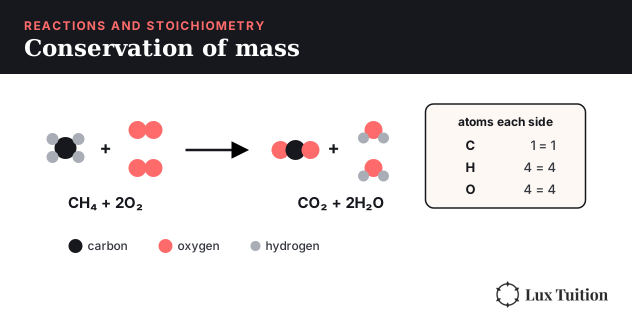
The law of conservation of mass says that matter can’t be created or destroyed, although it can be transformed into different forms. For chemical reactions this means:
- In a chemical reaction, no atoms are created or destroyed.
- Atoms can be rearranged to create new molecules.
- The total number of atoms in the reactants equals the total number of atoms in the products.
How to read a chemical equation
Every chemical equation follows the law of conservation of mass: the number of each type of atom in the reactants (left side) must equal the number of each type of atom in the products (right side).
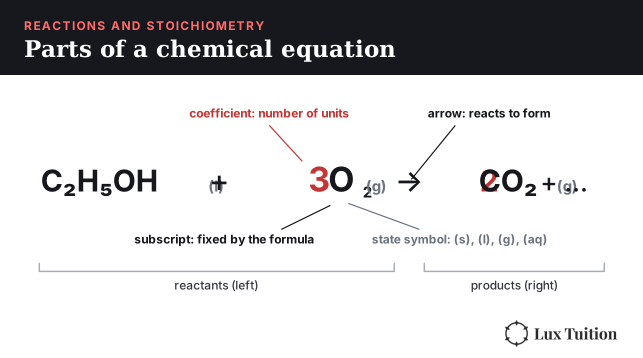
- Each equation must show the state of every substance: gas (g), liquid (l), solid (s) or aqueous solution (aq).
- The stoichiometric coefficient (the number in front of a formula) tells us how many units of that substance are involved.
- Equations show that every reaction involves a specific ratio of reactants to products.
How do you balance chemical equations?
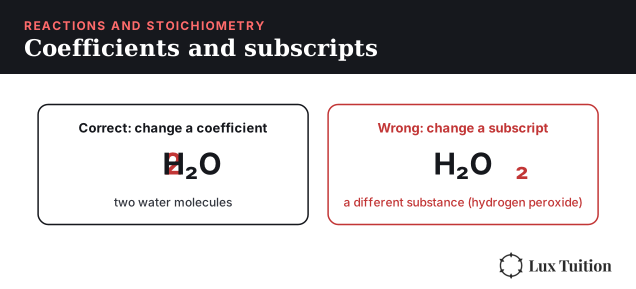
Balancing a chemical equation simply means changing the coefficients until the number of each type of atom in the reactants equals the number in the products.
- Count the atoms of each element in the reactants and in the products.
- Multiply the formulae by coefficients until the atoms on each side are equal. This often involves finding the lowest common multiple.
Only the coefficients change. The subscripts inside a formula are fixed, because changing them would turn the substance into a different chemical.
Mass changes in chemical reactions
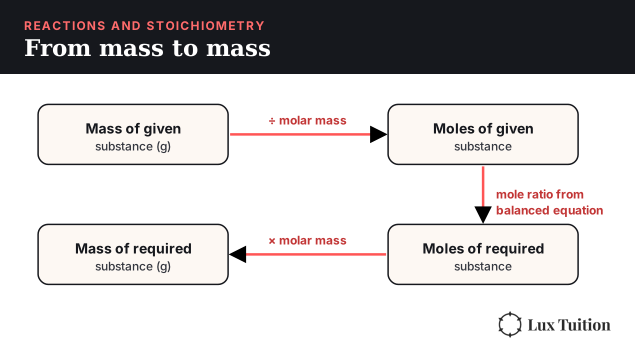
According to the law of conservation of mass, the total mass of the reactants must equal the total mass of the products of a chemical reaction. To calculate the mass of a product or reactant, work in moles (explained in the next section):
- Convert the mass of the given substance into moles by dividing by its molar mass.
- Use the coefficients in the balanced equation to find the moles of the substance you need.
- Multiply those moles by that substance’s molar mass to find its mass.
How Are Measurements Made in Chemistry?
conduct an investigation to determine that chemicals react in simple whole number ratios by moles
explore the concept of the mole and relate this to Avogadro's constant to describe, calculate and manipulate masses, chemical amounts and numbers of particles in: (ACSCH007, ACSCH039) moles of elements and compounds n = m/MM (n = chemical amount in moles, m = mass in grams, MM = molar mass in gmol⁻¹); percentage composition calculations and empirical formulae; limiting reagent reactions
What is a mole?
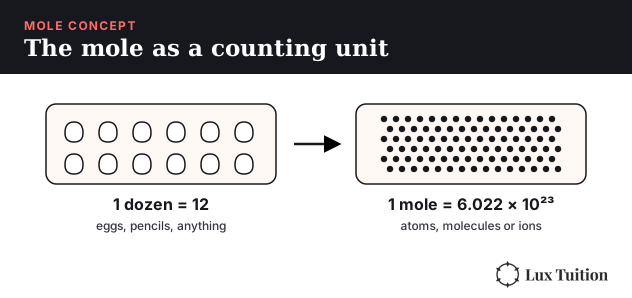
Moles are used by chemists to count the number of particles in a reaction. Just as a dozen always means 12, a mole always means the same number of particles: 6.022 × 10²³, known as Avogadro’s constant (NA = 6.022 × 10²³ mol−1). The particles can be atoms, molecules or ions.
The mole was originally defined as the number of atoms in exactly 12 g of carbon-12. Since 2019 it has been defined by fixing Avogadro’s constant exactly, which gives effectively the same number.
Molar mass of elements and compounds
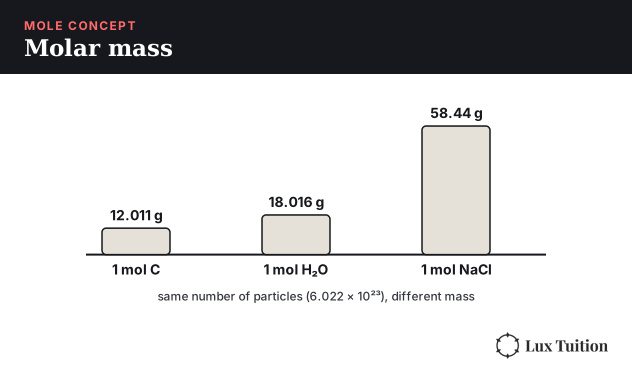
Moles are useful because they convert a number of particles into a mass. The atomic mass of an element in the periodic table (in amu) converts directly into grams per mole (g/mol), so 1 mole of carbon is 12.011 g, while 1 mole of hydrogen is 1.008 g.
Molar mass (MM) is the mass of a substance per mole of that substance. For a compound, it’s found by adding up the relative atomic masses of all the atoms in its formula:
- NaCl: 22.99 + 35.45 = 58.44 g/mol
- H2O: (2 × 1.008) + 16.00 = 18.016 g/mol
So one mole of different substances contains the same number of particles but has a different mass.
The mole formula: n = m/MM
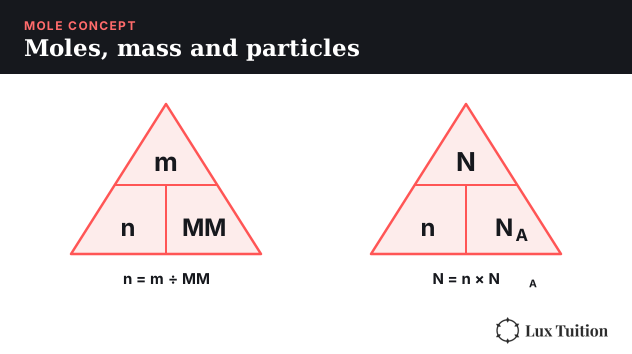
n = m ÷ MM
where n is the number of moles, m is the mass in grams and MM is the molar mass in g/mol. If you have any two of these variables, you can find the third by rearranging the formula.
Moles and numbers of particles
Because a mole is a fixed number of particles, the number of particles (N) is the number of moles multiplied by Avogadro’s constant: N = n × NA. Moles are the bridge between the three things chemists measure or count: mass, chemical amount and number of particles.
Density: the mass of liquids and gases
For liquids and gases, it’s usually easier to measure volume than mass, so density is used to convert between them:
d = m ÷ V
where d is the density in g/mL or g/L, m is the mass in grams and V is the volume in mL or L.
- Substances expand as they warm, so the density of a liquid is usually given at a stated temperature. Water, for example, has a density of 0.998 g/mL at 20 °C but 0.98 g/mL at 65 °C.
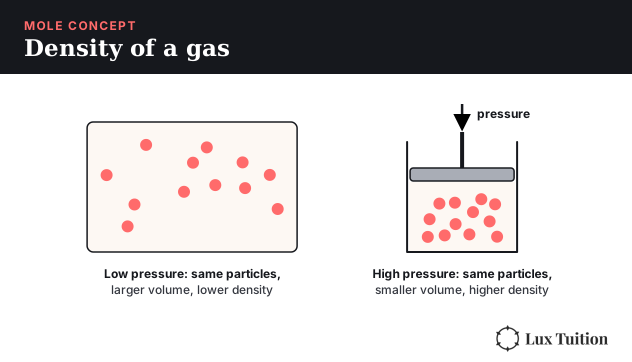
- The density of a gas also depends on pressure, because gases can be compressed into a smaller space, so it’s given at a stated temperature and pressure. Methane at 25 °C and 1 atm has a density of 0.656 g/L.
What is a limiting reagent?
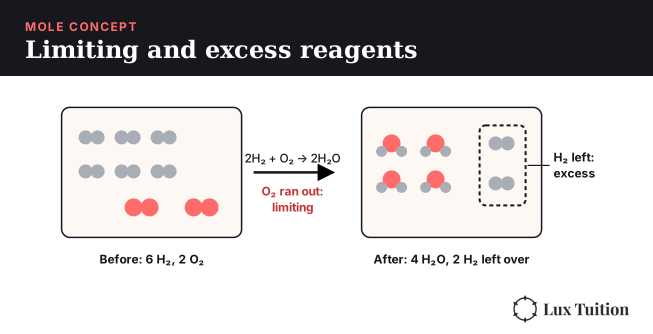
In many chemical reactions, one reactant is used up before the other.
- The reactant that runs out first is the limiting reagent: it limits the amount of product that can form.
- The reactant that isn’t used up is the excess reagent.
You find the limiting reagent from the stoichiometry of the balanced equation and the number of moles of each reactant you have. Comparing masses directly doesn’t work, because the equation is a ratio of moles, not grams.
Percentage composition from a formula
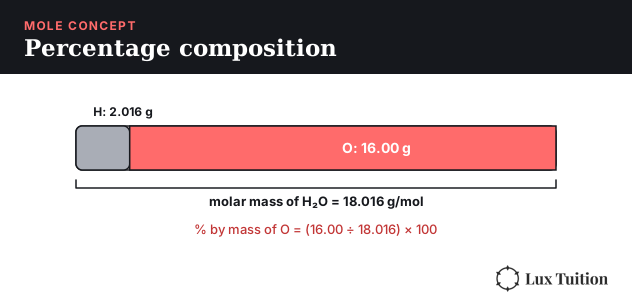
Percentage composition by mass (met in Module 1 as gravimetric analysis) can also be calculated for any compound whose formula you know:
% by mass of an element = (mass of that element in 1 mol of substance ÷ molar mass of substance) × 100
Empirical and molecular formulae
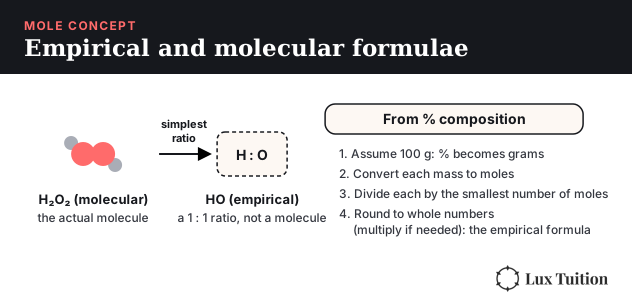
An empirical formula is the simplest whole-number ratio of the elements in a compound. The empirical formula of water is H2O, but hydrogen peroxide (H2O2) has the empirical formula HO.
The empirical formula can be determined from the percentage composition of each element in a sample of the compound:
- Assume there is 100 g of the compound, so each percentage becomes a mass in grams.
- Convert the mass of each element into moles.
- Find the whole-number ratio between the moles of each element.
- That whole-number ratio is the empirical formula.
The molecular formula is the actual ratio of elements in one molecule of the compound, rather than just the simplest ratio. It’s always a whole-number multiple of the empirical formula:
| Molecule | Molecular formula | Empirical formula |
|---|---|---|
| water | H2O | H2O |
| ethane | C2H6 | CH3 |
| carbon dioxide | CO2 | CO2 |
| glucose | C6H12O6 | CH2O |
If you know the empirical formula and the molar mass of the compound, you can find the molecular formula: divide the molar mass of the compound by the molar mass of one empirical formula unit, then multiply every subscript in the empirical formula by that whole number.
How Are Chemicals in Solutions Measured?
manipulate variables and solve problems to calculate concentration, mass or volume using: c = n/V (molarity formula) (ACSCH063); dilutions (number of moles before dilution = number of moles of sample after dilution)
conduct an investigation to make a standard solution and perform a dilution
Solutions, concentrated and dilute
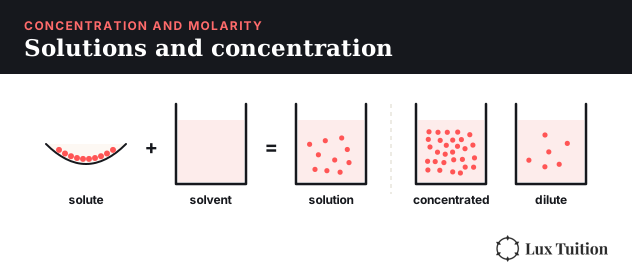
A solution is made up of two components:
- the solute, the substance that is dissolved
- the solvent, the liquid that dissolves the solute.
Concentration is the amount of solute dissolved in a given amount of solution. A relatively large amount of solute makes the solution concentrated; a relatively small amount makes it dilute.
Molarity: c = n/V
Calculating concentration is needed for aqueous chemical reactions, chemical manufacturing, analytical chemistry and working out the strength of medicines.
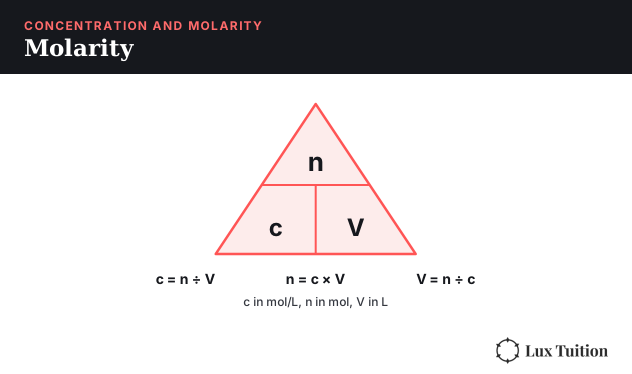
c = n ÷ V
where c is the concentration as molarity (mol/L), n is the number of moles of solute and V is the volume of solution in litres. If you have any two of these variables, you can find the third by rearranging the formula.
Molarity (mol/L, written M) is commonly used by chemists because it lets the moles of solute be calculated straight from a volume: 1 M = 1 mol/L and 10 M = 10 mol/L.
Other ways of measuring concentration
- Grams per litre (g/L): mass of solute per litre of solution. Use the units to guide the calculation.
- Percentage by mass, %(w/w): mass of solute ÷ mass of solution × 100.
- Percentage by volume, %(v/v): volume of solute ÷ volume of solution × 100.
- Mass per volume, %(w/v): grams of solute per 100 mL of solution.
- Parts per million (ppm): commonly used for pollution and contamination. It’s grams per 1 000 000 g, or more conveniently milligrams per kilogram (mg/kg). For dilute aqueous solutions, 1 ppm is also about 1 mg/L, since 1 L of water has a mass of about 1 kg.
Dilution: c1V1 = c2V2
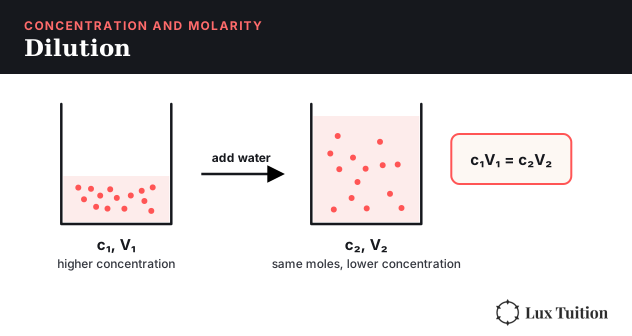
Dilution is the process of adding more solvent to a solution, which decreases its concentration, like adding water to cordial. The number of moles of solute doesn’t change during a dilution, only the volume, so:
c1V1 = c2V2
where c1 and V1 are the initial concentration and volume, and c2 and V2 are the final concentration and volume.
Measuring volumes accurately
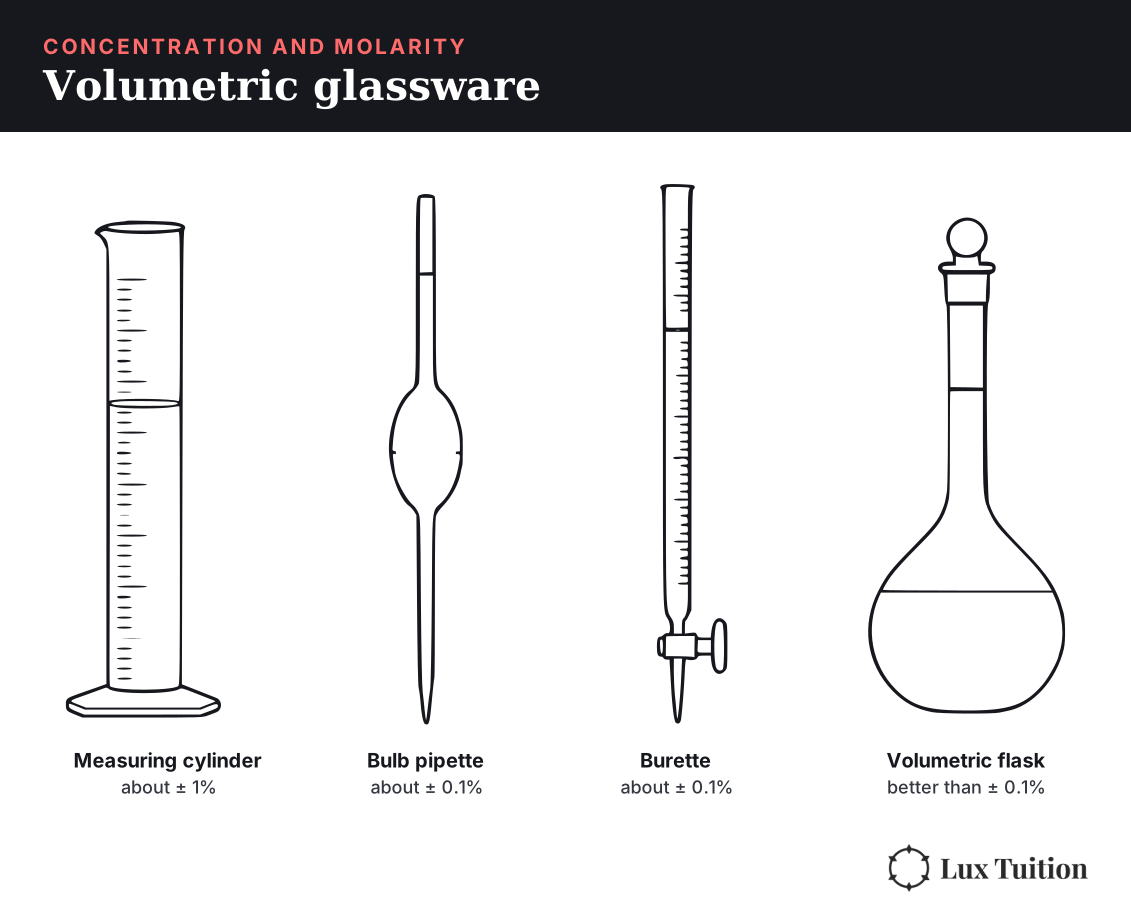
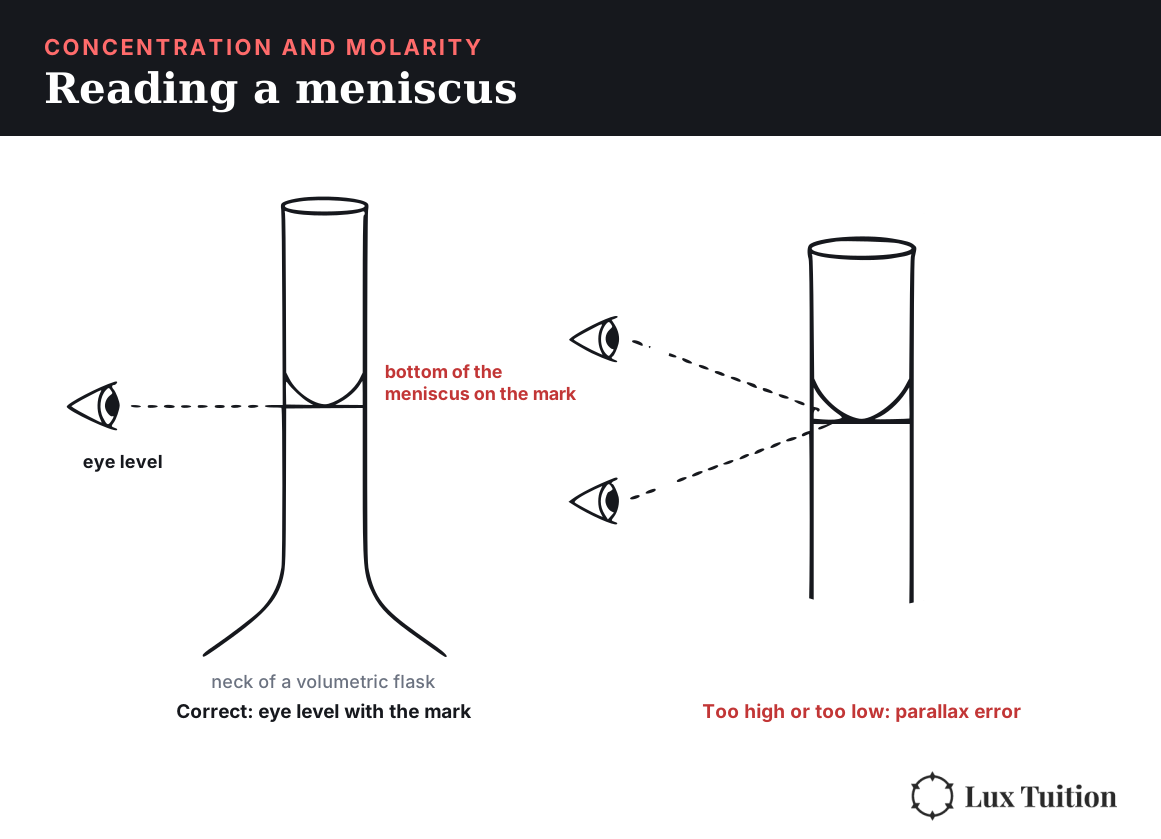
Special calibrated glassware is used to measure volume accurately. It must be filled so that the bottom of the meniscus (the curved liquid surface) touches the volume mark, and the level should be read with your eye level with the mark to avoid parallax error.
- Measuring cylinder: for approximate amounts, accurate to about ± 1%.
- Pipettes and burettes: for transferring accurate volumes of solution, accurate to about ± 0.1% for good-quality glassware.
- Volumetric flasks: hold one fixed volume, and are the most accurate of the four, better than ± 0.1%.
What is a standard solution?
A standard solution is a solution whose concentration is accurately known. Standard solutions are used to determine the concentration of other solutions, and aqueous standard solutions are made with deionised (or distilled) water.
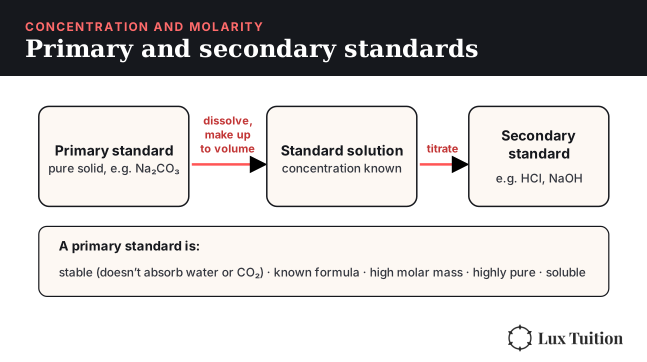
A primary standard is a highly pure substance that can be used to make a standard solution directly. It must be:
- stable in its pure form
- of known chemical formula
- of high molar mass, to minimise weighing errors
- able to be highly purified
- soluble in the chosen solvent.
Common primary standards are anhydrous sodium carbonate (Na2CO3) for bases and potassium hydrogen phthalate (KH(C8H4O4)) for acids.
Strong acids and bases make poor primary standards. Hydrochloric acid (HCl) isn’t stable in storage, because HCl gas escapes from the solution and changes its concentration, and it isn’t a solid that can be weighed accurately. Sodium hydroxide (NaOH) is hygroscopic (it absorbs water vapour from the air, increasing in mass) and it degrades by reacting with carbon dioxide in the air to form Na2CO3.
Instead, a primary standard can be reacted with another solution, such as a strong acid or base, to determine that solution’s concentration. Once standardised this way, the solution is called a secondary standard.
How to make a standard solution
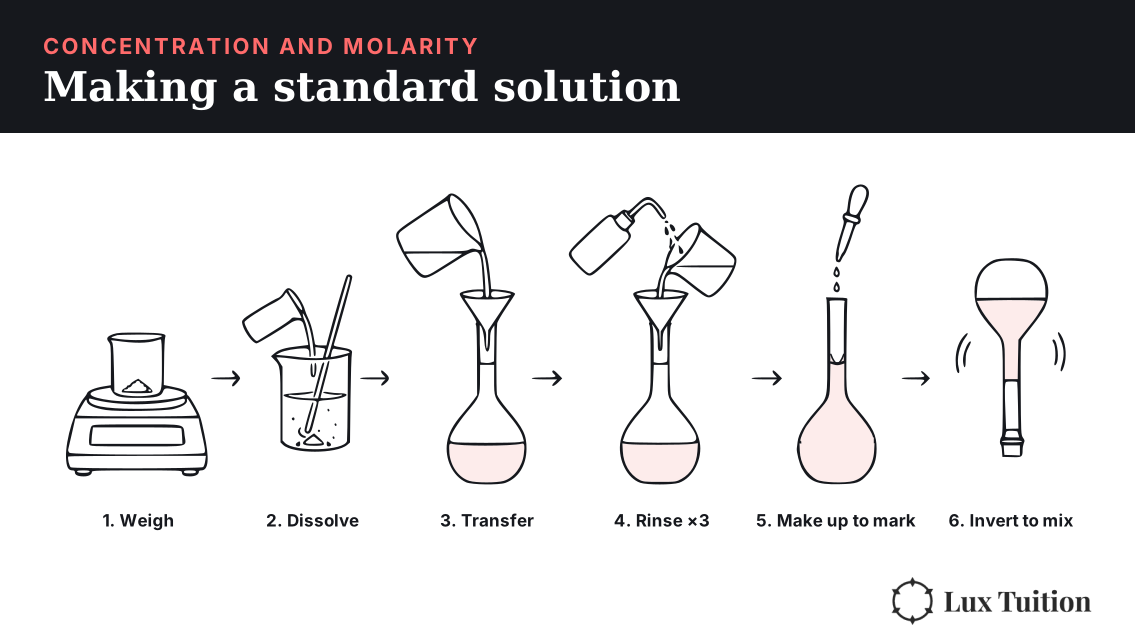
- Use a balance to accurately weigh a specific mass of the primary standard into a beaker.
- Dissolve it in a small volume of deionised water.
- Transfer the solution to a volumetric flask using a funnel.
- Rinse the beaker (and funnel) at least three times with deionised water, adding the rinsings to the flask so no solute is lost.
- Fill the flask with water to just below the calibration line, then add water dropwise until the bottom of the meniscus touches the line.
- Stopper the flask and invert it about 10 times to mix the solution evenly.
How Does the Ideal Gas Law Relate to All Other Gas Laws?
Properties of gases and the kinetic theory
A gas is a low-density state of matter that expands to fill the space of its container. Gases can be compressed, and they rapidly mix together. Gas volume is usually given in L, m3 or cm3 (1 L = 1000 cm3 = 1 dm3).
The kinetic theory of gases explains gas behaviour by modelling a gas as many tiny particles:
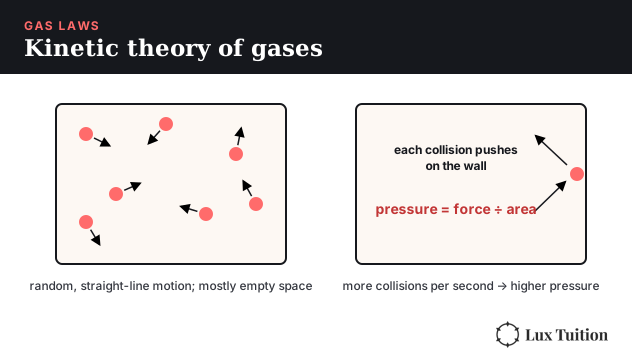
- Gas particles are constantly moving randomly in straight lines, bouncing off the walls and off each other.
- The particles themselves are much smaller than the space between them, so most of a gas’s volume is empty space.
This explains why gases are compressible, how they expand to fill their container, and how the volume and pressure of a gas are related. Raising the temperature increases the kinetic energy of the particles, so they move faster and hit the walls harder and more often. At constant pressure the gas expands; in a fixed container its pressure rises instead.
Gas pressure and its units
Pressure is force divided by surface area. The more gas particles there are in a given volume, the more often they collide with the walls of the container, increasing the force on it.
Pressure has several units:
- SI unit: newtons per square metre (N m−2), also called pascals (Pa)
- bar, used in chemistry: 1 bar = 100 kPa
- millimetres of mercury (mmHg), from mercury barometers
- standard atmosphere (atm): 1 atm = 101.3 kPa, the average atmospheric pressure at sea level.
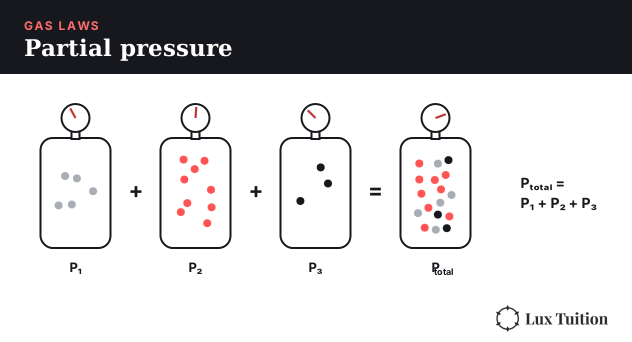
Partial pressure. The total pressure of a mixture of gases in a container is the sum of the individual pressures of each gas, and each individual pressure is called a partial pressure: Ptotal = P1 + P2 + P3.
Boyle’s law: pressure and volume
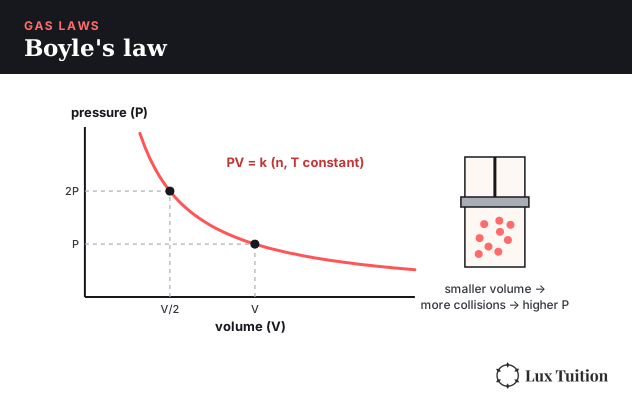
For a fixed amount of gas at constant temperature, as volume increases, pressure decreases:
PV = k
where P is pressure, V is volume and k is a constant. All of these gas laws assume the other factors, such as the moles of gas, stay constant.
Charles’ law, absolute zero and the Kelvin scale
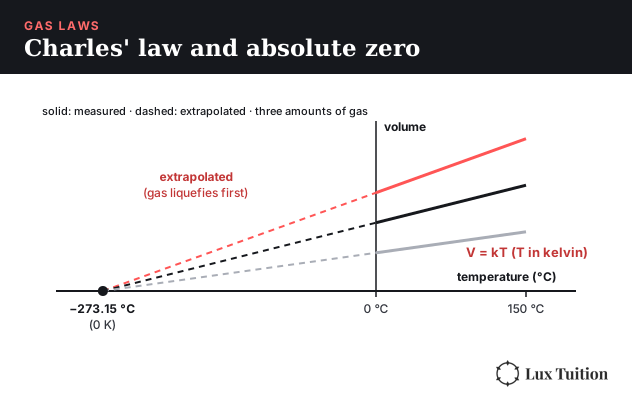
For a fixed amount of gas at constant pressure, as temperature increases, the volume of the gas increases:
V = kT
where T is the temperature in kelvin, V is volume and k is a constant.
If you extend a graph of volume against temperature to lower and lower temperatures, the line reaches zero volume at −273.15 °C. Real gases turn into liquids before they get that cold, but the extrapolation points to the coldest possible temperature, absolute zero, where particles have the least possible energy.
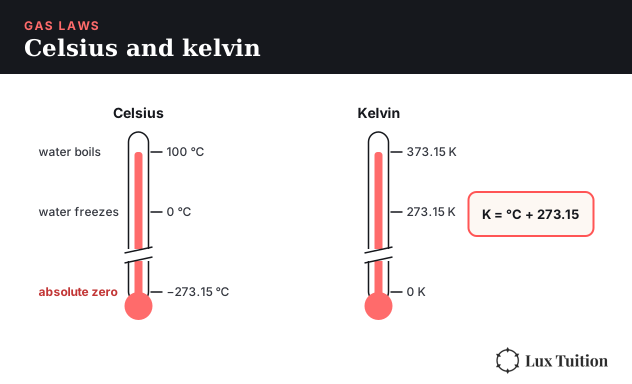
The Kelvin scale starts at absolute zero: 0 K = −273.15 °C. A change of 1 K is the same size as a change of 1 °C, so to convert Celsius to kelvin you add 273.15 (K = °C + 273.15).
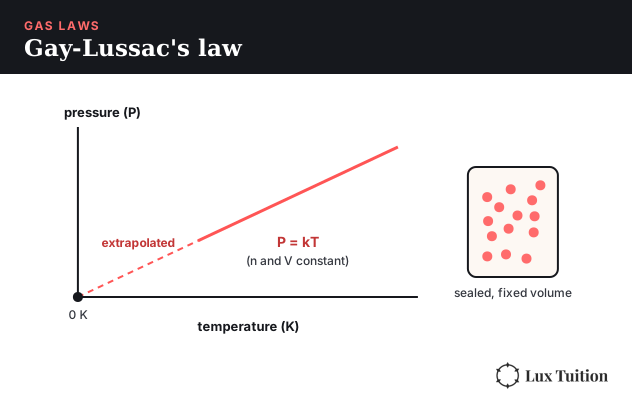
Gay-Lussac’s law: pressure and temperature
For a fixed amount of gas in a fixed volume, as temperature increases, pressure increases:
P = kT
where P is pressure, T is the temperature in kelvin and k is a constant. Pressure and volume can be in any units, as long as they match on both sides of an equation, but temperature must always be in kelvin.
The combined gas law
Combining Boyle’s, Charles’ and Gay-Lussac’s laws gives PV/T = k. In its more useful form it compares one gas under two sets of conditions:
P1V1 ÷ T1 = P2V2 ÷ T2
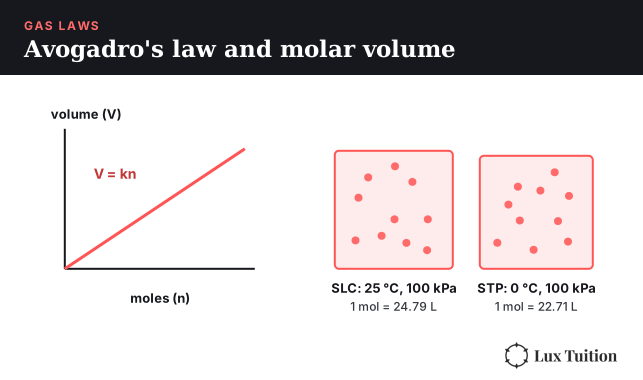
Avogadro’s law and molar volume
The volume of any gas is proportional to the number of particles (moles) of gas, at constant temperature and pressure:
V = kn
The molar volume of a gas is the volume taken up by 1 mole of it. It depends on temperature and pressure, but any gas has the same molar volume under the same conditions. Two standard sets of conditions are used:
- Standard laboratory conditions (SLC): 25 °C and 100 kPa, where 1 mole of gas occupies 24.79 L.
- Standard temperature and pressure (STP): 0 °C and 100 kPa, where 1 mole of gas occupies 22.71 L.
The ideal gas law: PV = nRT
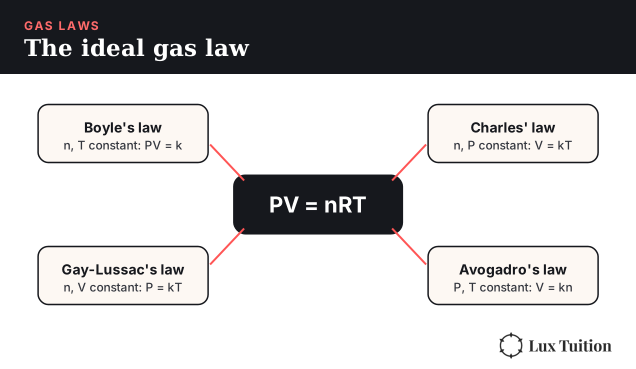
Adding all of these laws together gives the ideal gas law, which describes how any gas behaves:
PV = nRT
where P is pressure (kPa), V is volume (L), n is moles of gas (mol), R is the gas constant (8.314 J mol−1 K−1, which is the same as 8.314 L kPa mol−1 K−1 and is on your data sheet) and T is temperature (K). The units matter.
Each of the other gas laws is the ideal gas law with two variables held constant:
- Boyle’s law: hold n and T constant, so PV = nRT becomes PV = constant.
- Charles’ law: hold n and P constant, so V = (nR/P)T, or V = kT.
- Gay-Lussac’s law: hold n and V constant, so P = (nR/V)T, or P = kT.
- Avogadro’s law: hold P and T constant, so V = (RT/P)n, or V = kn.
When is the ideal gas law less accurate?
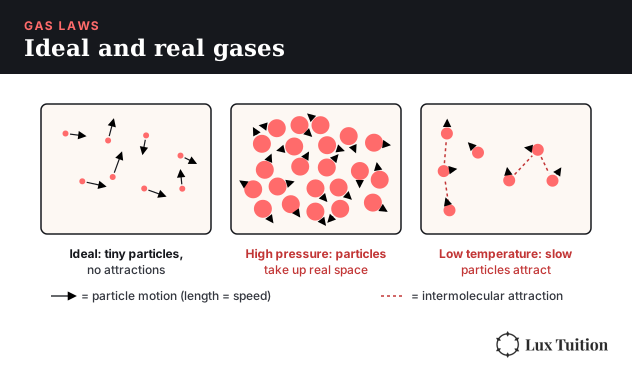
The ideal gas law assumes the kinetic theory: gas particles take up no space and don’t interact with each other. In reality, gas particles take up some space and feel some intermolecular attraction. In most conditions the ideal gas law is very accurate, but it becomes less accurate:
- at very high pressures, where the particles are squeezed close together so their own volume matters
- at very low temperatures, where the particles move more slowly, so intermolecular attractions have more effect and the pressure is lower than predicted.
Year 11 Chemistry Module 2 Revision Summary
What Comes After Module 2 in Year 11 Chemistry?
Module 2 gives you the tools you’ll use for the rest of the course:
- Module 3: Reactive Chemistry uses balanced equations, moles and concentration to predict and measure the products of reactions.
- Module 4: Drivers of Reactions uses moles to measure energy changes in reactions.
If you missed the foundations, the Year 11 Chemistry Module 1 notes cover atomic structure and bonding. For the bigger picture, our ultimate guide to scoring Band 6 in Chemistry covers the HSC course and how to study it, and a spaced-repetition guide to Anki is a good way to lock in formulae and units.
Year 11 Chemistry Tutoring in Blacktown
Quantitative chemistry is where many students first start losing marks, because every calculation depends on getting the moles right. In our Year 11 Chemistry tutoring in Blacktown, theory is broken down by our tutors into the smallest possible parts and practised in classes of 1 to 5 students, a few minutes from Blacktown Station. Check our pricing page, or book a free trial with no obligations.
Frequently Asked Questions
What is Module 2 in Year 11 Chemistry?
Module 2 is Introduction to Quantitative Chemistry, the second of four Year 11 modules in the NSW Chemistry Stage 6 Syllabus. It covers balancing equations and conservation of mass, the mole concept, concentration and dilution, and the gas laws.
What is the difference between an empirical formula and a molecular formula?
The empirical formula is the simplest whole-number ratio of the elements in a compound, while the molecular formula is the actual number of each atom in one molecule. Hydrogen peroxide has the molecular formula H2O2 but the empirical formula HO. The molecular formula is always a whole-number multiple of the empirical formula.
How do you find the limiting reagent?
Convert each reactant to moles, then use the ratio from the balanced equation to see which reactant would run out first. That reactant is the limiting reagent and decides how much product forms. Comparing masses directly doesn't work, because equations are ratios of moles.
Why must temperature be in kelvin for the gas laws?
The gas laws say volume or pressure is proportional to temperature, which only works on a scale that starts at absolute zero. On the Celsius scale, 0 °C isn't zero energy, so doubling a Celsius temperature doesn't double the volume or pressure. Always convert with K = °C + 273.15.
What is the difference between SLC and STP?
Both use a pressure of 100 kPa. Standard laboratory conditions (SLC) are at 25 °C, where 1 mole of any gas occupies 24.79 L, while standard temperature and pressure (STP) is at 0 °C, where 1 mole occupies 22.71 L.
Why can't sodium hydroxide be used as a primary standard?
Sodium hydroxide is hygroscopic, so it absorbs water from the air and its mass keeps increasing while you weigh it. It also reacts with carbon dioxide in the air to form sodium carbonate, so its purity isn't reliable. A primary standard must be stable, pure and of known formula.
Learn it properly with a specialist tutor at Blacktown or online across NSW. Enquire about a free trial — no cost, no obligation. See online formats and class sizes.
Realistic study tips to help you prepare better for assessments with less stress, plus a printable study planner