
Module 3 is where chemistry starts to predict. Given two chemicals, can you say whether they’ll react, what they’ll make and how fast it will happen? Reactive chemistry answers all three, and those answers sit behind everything from fertiliser and batteries to catalytic converters. This page is part of our Year 11 Chemistry notes, which summarise all four modules in one place.
These Year 11 Chemistry Module 3 notes follow the three inquiry questions of Module 3: Reactive Chemistry in the NSW Chemistry Stage 6 Syllabus. They’re written from the lessons our tutors teach in class, and each topic opens with the exact syllabus dot point it covers. Module 3 leans on balanced equations and moles, so if those feel shaky, revise the Year 11 Chemistry Module 2 notes first.
These are theory and revision notes. We’ve left out worked examples and practice questions, and reading notes doesn’t replace the practical investigations the syllabus asks you to do in class.
Key Takeaways
- A chemical change makes new substances, and is signalled by gas, a precipitate, a colour change, a temperature change or a solid disappearing.
- The main reaction types are synthesis, decomposition, combustion, precipitation, acid/base and acid/carbonate, and each has a predictable pattern of products.
- The activity series ranks metals by how readily they lose electrons: a metal displaces the ion of any metal below it.
- Oxidation is loss of electrons (an increase in oxidation number) and reduction is gain of electrons (a decrease); they always happen together.
- A galvanic cell separates the two half-reactions so electrons flow through a wire. Oxidation happens at the anode, reduction at the cathode, and E°cell = E°cathode − E°anode must be positive for the reaction to be spontaneous.
- By collision theory, particles react only when they collide with enough energy (at least the activation energy) and the right orientation, which explains how temperature, surface area, concentration and catalysts change the rate.
For how to study all this effectively, see how to actually understand HSC Chemistry.
What Does Year 11 Chemistry Module 3 Cover?
Module 3 is the third of four Year 11 modules in the NESA Chemistry Stage 6 Syllabus (2017). It’s organised around three inquiry questions, and these notes follow the same order:
| Syllabus section | Inquiry question |
|---|---|
| Chemical Reactions | What are the products of a chemical reaction? |
| Predicting Reactions of Metals | How is the reactivity of various metals predicted? |
| Rates of Reactions | What affects the rate of a chemical reaction? |
Did You Know? The first battery was built by Alessandro Volta in 1800 from a stack of zinc and copper discs separated by brine-soaked cloth. The unit of potential difference, the volt, is named after him. Source: Encyclopaedia Britannica, voltaic pile
What Are the Products of a Chemical Reaction?
use modelling to demonstrate the rearrangement of atoms to form new substances; the conservation of atoms in a chemical reaction (ACSCH042, ACSCH080)
Physical and chemical changes
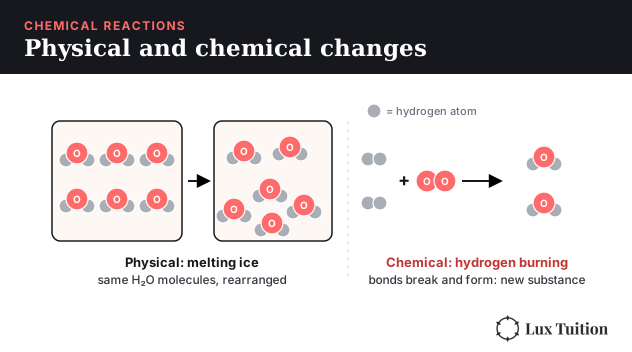
Every change in matter is either physical or chemical:
- A physical change changes the state or form of a substance but makes no new substance, for example melting, dissolving or mixing.
- A chemical change breaks and forms chemical bonds, so new substances are made. Photosynthesis is a chemical change: plants make a new substance, glucose, from carbon dioxide and water.
Indicators of a chemical change
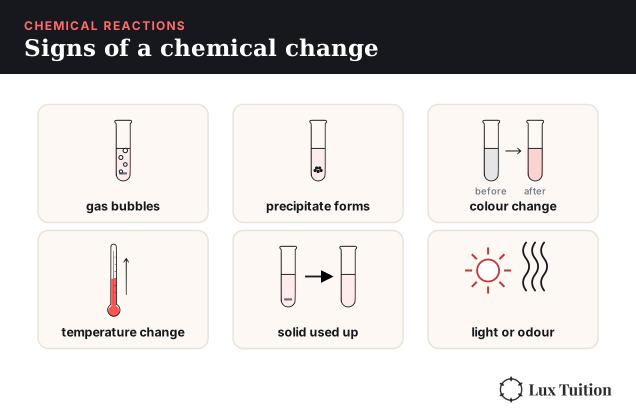
You can’t see bonds breaking, so chemists look for evidence that a new substance has formed:
- a gas is released, seen as bubbling or fizzing
- a solid precipitate forms when two solutions are mixed
- the colour changes
- the temperature changes (the mixture heats up or cools down)
- a solid disappears
- light is given off or an odour is produced.
Magnesium reacting with hydrochloric acid shows several of these at once: the magnesium disappears, bubbles of hydrogen gas form and the mixture warms up. No single indicator is proof on its own, since boiling also makes bubbles and dissolving can change the temperature, so look for more than one.
Modelling the rearrangement and conservation of atoms
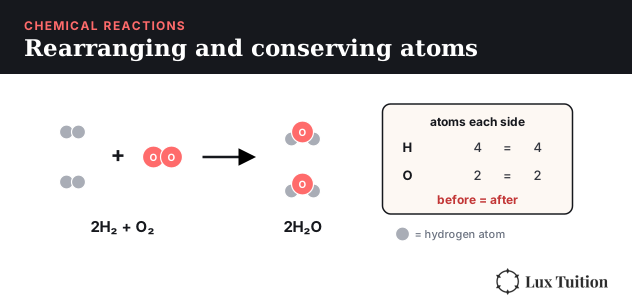
In a chemical reaction the bonds in the reactants break, and the same atoms join up in new arrangements to form the products. Molecular models, whether ball-and-stick kits or drawings, show both ideas at once:
- the rearrangement of atoms: the atoms end up bonded to different partners, which is why the products are new substances
- the conservation of atoms: every atom in the reactants appears in the products, so no atoms are created or destroyed.
That’s why chemical equations must balance. Balancing is covered in the Module 2 notes on balancing equations.
Synthesis reactions
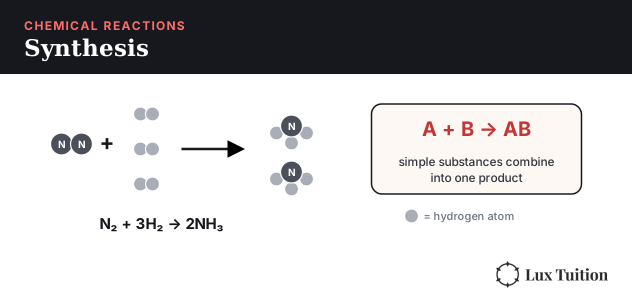
The word synthesis comes from the Greek syn, “together”, and thesis, “to put”. In a synthesis reaction, two or more simpler substances combine to form one more complex product:
A + B → AB
Synthesis is the key reaction type for making medicines, plastics and flavourings. The synthesis of ammonia for fertiliser is an example:
N2(g) + 3H2(g) → 2NH3(g)
Decomposition reactions
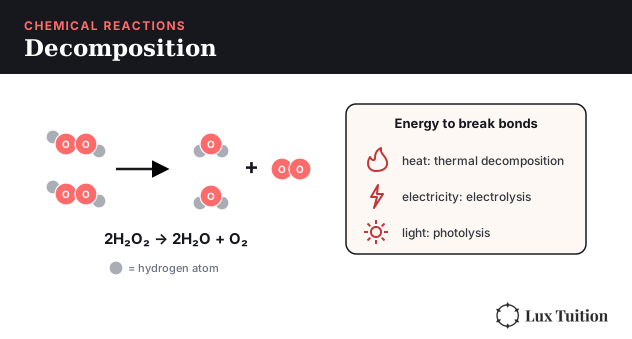
In a decomposition reaction, one reactant breaks down into two or more products:
AB → A + B
For example, hydrogen peroxide decomposes into water and oxygen:
2H2O2(l) → 2H2O(l) + O2(g)
Decomposition often needs an input of energy to break the bonds, and it’s named after where that energy comes from:
- thermal decomposition uses heat
- electrolysis uses electricity
- photolysis uses light.
Combustion reactions
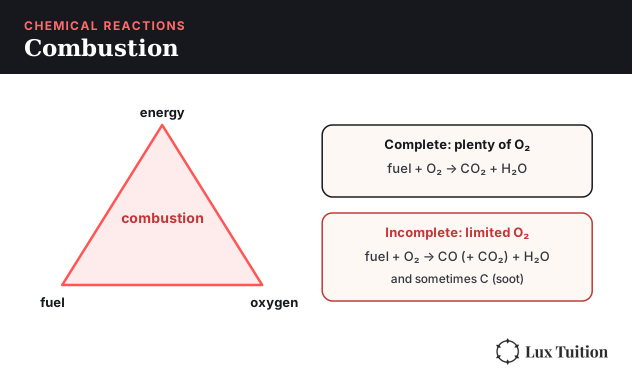
Combustion is a rapid reaction with oxygen that releases a large amount of heat and light. The fuel bonds with oxygen to form oxides. Combustion needs three things, often drawn as the fire triangle: fuel, oxygen and energy to start the reaction.
- Complete combustion happens when there’s plenty of oxygen. A hydrocarbon fuel produces only carbon dioxide and water.
- Incomplete combustion happens when oxygen is limited. Carbon monoxide forms instead of carbon dioxide, and solid carbon (soot) may also form.
For butane, the two equations are:
- complete: 2C4H10(g) + 13O2(g) → 8CO2(g) + 10H2O(l)
- incomplete, forming carbon monoxide: 2C4H10(g) + 9O2(g) → 8CO(g) + 10H2O(l)
To balance a combustion equation:
- Write the formula of the fuel.
- Add O2 to the reactants, and CO2 (or CO for incomplete combustion) and H2O to the products.
- Balance carbon, then hydrogen.
- Balance oxygen last. If the number of O2 molecules isn’t a whole number, multiply every coefficient by 2.
- Add state symbols.
Precipitation reactions
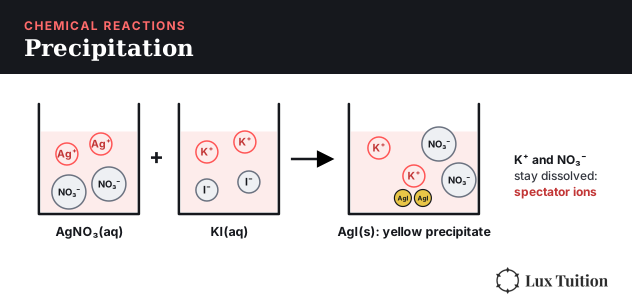
A precipitate is an insoluble solid that forms when two solutions are mixed. It appears as a fine powder that clouds the solution before settling. When silver nitrate and potassium iodide solutions are mixed, a yellow precipitate of silver iodide forms:
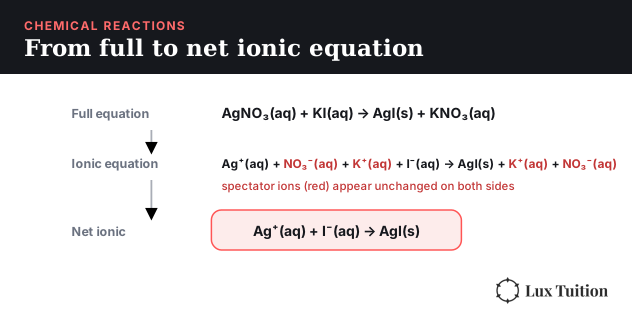
AgNO3(aq) + KI(aq) → AgI(s) + KNO3(aq)
Each soluble salt dissociates into separate ions in solution. When ions that make an insoluble salt meet, they bond and fall out of solution as a solid. Ions that stay dissolved and don’t form the precipitate are called spectator ions. Here, K+ and NO3− are the spectator ions.
Solubility rules
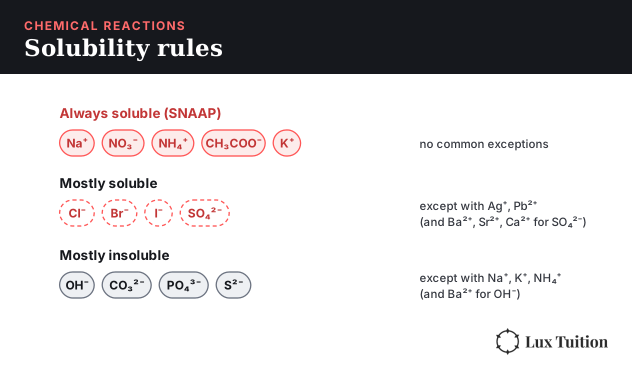
To predict whether a precipitate will form, check whether any possible product is insoluble using a solubility table or these rules:
- Always soluble: salts containing sodium (Na+), nitrate (NO3−), ammonium (NH4+), acetate (CH3COO−) or potassium (K+). The mnemonic is SNAAP.
- Mostly soluble: chlorides, bromides and iodides, except those of silver (Ag+) and lead(II) (Pb2+); and sulfates, except those of barium, strontium and lead(II), with calcium and silver sulfates only slightly soluble.
- Mostly insoluble: hydroxides (OH−), carbonates (CO32−), phosphates (PO43−) and sulfides (S2−), unless they’re paired with a SNAAP ion. Barium hydroxide is also soluble, and calcium and strontium hydroxides are slightly soluble.
Ionic and net ionic equations
The full equation above hides what’s really happening, because most of the species are dissolved ions. There are two other ways to write it:
- An ionic equation shows every dissolved species as separate ions: Ag+(aq) + NO3−(aq) + K+(aq) + I−(aq) → AgI(s) + K+(aq) + NO3−(aq)
- A net ionic equation leaves out the spectator ions and shows only the change: Ag+(aq) + I−(aq) → AgI(s)
To write a net ionic equation for a precipitation reaction, identify the precipitate, write it as the product, and write only the ions that form it as the reactants.
Acids and bases
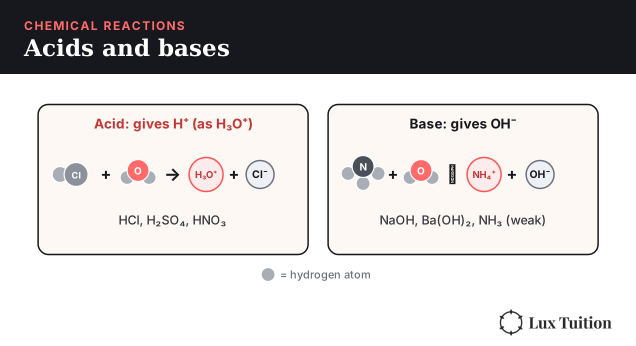
At Year 11 level, acids and bases are defined by the ions they produce in water. (You’ll meet a more complete definition in HSC Chemistry.)
- An acid produces hydrogen ions, H+, in solution. In water these exist as hydronium ions, H3O+. Examples are hydrochloric acid (HCl), sulfuric acid (H2SO4) and nitric acid (HNO3): HCl(aq) + H2O(l) → H3O+(aq) + Cl−(aq)
- A base produces hydroxide ions, OH−, in solution. Examples are sodium hydroxide (NaOH), barium hydroxide (Ba(OH)2) and ammonia (NH3): NH3(aq) + H2O(l) ⇌ NH4+(aq) + OH−(aq)
Acid/base (neutralisation) reactions
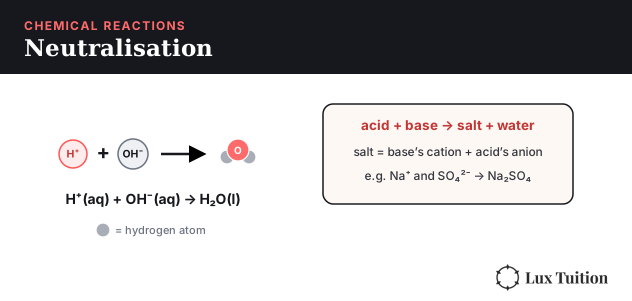
Acids and bases neutralise each other:
acid + base → salt + water
For example: H2SO4(aq) + 2NaOH(aq) → Na2SO4(aq) + 2H2O(l)
The “salt” is the ionic compound made from the base’s cation and the acid’s anion. When a strong acid reacts with a soluble hydroxide to form a soluble salt, the metal ion and the acid’s anion are spectators, so the net ionic equation is always the same:
H+(aq) + OH−(aq) → H2O(l)
Acid/carbonate reactions
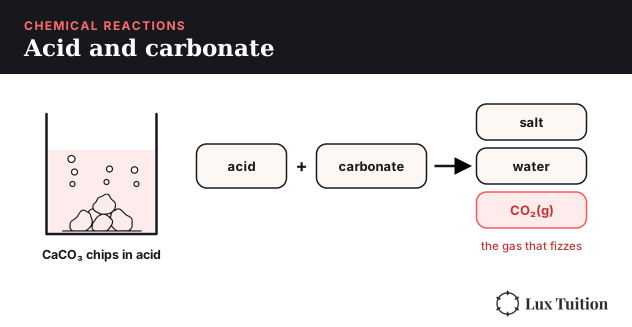
Acids react with carbonates (and hydrogen carbonates) to produce a salt, water and carbon dioxide gas:
acid + carbonate → salt + water + carbon dioxide
For example: 2HNO3(aq) + Na2CO3(aq) → 2NaNO3(aq) + H2O(l) + CO2(g)
This is how acid rain erodes limestone and marble statues, which are made of calcium carbonate, CaCO3.
Testing for carbon dioxide and hydrogen
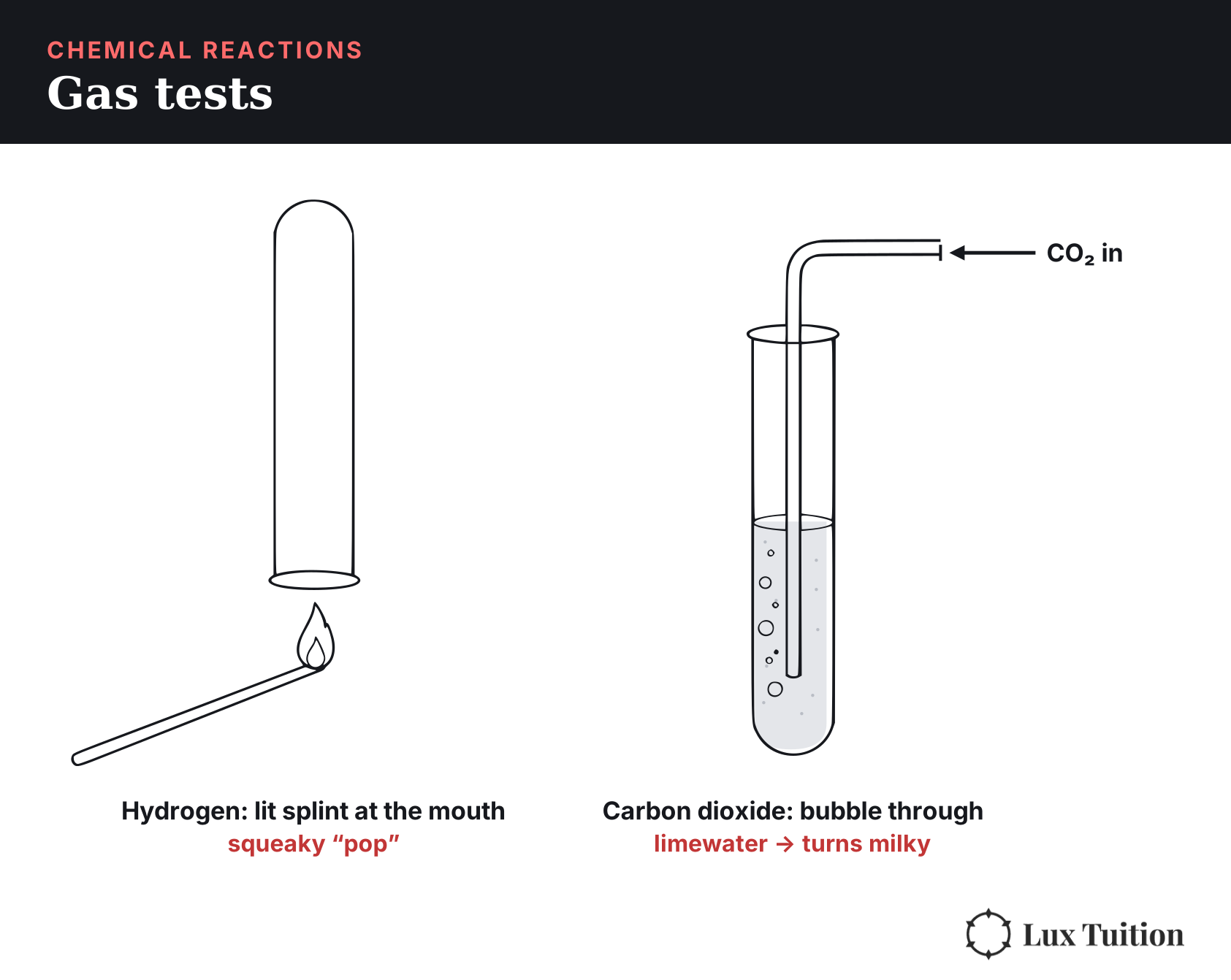
Two simple gas tests identify the products of these reactions:
- Limewater test for CO2: bubble the gas through limewater, a solution of calcium hydroxide. Carbon dioxide turns it milky because a precipitate of calcium carbonate forms: Ca(OH)2(aq) + CO2(g) → CaCO3(s) + H2O(l)
- Pop test for H2: collect the gas in a test tube and hold a lit splint at its mouth. Hydrogen burns with a squeaky “pop”.
How Aboriginal Peoples detoxify cycad seeds
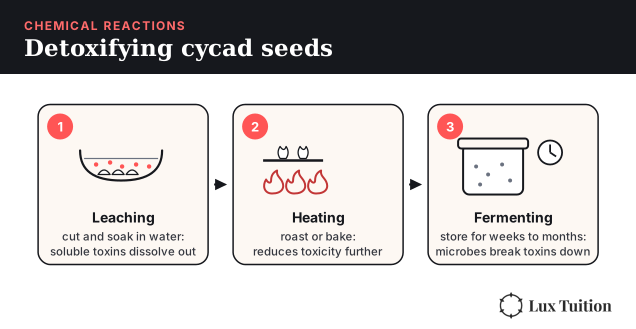
Cycad seeds (from plants such as Macrozamia) have long been a staple food for some Aboriginal communities, but they contain water-soluble toxic glycosides, including cycasin and macrozamin. Communities in different regions have developed different methods to make the seeds safe to eat, and each method relies on a chemical or physical process:
- Leaching: the kernels are cut open or crushed and soaked in running water for several days. Cutting increases the surface area, so the water-soluble toxins dissolve out faster.
- Heating: roasting or baking, usually after leaching, further reduces the toxicity of the kernels.
- Fermentation: in south-western Australia, Macrozamia seeds were stored for weeks to months so microbes grew on them. The microbes break the toxins down biologically.
Writing balanced equations for each reaction type
Once you know the reaction type, you can predict the products and then balance the equation:
| Reaction type | General pattern |
|---|---|
| Synthesis | A + B → AB |
| Decomposition | AB → A + B |
| Combustion | fuel + oxygen → oxides (CO2 and H2O for a hydrocarbon) |
| Precipitation | two soluble salts → insoluble salt + soluble salt |
| Acid/base | acid + base → salt + water |
| Acid/carbonate | acid + carbonate → salt + water + carbon dioxide |
| Metal and acid | metal + acid → salt + hydrogen |
Always check the formulae first, since balancing only changes coefficients, then add state symbols.
How Is the Reactivity of Various Metals Predicted?
Metal reactions with oxygen
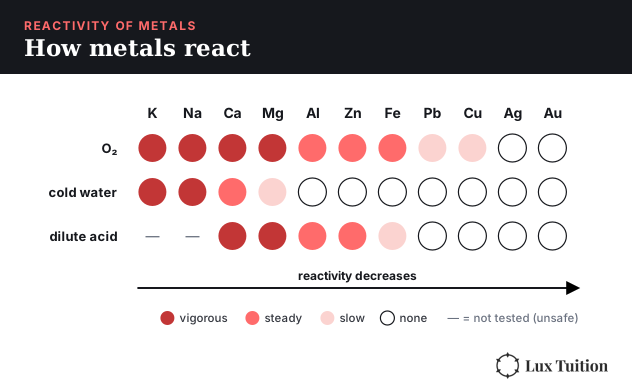
Many metals react with oxygen to form a metal oxide:
metal + oxygen → metal oxide
For example: 4Na(s) + O2(g) → 2Na2O(s)
- Group 1 metals such as sodium and potassium react rapidly with oxygen, even at room temperature.
- Group 2 metals such as magnesium burn brightly once they’re given enough activation energy, for example by heating magnesium ribbon in a flame.
- Less reactive metals such as copper react slowly, forming a surface layer of oxide when heated.
- Unreactive metals such as silver and gold don’t react with oxygen at all.
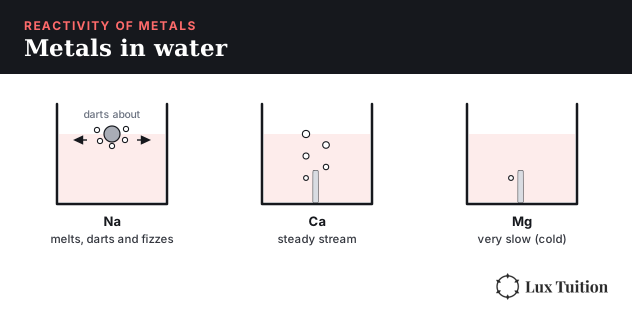
Metal reactions with water
Reactive metals react with water to form a metal hydroxide (or oxide) and hydrogen gas:
metal + water → metal hydroxide + hydrogen
For example: 2Na(s) + 2H2O(l) → 2NaOH(aq) + H2(g)
- Group 1 metals react violently with cold water.
- Group 2 metals such as calcium react more slowly with cold water; magnesium reacts only very slowly unless the water is hot.
- Less reactive metals such as iron react very slowly, or only with steam.
- Copper, silver and gold don’t react with water.
Metal reactions with dilute acid
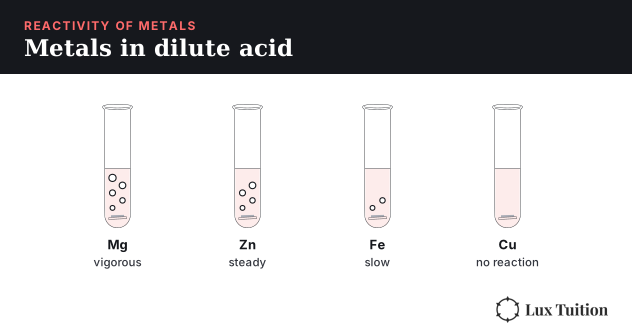
Metals above hydrogen in the activity series react with dilute acids to form a salt and hydrogen gas:
metal + acid → salt + hydrogen
For example: Mg(s) + 2HCl(aq) → MgCl2(aq) + H2(g), with the net ionic equation Mg(s) + 2H+(aq) → Mg2+(aq) + H2(g)
- Group 1 metals aren’t tested with acids, because they react dangerously with the water in the acid.
- Group 2 metals such as magnesium react vigorously.
- Less reactive metals such as zinc and iron react more slowly.
- Copper, silver and gold don’t react with dilute acids.
Metal displacement reactions
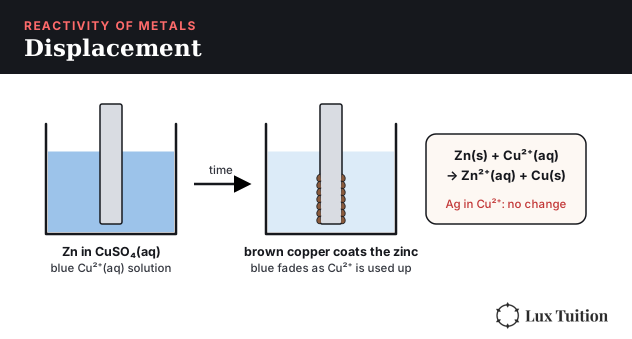
A metal can also react with the ions of another metal in solution. If zinc is placed in blue copper(II) sulfate solution, copper forms on the zinc and zinc dissolves as ions, so the blue colour fades:
Zn(s) + Cu2+(aq) → Zn2+(aq) + Cu(s)
Copper in silver nitrate solution does the same: silver crystals grow on the copper and the solution turns blue as Cu2+ ions form. But silver placed in copper(II) sulfate solution shows no change. The rule is that a more reactive metal displaces a less reactive metal from a solution of its ions, and never the reverse. These are called displacement reactions.
The activity series of metals
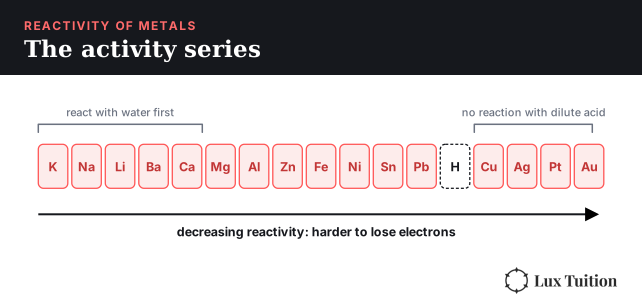
The activity series ranks metals from most reactive to least reactive, based on how they behave with oxygen, water, dilute acid and other metals’ ions. A common version is:
K > Na > Li > Ba > Ca > Mg > Al > Zn > Fe > Ni > Sn > Pb > (H) > Cu > Ag > Pt > Au
A metal displaces the ions of any metal to its right from solution. The exception is the very reactive metals, such as K, Na and Ca, which react with the water in the solution instead. Hydrogen is included as a reference point: metals to its left react with dilute acids to release hydrogen gas, and metals to its right don’t.
Limitations of the activity series
An activity series built from class experiments has some limitations:
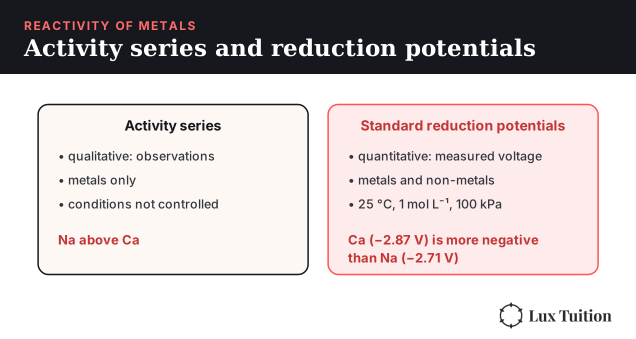
- It’s qualitative. It’s based on observations described in vague words like “violent”, “fast” or “slow”, which are open to interpretation.
- The rate of a reaction depends on more than the metal: temperature, surface area (powder reacts faster than a lump) and the concentration of the solution all change how vigorous a reaction looks.
- Many metals, such as aluminium, have a protective oxide layer that makes them look less reactive than they are.
The secondary-sourced alternative is the table of standard reduction potentials. It’s quantitative, measured as voltages under standard conditions (25 °C, 1 mol L−1 and 100 kPa), and it includes non-metals as well as metals. The two series mostly agree, but not always: sodium sits above calcium in a typical activity series, yet calcium’s standard reduction potential (−2.87 V) is more negative than sodium’s (−2.71 V).
Why metal reactivity follows periodic trends
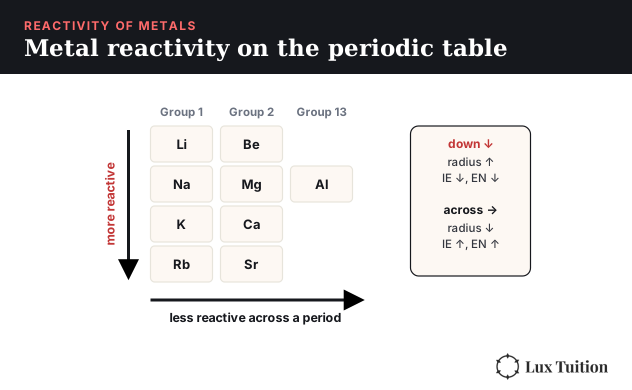
A metal’s reactivity is its tendency to lose its valence electrons. Three atomic properties, all covered in Module 1’s periodic trends, decide how easily that happens:
- Atomic radius: the distance from the nucleus to the outermost electrons. The further away the valence electrons are, the more weakly they’re held.
- First ionisation energy: the energy needed to remove one electron from a neutral gaseous atom. A lower ionisation energy means the electron is lost more easily.
- Electronegativity: the ability of an atom to attract electrons in a bond. The most reactive metals have the lowest electronegativity.
Reactivity down a group
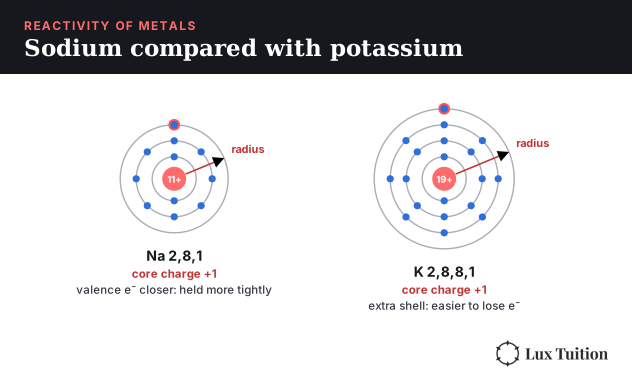
Going down a group, reactivity increases. Sodium and potassium are both in Group 1 and have the same core charge (+1), but potassium has an extra electron shell. Its valence electron is further from the nucleus and more shielded, so the attraction is weaker. Potassium therefore has a lower ionisation energy and lower electronegativity than sodium, loses its electron more readily and is more reactive. The same pattern holds in Group 2, where calcium is more reactive than magnesium.
Reactivity across a period
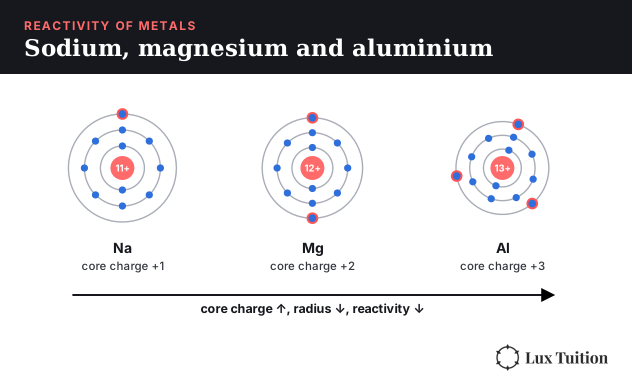
Going across a period, reactivity decreases. Sodium, magnesium and aluminium all have three electron shells, but the core charge increases from +1 to +2 to +3. The stronger pull shrinks the atomic radius and holds the valence electrons more tightly, which raises the ionisation energy and electronegativity. Aluminium also has to lose three electrons to form its ion, while sodium loses only one. So the reactivity order is Na > Mg > Al.
| Direction | Core charge | Atomic radius | Ionisation energy | Electronegativity | Metal reactivity |
|---|---|---|---|---|---|
| Down a group | Same | Increases | Decreases | Decreases | Increases |
| Across a period | Increases | Decreases | Increases | Increases | Decreases |
What is a redox reaction?
A redox reaction is one in which electrons are transferred from one reactant to another. It combines two processes:
- Oxidation is the loss of electrons.
- Reduction is the gain of electrons.
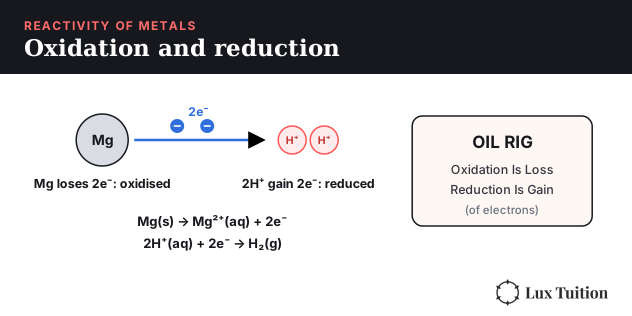
The mnemonic OIL RIG helps: Oxidation Is Loss, Reduction Is Gain. The two always happen together, because the electrons lost by one species must be gained by another. The metal reactions above are all redox reactions. When magnesium reacts with acid, magnesium loses two electrons (it’s oxidised) and two hydrogen ions gain them (they’re reduced):
- Mg(s) → Mg2+(aq) + 2e−
- 2H+(aq) + 2e− → H2(g)
Oxidising and reducing agents
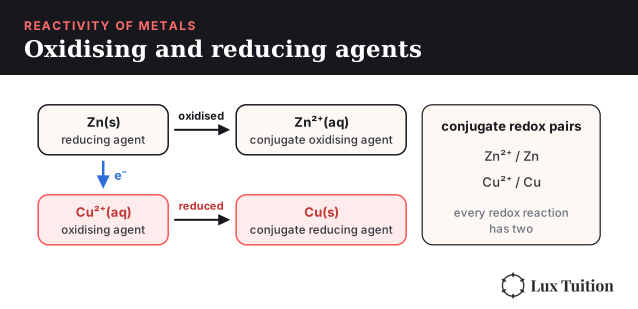
- A reducing agent (reductant) donates electrons to another species. It reduces that species, and is itself oxidised.
- An oxidising agent (oxidant) accepts electrons from another species. It oxidises that species, and is itself reduced.
Metals lose electrons readily, so they usually act as reducing agents. In Zn(s) + Cu2+(aq) → Zn2+(aq) + Cu(s), zinc is the reducing agent and Cu2+ is the oxidising agent. Each reactant and the product it forms make a conjugate redox pair, here Zn/Zn2+ and Cu2+/Cu, so every redox reaction contains two conjugate pairs. The products can react in turn: Zn2+ is the conjugate oxidising agent, because it could accept electrons from a stronger reducing agent.
Oxidation numbers
Oxidation numbers (or oxidation states) track electrons in reactions where it isn’t obvious who gained or lost them, such as reactions between molecules. They treat every compound as if it were fully ionic, and they’re assigned with these rules:
| Rule | Species | Oxidation number | Example |
|---|---|---|---|
| 1 | Free element | 0 | Na, O2, Cl2, Fe |
| 2 | Simple ion | Equal to the ion's charge | Fe2+ = +2; Cl− = −1 |
| 3 | Group 1 and 2 metals in compounds | +1 and +2 | K in KCl = +1; Ca in CaCl2 = +2 |
| 4 | Hydrogen in compounds | +1 (−1 in metal hydrides) | H in H2O = +1; H in NaH = −1 |
| 5 | Oxygen in compounds | −2 (−1 in peroxides) | O in H2O = −2; O in H2O2 = −1 |
| 6 | Fluorine in compounds | −1 (other halogens are usually −1 with metals) | F in HF = −1; Cl in NaCl = −1 |
| 7 | Neutral compound | All oxidation numbers add to 0 | CO2: (+4) + 2(−2) = 0 |
| 8 | Polyatomic ion | All oxidation numbers add to the ion's charge | SO42−: (+6) + 4(−2) = −2 |
To find an unknown oxidation number, assign the fixed values first, call the unknown x and solve so the total equals the overall charge. For a transition metal, the oxidation number is shown in Roman numerals in the name: iron in Fe2O3 is +3, so the compound is iron(III) oxide.
In any reaction:
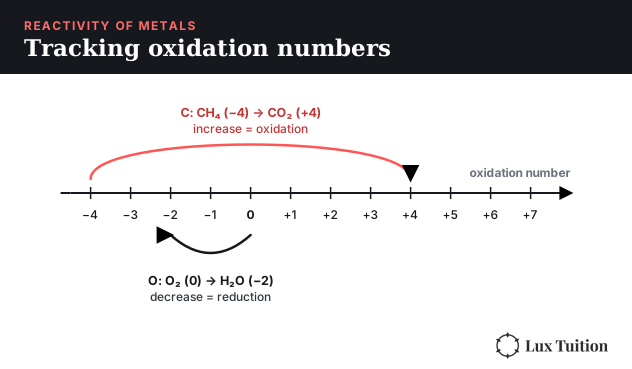
- an increase in oxidation number is oxidation
- a decrease in oxidation number is reduction.
In the combustion of methane, carbon goes from −4 to +4 (oxidised) and oxygen from 0 to −2 (reduced).
Half-equations and overall redox equations
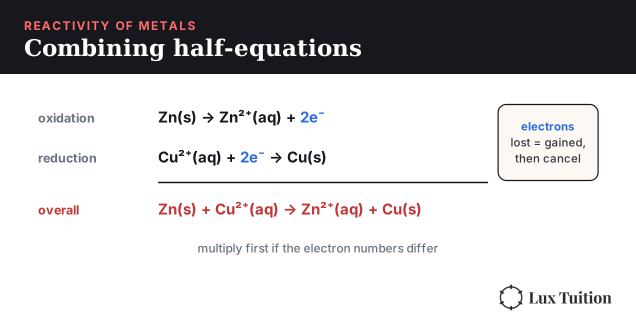
A half-equation shows either the oxidation or the reduction on its own, with the electrons written in. To combine two half-equations into the overall equation:
- Multiply one or both half-equations so the number of electrons lost equals the number gained.
- Add the two half-equations together.
- Cancel the electrons, and any H+ or H2O that appears on both sides.
- Check that both the atoms and the total charge balance.
For zinc displacing copper, the electrons already match:
- Oxidation: Zn(s) → Zn2+(aq) + 2e−
- Reduction: Cu2+(aq) + 2e− → Cu(s)
- Overall: Zn(s) + Cu2+(aq) → Zn2+(aq) + Cu(s)
Balancing half-equations in acidic solution
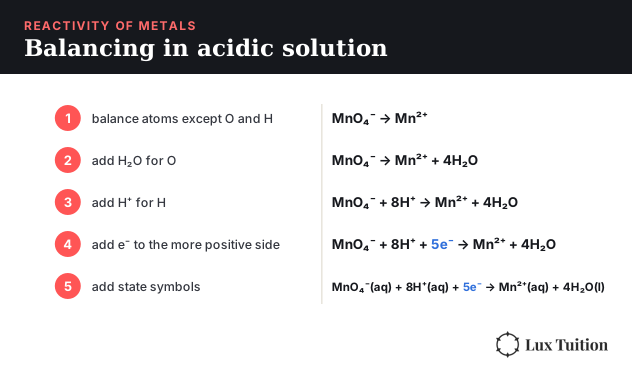
Half-equations involving polyatomic ions such as permanganate, MnO4−, need extra species. In acidic solution, use these five steps:
- Balance all atoms except oxygen and hydrogen.
- Balance oxygen by adding H2O to the side with less oxygen.
- Balance hydrogen by adding H+ to the side with less hydrogen.
- Balance charge by adding electrons to the more positive side.
- Add state symbols.
Following these steps, the reduction of permanganate to manganese(II) ions is:
MnO4−(aq) + 8H+(aq) + 5e− → Mn2+(aq) + 4H2O(l)
What is a galvanic cell?
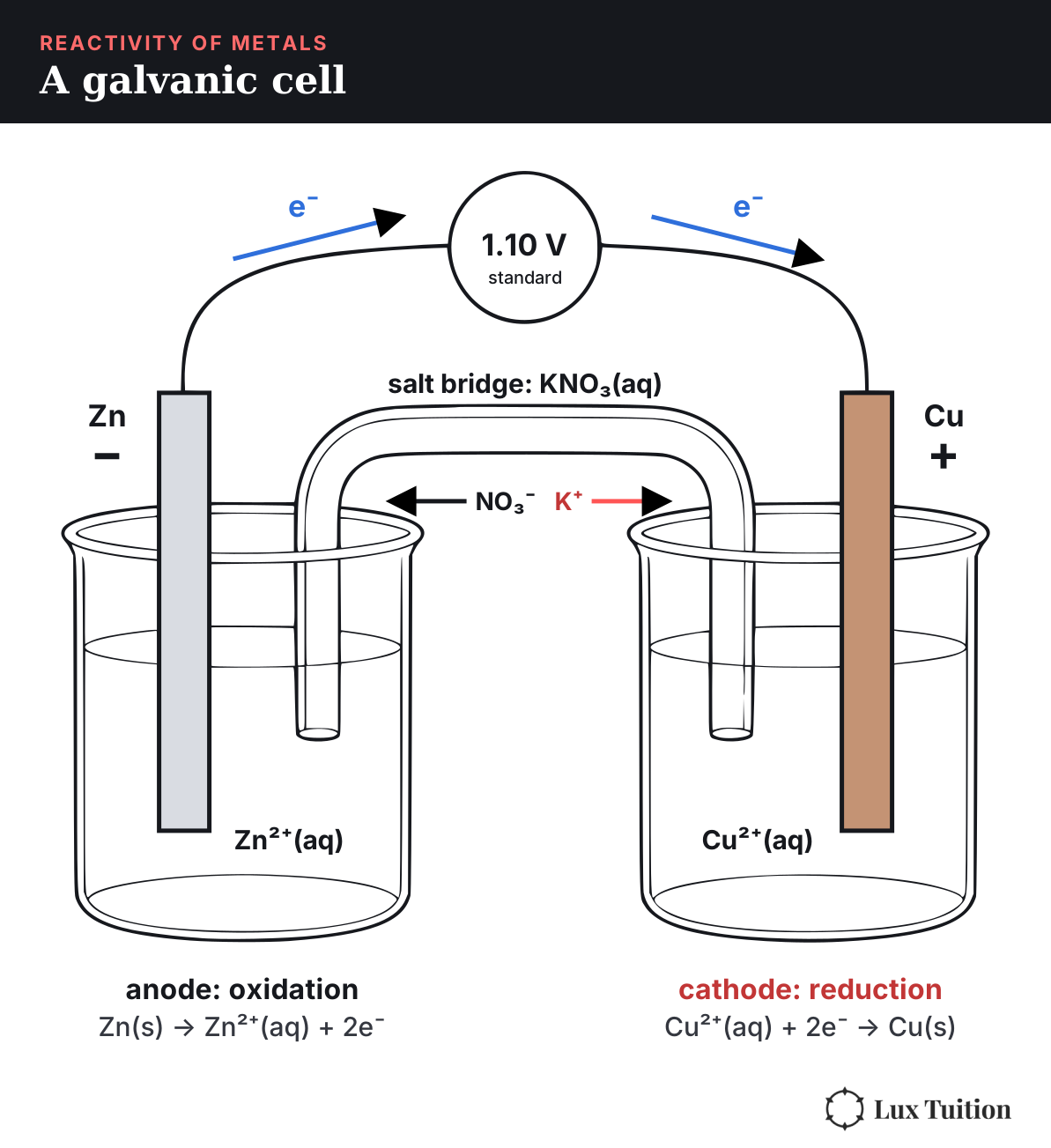
A galvanic cell (or voltaic cell) converts chemical energy into electrical energy using a spontaneous redox reaction. The trick is to separate the oxidation and the reduction into two half-cells, so the electrons have to travel through an external wire to get from one to the other. That flow of electrons is an electric current. A battery is two or more cells connected in series to produce a higher voltage.
In the classic zinc–copper cell, a zinc electrode sits in zinc sulfate solution and a copper electrode sits in copper(II) sulfate solution. The overall reaction is Zn(s) + Cu2+(aq) → Zn2+(aq) + Cu(s).
Half-cells and electrodes
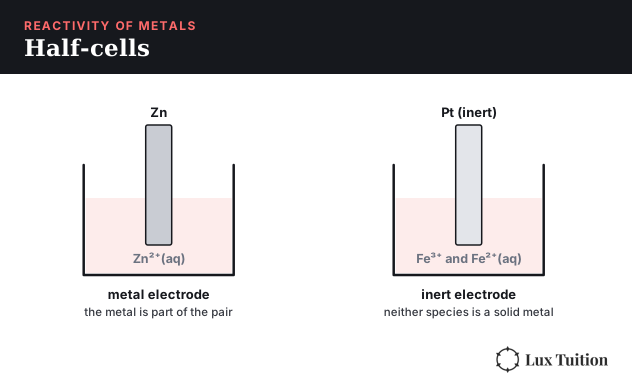
A half-cell is an electrode in contact with a solution of ions:
- If one member of the redox pair is a solid metal, that metal is the electrode, for example Zn in Zn2+(aq).
- If neither member is a solid, as in the Fe3+/Fe2+ pair, an inert electrode of platinum or graphite is used. It conducts electrons without reacting.
Measuring and comparing half-cell potentials
To compare half-cells in the lab, connect pairs of them with a salt bridge and a voltmeter, or measure each one against the same reference half-cell. The half-cell that becomes the cathode more readily has the more positive reduction potential, so ranking the voltages ranks the half-cells. Measured values usually differ a little from the data sheet, because lab solutions aren’t exactly 1 mol L−1 or 25 °C, electrodes can carry a surface oxide, and the salt bridge and wires have resistance.
Anode, cathode and electron flow
- The anode is the electrode where oxidation happens. In a galvanic cell it’s the negative electrode.
- The cathode is the electrode where reduction happens. In a galvanic cell it’s the positive electrode.
- Electrons flow through the external wire from the anode to the cathode.
The mnemonic AN OX, RED CAT helps: anode oxidation, reduction cathode. In the zinc–copper cell, zinc is the anode (it’s oxidised and the electrode gets thinner) and copper is the cathode (copper metal is deposited on it).
The salt bridge
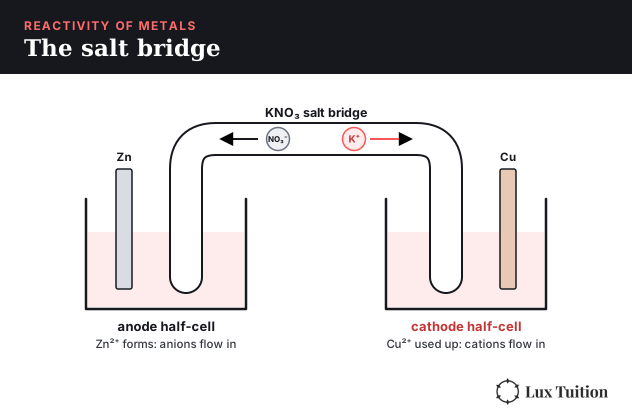
The salt bridge connects the two solutions, often as a strip of filter paper soaked in potassium nitrate or potassium chloride solution. Potassium nitrate is used when a half-cell contains Ag+ or Pb2+ ions, since chloride would precipitate them. It completes the circuit and keeps each half-cell electrically neutral:
- Anions from the salt bridge move towards the anode half-cell, balancing the positive ions being made there.
- Cations move towards the cathode half-cell, replacing the positive ions being removed there.
Without a salt bridge, charge builds up in each half-cell and the current stops almost immediately.
predict the spontaneity of redox reactions using the value of cell potentials (ACSCH079, ACSCH080)
Standard reduction potentials and the standard hydrogen electrode
The potential difference between two half-cells is the voltage that drives electrons through the external circuit. It’s measured with a voltmeter, in volts (V). To compare half-cells fairly, it’s measured under standard conditions: 25 °C, 1 mol L−1 for solutions and 100 kPa for gases. A value measured this way is written with the symbol E°.
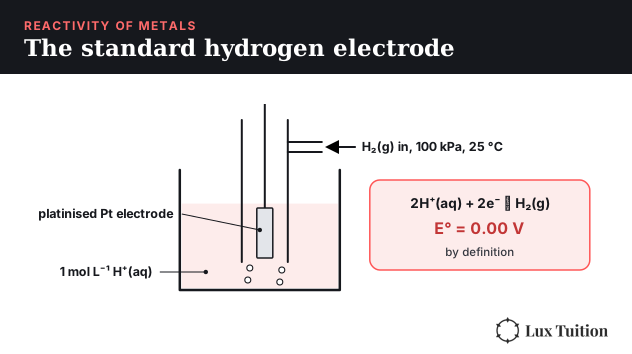
A single half-cell’s potential can’t be measured on its own, so every half-cell is measured against a reference, the standard hydrogen electrode (SHE). It’s a platinum electrode in 1 mol L−1 H+(aq), with hydrogen gas at 100 kPa bubbled over it:
2H+(aq) + 2e− ⇌ H2(g) E° = 0.00 V (by definition)
A half-cell’s standard reduction potential is its potential difference measured against the SHE. It’s positive if the half-cell acts as the cathode when paired with the SHE, and negative if it acts as the anode. It measures how strongly that half-cell’s species tends to gain electrons (be reduced) compared with H+. For example, Cu2+/Cu is +0.34 V and Zn2+/Zn is −0.76 V.
Reading the table of standard reduction potentials
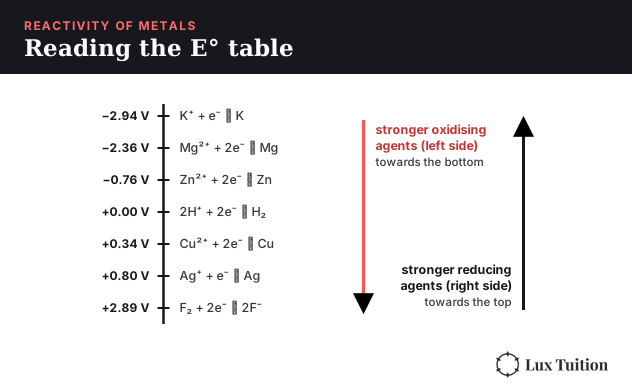
Every entry in the table is written as a reduction: oxidising agent + electrons ⇌ reducing agent. In the NSW data sheet it runs from the most negative E° at the top to the most positive at the bottom:
- At the top, with the most negative E°, the species on the right (such as K, Na and Mg) are the strongest reducing agents. These metals are the most reactive, so these half-reactions tend to run in reverse, as oxidation.
- At the bottom, with the most positive E°, the species on the left (such as F2, Cl2 and Ag+) are the strongest oxidising agents.
To predict whether a metal reacts with a solution: a metal reacts with the oxidising agent (the left-hand species) of any half-reaction that has a more positive E° than its own. As with the activity series, the most reactive metals react with water first. So zinc (−0.76 V) reacts with Cu2+ (+0.34 V), but copper doesn’t react with Zn2+.
Calculating the cell potential
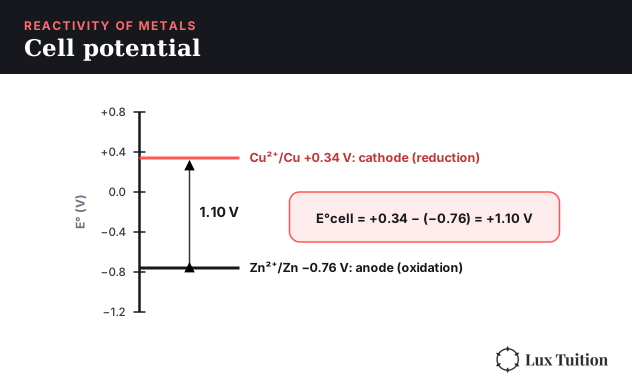
In a cell made from two half-cells, the one with the more negative E° is oxidised (the anode) and the one with the more positive E° is reduced (the cathode). The standard cell potential is:
E°cell = E°cathode − E°anode
For the zinc–copper cell, E°cell = +0.34 − (−0.76) = +1.10 V. E° values are intensive properties, so never multiply them by the coefficients used to balance the electrons.
Predicting spontaneity from E°cell
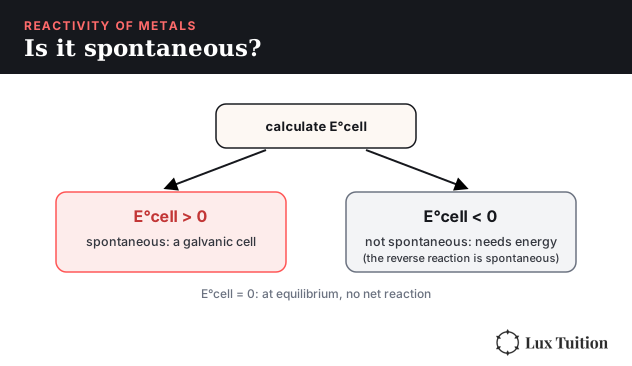
The sign of the cell potential tells you whether a redox reaction happens on its own:
- If E°cell > 0, the reaction is spontaneous, and it can be used in a galvanic cell to produce electricity. The larger E°cell is, the greater the driving force.
- If E°cell < 0, the reaction is not spontaneous. It only happens if energy is supplied, as in electrolysis. The reverse reaction is spontaneous instead.
What Affects the Rate of a Chemical Reaction?
explain a change in reaction rate using collision theory (ACSCH003, ACSCH046)
What is the rate of reaction?
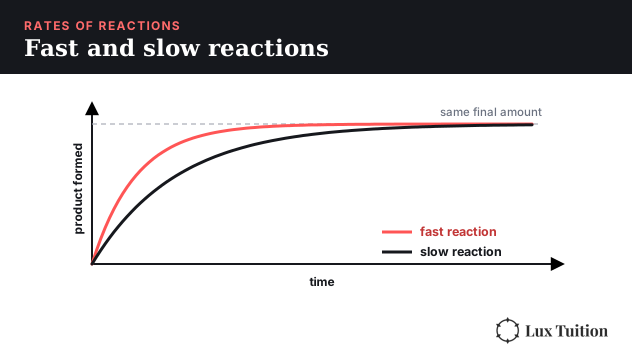
The rate of reaction is how fast reactants are used up or products are formed, measured as a change in amount (or concentration, mass or volume) per unit of time. Petrol burning and gunpowder exploding are fast reactions. Iron rusting and fruit ripening are slow ones.
Collision theory
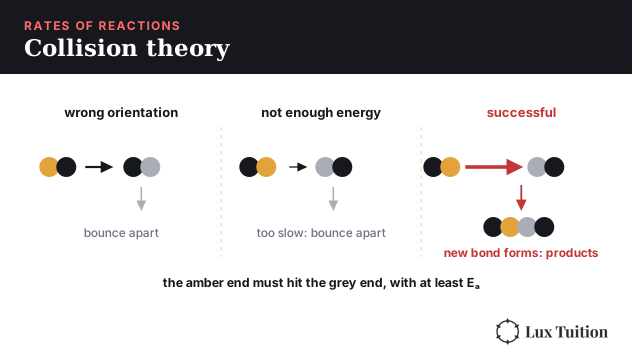
Collision theory explains why reactions happen at the rates they do. For reactant particles to react, they must collide, but most collisions don’t lead to a reaction. A collision is successful only if the particles:
- collide with enough energy, at least the activation energy, to break the existing bonds, and
- collide with the correct orientation, so the atoms that need to bond actually meet.
The rate of reaction depends on the number of successful collisions per second. Anything that increases the frequency of collisions, or the fraction that have enough energy, increases the rate.
Activation energy
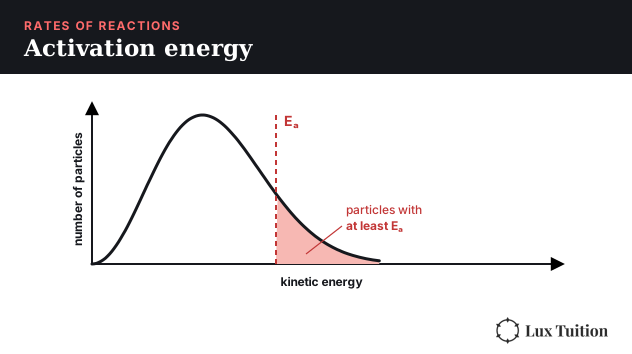
The activation energy (Ea) is the minimum energy a collision must have for a reaction to occur. It’s needed to start breaking the bonds in the reactants and reach the transition state, the unstable, highest-energy arrangement partway between reactants and products. A reaction with a small activation energy happens readily and quickly; one with a large activation energy is slow at room temperature.
Energy profile diagrams
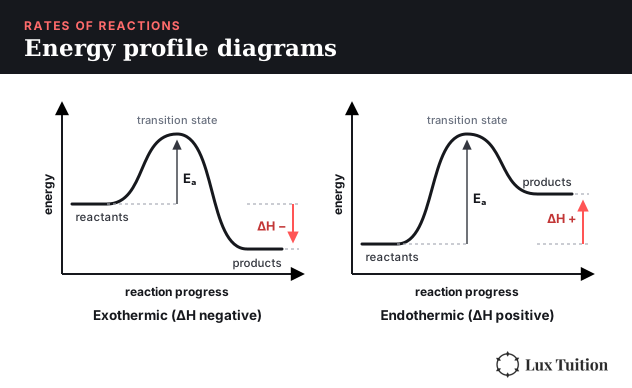
An energy profile diagram plots the energy of the reacting system against the progress of the reaction:
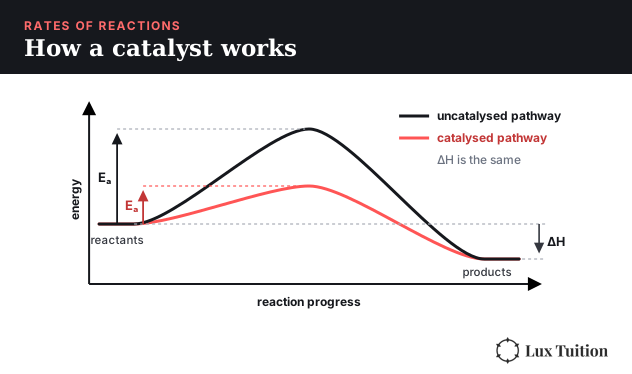
- The activation energy is measured from the reactants up to the peak (the transition state).
- ΔH, the enthalpy change, is the energy of the products minus the energy of the reactants.
- In an exothermic reaction, such as combustion, the products are lower in energy than the reactants, so ΔH is negative and energy is released to the surroundings.
- In an endothermic reaction, such as the thermal decomposition of calcium carbonate, CaCO3(s) → CaO(s) + CO2(g), the products are higher in energy than the reactants, so ΔH is positive and energy is absorbed.
Energy changes and enthalpy are covered in more depth in the Module 4 notes.
Temperature
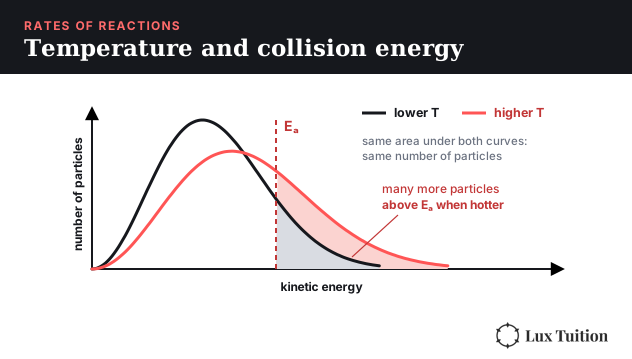
Increasing the temperature increases the rate of almost every reaction. At a higher temperature, particles have more kinetic energy and move faster, which has two effects:
- they collide more often, and
- a much larger fraction of collisions have energy equal to or greater than the activation energy.
The second effect is by far the more important one. A rise of about 10 °C can roughly double the rate of many reactions, even though the collision frequency rises by only a few per cent.
Surface area
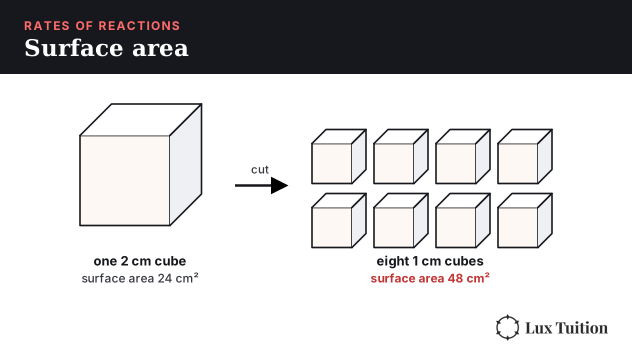
Breaking a solid into smaller pieces increases its surface area, so more particles are exposed to the other reactant. That increases the frequency of collisions, and so the rate. Powders have the highest surface area, which is why fine flour or coal dust can explode while a lump of coal burns slowly.
Concentration and pressure
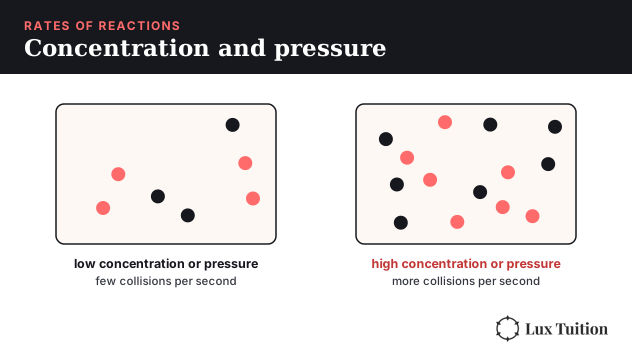
- For solutions, increasing the concentration puts more reactant particles in the same volume, so collisions happen more often and the rate increases.
- For gases, increasing the pressure has the same effect, because the particles are squeezed closer together.
Catalysts
A catalyst increases the rate of a reaction without being used up. It provides an alternative reaction pathway with a lower activation energy, so at the same temperature a much larger fraction of collisions are successful. Some catalysts also help by holding the reactant particles in the correct orientation, such as on the surface of a metal. Catalytic converters in cars use platinum, palladium and rhodium to convert carbon monoxide into carbon dioxide and reduce pollution. Enzymes are biological catalysts.
A catalyst lowers the activation energy of the forward and reverse reactions equally, and it doesn’t change ΔH.
Measuring the rate of reaction
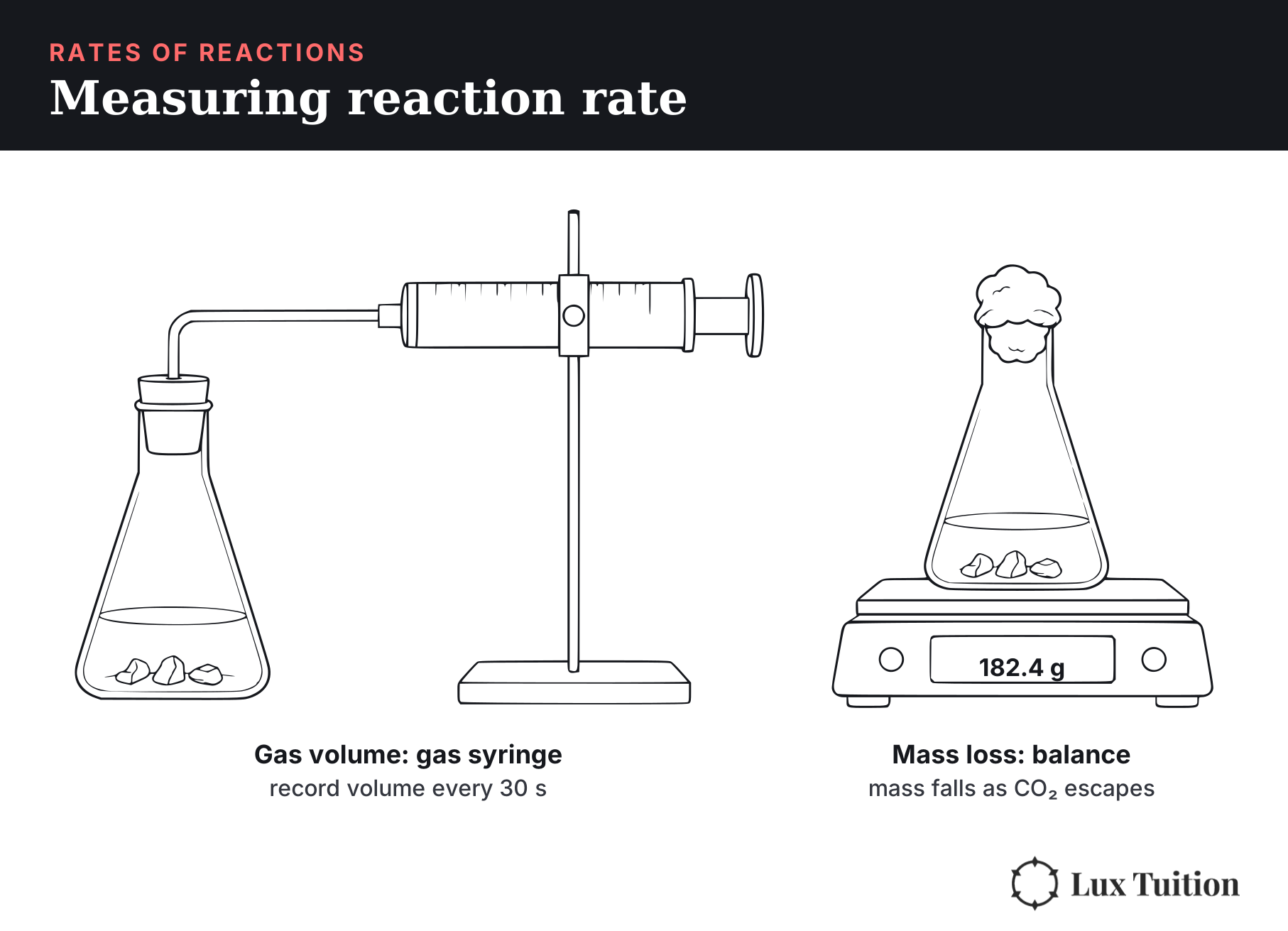
To measure a rate, track a property that changes as the reaction proceeds:
- Volume of gas produced: collect the gas in a gas syringe or an upturned measuring cylinder and record the volume at regular times, as for marble chips (CaCO3) reacting with hydrochloric acid.
- Mass loss: run the reaction in an open flask on a balance. As gas escapes, the mass falls.
- pH change: useful when an acid or base is used up or made.
- Temperature change: exothermic reactions heat up and endothermic reactions cool down.
- Colour or turbidity: for example, timing how long a precipitate takes to hide a mark under the flask.
Digital probes and data loggers connected to a computer can record many readings quickly and accurately.
Interpreting rate graphs
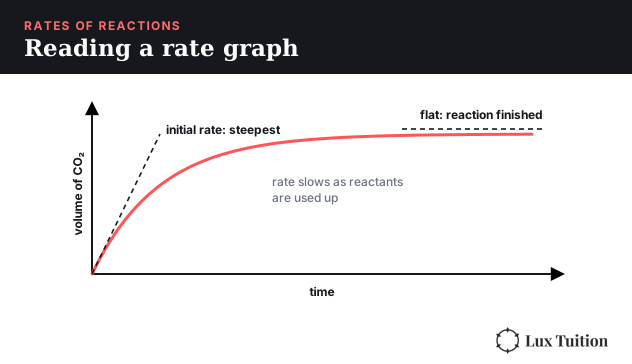
On a graph of product formed (or reactant used) against time:
- the gradient is the rate, so a steeper gradient means a faster reaction
- the initial rate, the gradient at the start, is the highest, because the reactant concentration is highest
- the rate slows as the reactants are used up, and the graph levels off when the reaction is complete.
To compare the rates of two conditions, compare their initial gradients. The final amount of product depends on the amount of limiting reagent, not the rate.
Year 11 Chemistry Module 3 Revision Summary
What Comes After Module 3 in Year 11 Chemistry?
Module 3 sets up the final Year 11 module and much of the HSC course:
- Module 4: Drivers of Reactions explains the energy changes you saw in energy profile diagrams, using enthalpy, Hess’s law and entropy to decide why reactions happen.
- In Year 12, Module 5: Equilibrium and Acid Reactions builds on rates and collision theory, and Module 6: Acid/Base Reactions extends the simple acid and base definitions used here. Our HSC Chemistry Module 5 notes and Module 6 notes pick these up.
The earlier modules are in our Year 11 Chemistry Module 1 notes and Module 2 notes. For the bigger picture, our ultimate guide to scoring Band 6 in Chemistry covers the HSC course and how to study it, and a spaced-repetition guide to Anki is a good way to memorise solubility rules and the activity series.
Year 11 Chemistry Tutoring in Blacktown
Redox and galvanic cells are where many students first get lost, because every question depends on keeping track of which species gains and which loses electrons. In our Year 11 Chemistry tutoring in Blacktown, theory is broken down by our tutors into the smallest possible parts and practised in classes of 1 to 5 students, a few minutes from Blacktown Station. Check our pricing page, or book a free trial with no obligations.
Frequently Asked Questions
What is Module 3 in Year 11 Chemistry?
Module 3 is Reactive Chemistry, the third of four Year 11 modules in the NSW Chemistry Stage 6 Syllabus. It covers the main types of chemical reactions, predicting how metals react using the activity series and standard reduction potentials, redox reactions and galvanic cells, and the factors that affect the rate of a reaction.
What is the difference between oxidation and reduction?
Oxidation is the loss of electrons, which increases a species' oxidation number. Reduction is the gain of electrons, which decreases its oxidation number. They always happen together, because the electrons lost by one species are gained by another. The mnemonic is OIL RIG: oxidation is loss, reduction is gain.
Which electrode is the anode in a galvanic cell?
The anode is the electrode where oxidation happens, and in a galvanic cell it's the negative electrode. It's the half-cell with the more negative standard reduction potential. Electrons flow through the wire from the anode to the cathode, where reduction happens.
How do you know if a redox reaction is spontaneous?
Calculate the cell potential using E°cell = E°cathode − E°anode, with values from the table of standard reduction potentials. If E°cell is positive, the reaction is spontaneous. If it's negative, the reaction won't happen on its own, but the reverse reaction will.
What are spectator ions?
Spectator ions are ions that are present in the reacting solutions but don't take part in the reaction, so they appear unchanged on both sides of the ionic equation. In the precipitation of silver iodide from silver nitrate and potassium iodide, K+ and NO3− are spectator ions and are left out of the net ionic equation.
How does a catalyst increase the rate of a reaction?
A catalyst provides an alternative pathway for the reaction with a lower activation energy. At the same temperature, a larger fraction of collisions then have enough energy to react, so the rate increases. The catalyst isn't used up, and it doesn't change the energy change (ΔH) of the reaction.
Learn it properly with a specialist tutor at Blacktown or online across NSW. Enquire about a free trial — no cost, no obligation. See online formats and class sizes.
Realistic study tips to help you prepare better for assessments with less stress, plus a printable study planner