

Module 4 asks the biggest question in Year 11 Chemistry: why do reactions happen at all? Some reactions release energy and some absorb it, some happen on their own and some never do. The answer comes from two quantities, enthalpy and entropy, and one equation that combines them. This page is part of our Year 11 Chemistry notes, which summarise all four modules in one place.
These Year 11 Chemistry Module 4 notes follow the three inquiry questions of Module 4: Drivers of Reactions in the NSW Chemistry Stage 6 Syllabus. They’re written from the lessons our tutors teach in class, and each topic opens with the exact syllabus dot point it covers. Module 4 builds on the energy profile diagrams and collision theory from the Year 11 Chemistry Module 3 notes, and on moles from Module 2.
These are theory and revision notes. We’ve left out worked examples and practice questions, and reading notes doesn’t replace the practical investigations the syllabus asks you to do in class.
Key Takeaways
- Enthalpy change (ΔH) is the heat energy absorbed or released by a reaction: negative for exothermic reactions and positive for endothermic ones.
- Calorimetry measures ΔH using q = mcΔT, and simple calorimeters usually underestimate it because heat is lost to the surroundings.
- Breaking bonds absorbs energy and forming bonds releases it; ΔH is the balance between the two.
- Hess’s law: the total enthalpy change of a reaction is the same whatever route it takes, so equations and their ΔH values can be added like algebra.
- Entropy (S) measures the number of ways particles and energy can be arranged. It increases when solids become liquids or gases, and when the number of gas particles increases.
- A reaction is spontaneous when ΔG = ΔH − TΔS is negative, so temperature can decide whether a reaction happens.
For how to study all this effectively, see how to actually understand HSC Chemistry.
What Does Year 11 Chemistry Module 4 Cover?
Module 4 is the last of four Year 11 modules in the NESA Chemistry Stage 6 Syllabus (2017). It’s organised around three inquiry questions, and these notes follow the same order:
| Syllabus section | Inquiry question |
|---|---|
| Energy Changes in Chemical Reactions | What energy changes occur in chemical reactions? |
| Enthalpy and Hess's Law | How much energy does it take to break bonds, and how much is released when bonds are formed? |
| Entropy and Gibbs Free Energy | How can enthalpy and entropy be used to explain reaction spontaneity? |
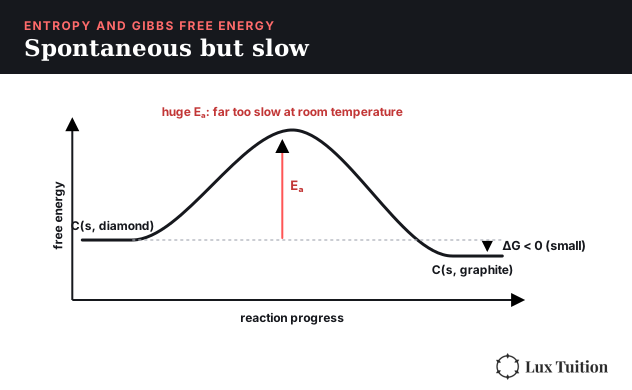
Did You Know? At room temperature and pressure, graphite is the stable form of carbon and diamond is only metastable. Diamond does turn into graphite, but so slowly (over millions to billions of years) that your ring is safe. Source: Wikipedia, Diamond
What Energy Changes Occur in Chemical Reactions?
Chemical energy and enthalpy
Every substance stores chemical energy in the bonds between its atoms and the attractions between its particles. In a reaction, old bonds break and new bonds form, so the products end up with a different amount of energy from the reactants. The difference is transferred to or from the surroundings, usually as heat.
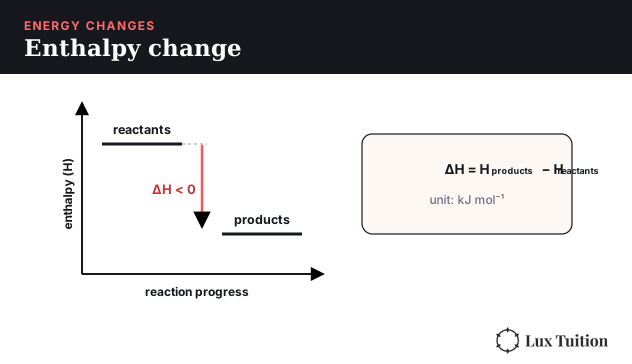
Enthalpy (H) is the total heat content of a substance or system. It can’t be measured directly, but the enthalpy change (ΔH), also called the heat of reaction, can:
ΔH = Hproducts − Hreactants
ΔH is measured in joules (J) or kilojoules (kJ), and usually quoted per mole of reaction as written, in kJ mol−1.
Exothermic and endothermic reactions
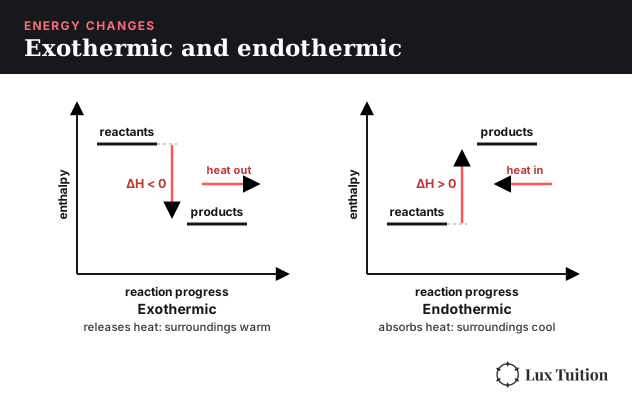
- In an exothermic reaction, the products have less enthalpy than the reactants, so ΔH is negative. Energy is released to the surroundings, and the temperature of the surroundings rises. Combustion is exothermic.
- In an endothermic reaction, the products have more enthalpy than the reactants, so ΔH is positive. Energy is absorbed from the surroundings, and the temperature of the surroundings falls. Photosynthesis and the thermal decomposition of calcium carbonate are endothermic.
The “system” is the reacting chemicals, and the “surroundings” are everything else, including the water they’re dissolved in and the thermometer. So in a beaker, an exothermic reaction feels hot and an endothermic one feels cold.
Thermochemical equations
A thermochemical equation is a balanced equation with its enthalpy change written beside it:
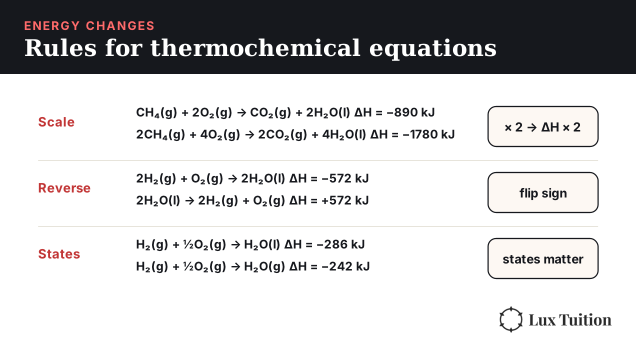
CH4(g) + 2O2(g) → CO2(g) + 2H2O(l) ΔH = −890 kJ mol−1
The ΔH applies to the mole amounts in the equation exactly as written, so three rules follow:
- Scaling: multiplying every coefficient by a number multiplies ΔH by the same number. Doubling the equation above gives ΔH = −1780 kJ.
- Reversing: writing the equation in reverse changes the sign of ΔH but not its size. If forming water releases 572 kJ, splitting the same amount of water absorbs 572 kJ.
- States matter: ΔH depends on the states of the reactants and products, because changing state involves energy too. Forming liquid water releases more energy than forming steam.
Dissolving ionic substances
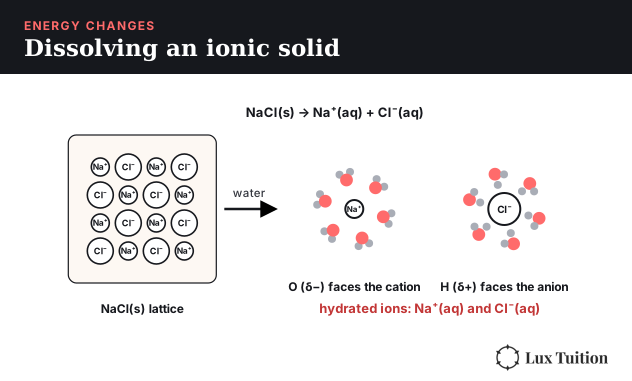
When an ionic solid dissolves, water molecules pull ions away from the lattice and surround them. The ion–dipole attractions are oriented: the partially negative oxygen ends of water molecules point towards cations, and the partially positive hydrogen ends point towards anions. The surrounded ions are called hydrated ions.
Dissolving involves two energy changes:
- Breaking the ionic lattice apart absorbs energy.
- Forming ion–dipole attractions with water releases energy.
Whichever is larger decides the overall sign. Dissolving calcium chloride is exothermic, so the solution warms up, while dissolving ammonium nitrate is endothermic, which is how instant cold packs work.
The enthalpy of solution (ΔHsoln) is the energy change per mole of solute dissolved. It’s found by measuring the temperature change of the water, calculating the heat the water gained or lost, and dividing by the moles of solute. The sign is opposite to the water’s heat change: if the water gains heat, the dissolving released it, so ΔHsoln is negative.
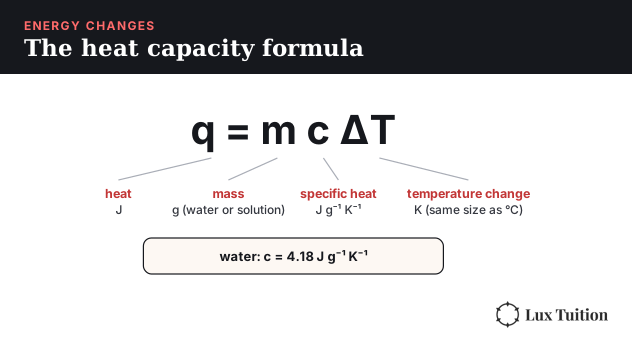
Specific heat capacity and q = mcΔT
Different substances need different amounts of energy to warm up. The specific heat capacity (c) of a substance is the energy needed to raise the temperature of 1 g of it by 1 K. For water, c = 4.18 J g−1 K−1, which is unusually high. That’s why water is used in calorimeters and hot water bottles.
The heat energy absorbed or released by a substance is:
q = mcΔT
- q is the heat energy, in joules (J)
- m is the mass of the substance being heated, in grams (g), usually the water
- c is its specific heat capacity, in J g−1 K−1
- ΔT is the temperature change, in K. A change of 1 °C is the same size as a change of 1 K, so temperature differences can be taken straight from a Celsius thermometer.
To turn q into an enthalpy change per mole, divide by the moles that reacted and give it the opposite sign to the water’s heat change:
ΔH = −q ÷ n
Convert q to kJ first so ΔH comes out in kJ mol−1. Here n is the moles of the limiting reactant (or of fuel burned), and a dilute solution is assumed to have the density and specific heat capacity of water.
Calorimetry
Calorimetry measures the heat released or absorbed by a reaction by transferring it to a known mass of water and measuring the temperature change.
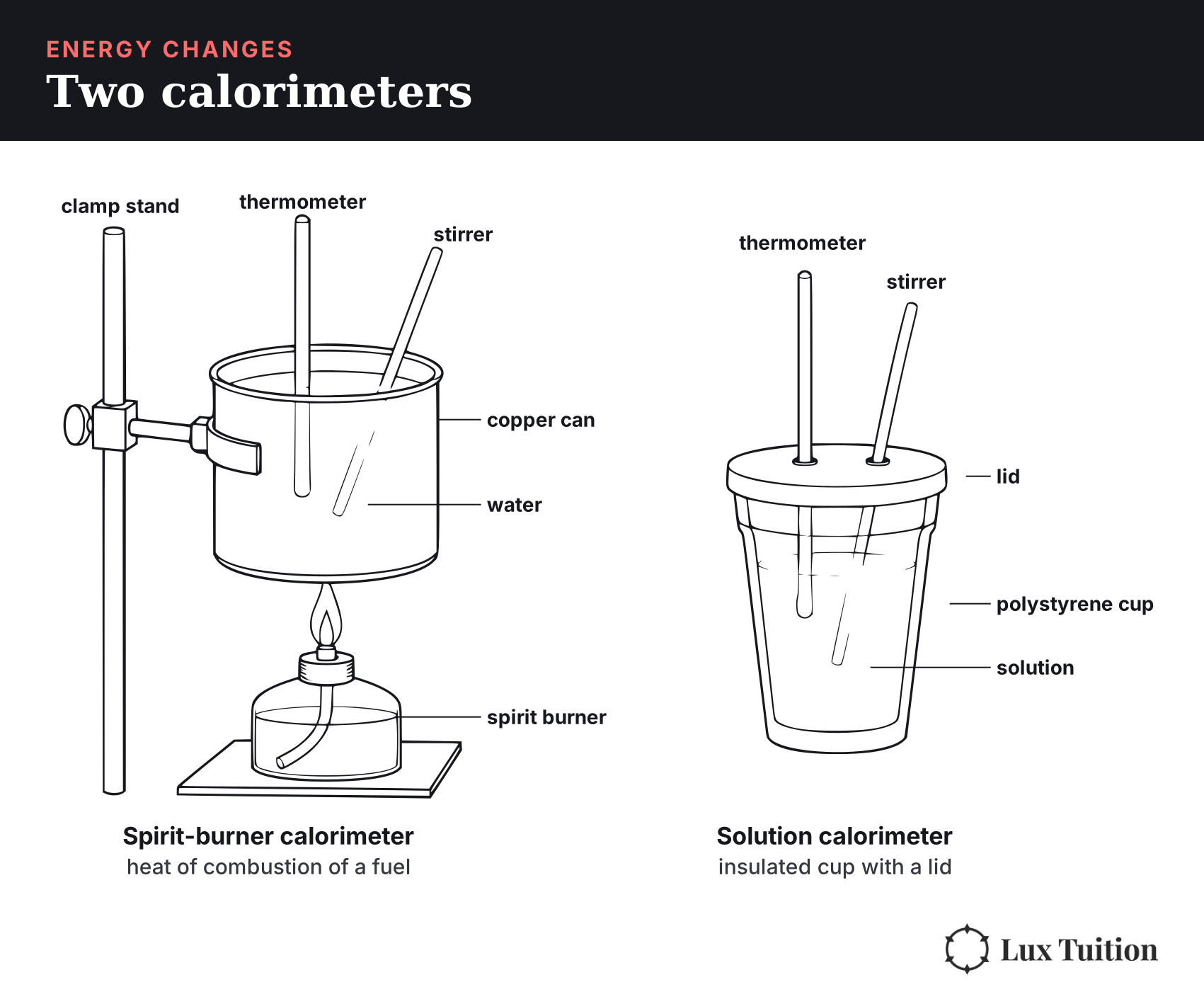
- A solution calorimeter, often an insulated polystyrene cup with a lid and a thermometer, is used for reactions in solution such as dissolving or neutralisation.
- A simple spirit-burner calorimeter is used to measure the heat of combustion of a fuel.
The heat of combustion (ΔHc) is the enthalpy change when one mole of a substance burns completely in oxygen. To measure it with a spirit burner:
- Measure the mass of water in a metal can and its starting temperature.
- Weigh the spirit burner with its fuel.
- Burn the fuel under the can, stirring the water so it heats evenly.
- Record the highest temperature the water reaches.
- Reweigh the burner to find the mass of fuel burned, and convert it to moles.
Why experimental results differ from data values
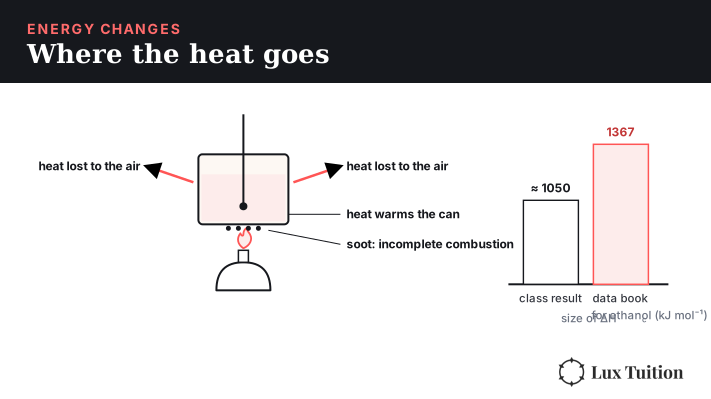
A simple calorimeter assumes that all the energy released by the fuel heats the water, which is never true. Experimental heats of combustion are usually much smaller in magnitude than the values in data tables:
| Source of error | Effect on the measured ΔHc | Improvement |
|---|---|---|
| Heat lost to the air around the can | Magnitude too small | Insulate the can, add a lid, shield from draughts |
| Heat absorbed by the can and thermometer | Magnitude too small | Include the can's heat capacity in the calculation |
| Incomplete combustion (soot on the can) | Magnitude too small | Improve the air supply |
| Fuel evaporating from the wick | Magnitude too small | Keep the burner capped when weighing |
A bomb calorimeter burns the sample in pure oxygen inside a sealed steel “bomb”, which sits in a known mass of water inside an insulated outer container, so almost all the energy is captured. Its values are the reliable secondary-sourced data that class results are compared with.
model and analyse the role of catalysts in reactions (ACSCH073)
Energy profile diagrams
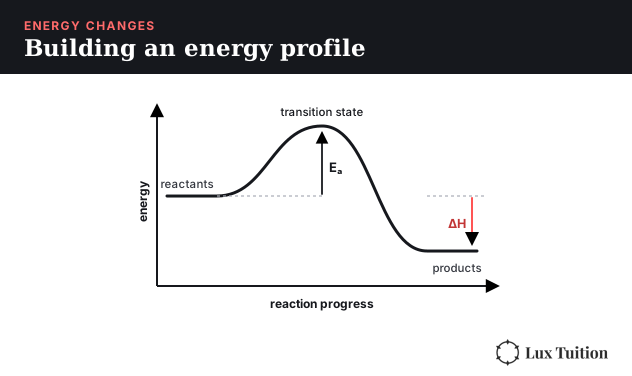
An energy profile diagram plots the enthalpy of the reacting system against the progress of the reaction. To construct one:
- Draw the reactants’ energy level on the left and the products’ energy level on the right, lower for an exothermic reaction and higher for an endothermic one.
- Join them with a curve over a peak, the transition state.
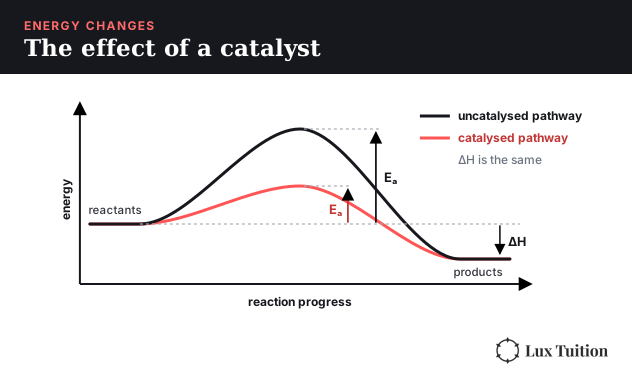
- Mark the activation energy (Ea) as the vertical gap from the reactants up to the peak.
- Mark ΔH as the vertical gap from the reactants to the products.
The activation energy decides how fast the reaction goes, while ΔH decides how much energy is released or absorbed. They’re independent: a very exothermic reaction can still be slow if its activation energy is high.
How catalysts change the energy profile
A catalyst provides an alternative reaction pathway with a lower activation energy. On an energy profile, the catalysed curve has a lower peak between the same reactant and product levels. That means:
- more collisions have enough energy to react, so the rate increases
- ΔH is unchanged, because the reactants and products are the same
- the catalyst is not consumed; it’s regenerated at the end of the reaction.
Catalysts are used in industry to make reactions fast enough at lower temperatures, which saves energy. Enzymes are the catalysts in living things.
Enthalpy of phase changes
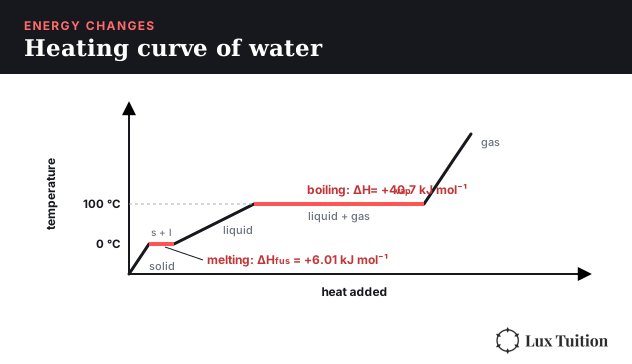
Changing state also involves an enthalpy change, even though no chemical bonds are broken. When a substance melts or boils, the heat supplied goes into overcoming intermolecular forces rather than raising the temperature. That’s why a heating curve shows flat plateaus at the melting and boiling points.
- The enthalpy of fusion (ΔHfus) is the energy needed to melt one mole of a substance. For water it’s +6.01 kJ mol−1.
- The enthalpy of vaporisation (ΔHvap) is the energy needed to vaporise one mole. For water it’s +40.7 kJ mol−1.
Both are endothermic. Vaporisation needs much more energy than fusion, because melting only loosens the particles while boiling separates them completely. The heat needed for a phase change is q = n × ΔHfus or n × ΔHvap.
How Much Energy Does It Take to Break Bonds, and How Much Is Released When Bonds Are Formed?
Breaking and forming bonds
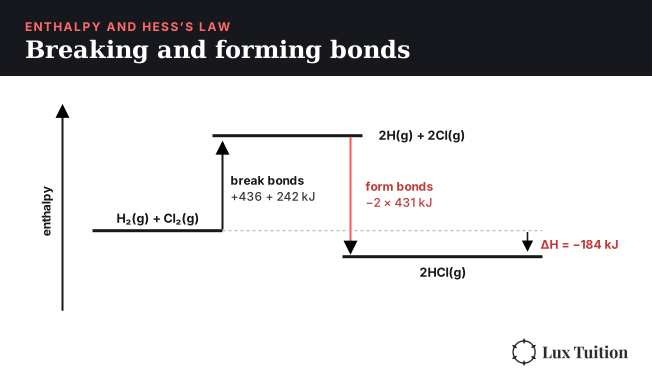
Atoms bonded together are more stable than separate atoms, so:
- breaking bonds absorbs energy (it’s endothermic)
- forming bonds releases energy (it’s exothermic).
Every reaction breaks the bonds in the reactants and forms the bonds in the products. The overall enthalpy change is the balance between the two:
- If forming the new bonds releases more energy than breaking the old ones absorbs, the reaction is exothermic.
- If breaking the old bonds absorbs more energy than forming the new ones releases, the reaction is endothermic.
This follows from the law of conservation of energy: energy can’t be created or destroyed, only transferred or transformed. Any energy not needed to break bonds is released to the surroundings, and any extra energy needed is taken from them.
Bond energy
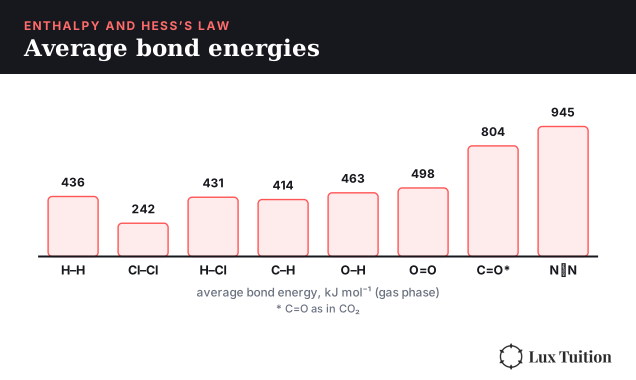
The bond energy is the energy needed to break one mole of a particular bond, with all the species in the gas phase. For example, it takes 436 kJ to break one mole of H–H bonds:
H2(g) → 2H(g) ΔH = +436 kJ mol−1
Forming one mole of the same bond releases the same amount: 2H(g) → H2(g) has ΔH = −436 kJ mol−1.
A reaction’s enthalpy change can be estimated from bond energies:
ΔH ≈ Σ(bond energies of bonds broken) − Σ(bond energies of bonds formed)
Table values are average bond energies. A C–H bond has a slightly different strength in methane than in ethanol, because its surroundings in the molecule are different. So bond-energy estimates are close to measured values but not exact.
What is Hess’s law?
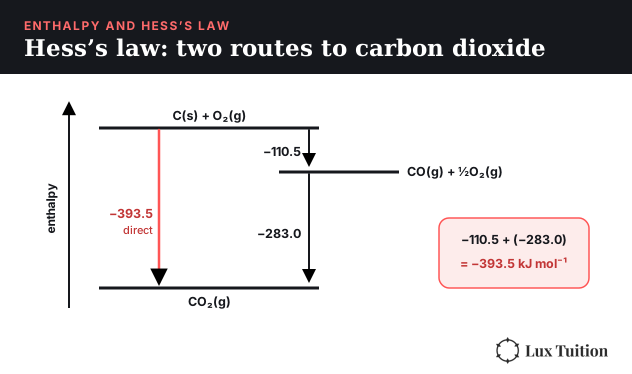
Hess’s law states that the total enthalpy change of a reaction is the same no matter what route is taken from the reactants to the products. It follows from the law of conservation of energy: if two routes gave different energy changes, energy could be created by going one way and back the other.
The syllabus example is carbon burning to form carbon dioxide. It can happen in one step:
C(s) + O2(g) → CO2(g) ΔH = −393.5 kJ mol−1
or in two steps, via carbon monoxide:
C(s) + ½O2(g) → CO(g) ΔH = −110.5 kJ mol−1 CO(g) + ½O2(g) → CO2(g) ΔH = −283.0 kJ mol−1
The two steps add up to the same overall reaction, and their ΔH values add up to the same total: −110.5 + (−283.0) = −393.5 kJ mol−1. Bond-energy estimates use the same idea: they imagine a route that breaks every reactant bond to make gaseous atoms, then forms the product bonds. This is useful because the first step can’t be measured directly, since some carbon always burns all the way to CO2. Hess’s law lets it be calculated instead.
Applying Hess’s law to energy cycles
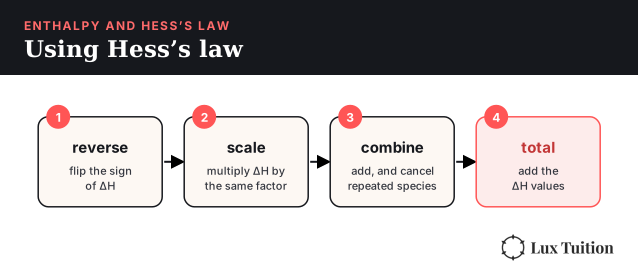
To find an unknown ΔH from a set of given equations:
- Write the target equation, with its reactants and products.
- Rearrange each given equation so its species are on the same side as in the target. Reverse an equation if needed, changing the sign of its ΔH.
- Scale each equation so the amounts match the target, multiplying its ΔH by the same factor.
- Add the equations together and cancel any species that appear on both sides.
- Add the adjusted ΔH values to get the ΔH of the target reaction.
Standard enthalpy of formation
The standard enthalpy of formation (ΔH°f) of a compound is the enthalpy change when one mole of it forms from its elements in their standard states, at 25 °C and 100 kPa. For ammonia:
½N2(g) + 1½H2(g) → NH3(g) ΔH°f = −46 kJ mol−1
By definition, ΔH°f of an element in its standard state, such as O2(g) or C(s, graphite), is zero.
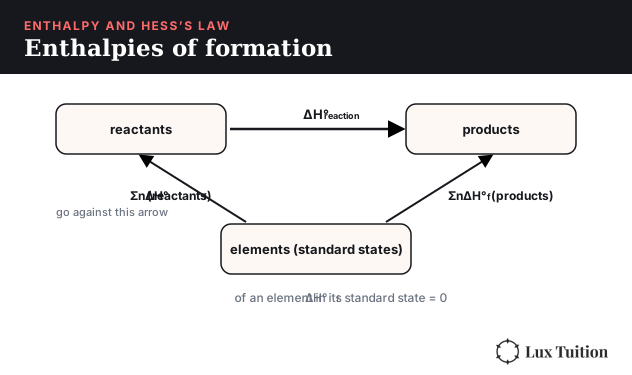
Hess’s law gives a shortcut for any reaction. Imagine breaking the reactants down into their elements (the reverse of their formation) and then forming the products from those elements:
ΔH°reaction = ΣnΔH°f(products) − ΣnΔH°f(reactants)
where n is each substance’s coefficient in the equation.
Enthalpy of photosynthesis and respiration
Photosynthesis and respiration are made of many steps, so their enthalpy changes can’t be measured directly in a calorimeter. Hess’s law gets around this using enthalpies of formation.
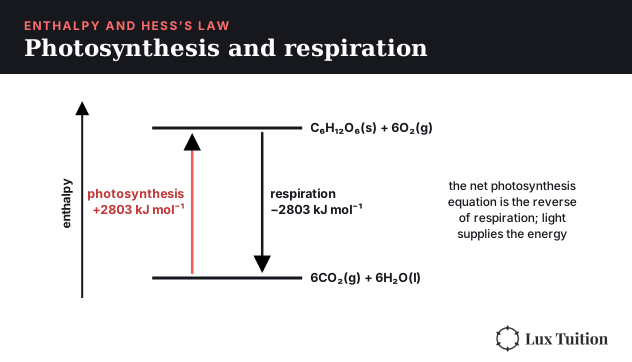
Photosynthesis uses light energy to turn carbon dioxide and water into glucose and oxygen:
6CO2(g) + 6H2O(l) → C6H12O6(s) + 6O2(g) ΔH° ≈ +2803 kJ mol−1
It’s strongly endothermic and non-spontaneous on its own: it only proceeds because it’s driven by absorbed light energy, which is stored in the bonds of glucose.
Cellular respiration is the overall reverse reaction, which releases that energy for the cell to use:
C6H12O6(s) + 6O2(g) → 6CO2(g) + 6H2O(l) ΔH° ≈ −2803 kJ mol−1
By Hess’s law, reversing a reaction reverses the sign of ΔH, so respiration releases exactly the energy photosynthesis stores. This value is also the heat of combustion of glucose, because respiration and burning glucose have the same overall equation.
How Can Enthalpy and Entropy Be Used to Explain Reaction Spontaneity?
use modelling to illustrate entropy changes in reactions
Systems and surroundings
Thermodynamics, the science of energy and entropy, splits the world in two:
- the system is the part being studied, such as the chemicals in a reaction
- the surroundings are everything else.
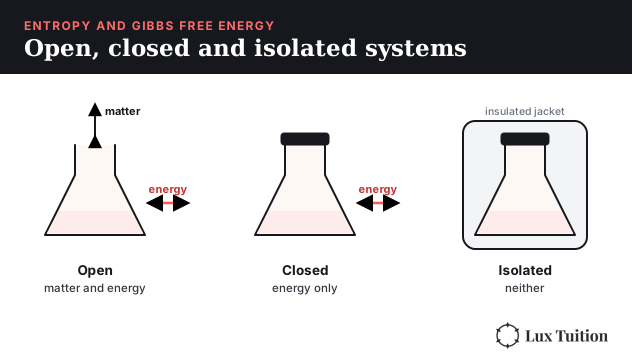
Systems are classified by what can cross their boundary:
- An open system exchanges both matter and energy with its surroundings, like an open beaker.
- A closed system exchanges energy but not matter, like a sealed flask.
- An isolated system exchanges neither, which an insulated, sealed container approximates.
What is entropy?
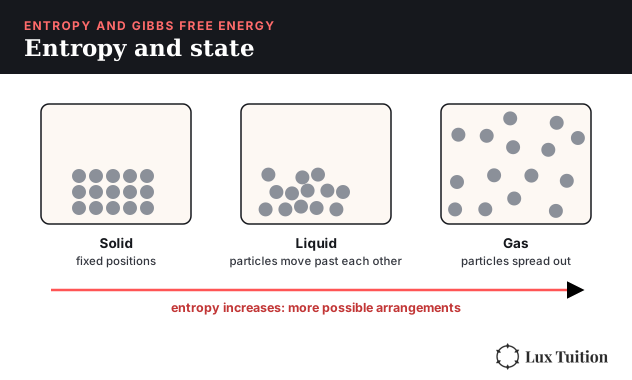
Entropy (S) is a measure of the number of possible ways the particles and energy of a system can be arranged. It’s often described as disorder: a system with more possible arrangements has higher entropy. The standard molar entropy (S°) of a substance is the entropy of one mole of it at 25 °C and 100 kPa, measured in J K−1 mol−1.
The second law of thermodynamics says the entropy of the universe always increases in a spontaneous process. Left alone, things tend towards more probable, more spread-out arrangements: gas spreads through a room, and heat flows from hot objects to cold ones. The third law says that a perfect crystal at absolute zero (0 K) has zero entropy, so absolute entropy values can be measured.
How entropy changes
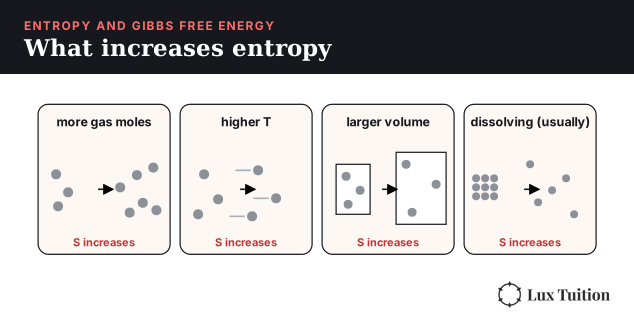
A simple model shows why. Put four particles in a box divided into two halves: there’s only one way for all four to be in the left half, but six ways to have two on each side. Give the particles more room, more energy or more freedom and the number of possible arrangements grows, so the spread-out states become far more likely. Particle diagrams like the ones below model entropy changes in reactions.
Entropy increases when particles gain more freedom to move or more possible positions:
- Change of state: S(solid) < S(liquid) < S(gas). Melting and boiling increase entropy.
- Moles of gas: more moles of gas mean more particles free to move, so higher entropy.
- Temperature: a hotter sample has more ways to distribute its energy, so higher entropy.
- Volume: a gas expanding into a larger volume has more possible positions, so its entropy increases.
- Dissolving: ions spread through a solution usually have higher entropy than the same ions locked in a crystal.
Entropy and enthalpy compared
| Enthalpy (H) | Entropy (S) | |
|---|---|---|
| What it measures | Heat energy stored in a system | Number of ways particles and energy can be arranged |
| Change | ΔH = Hproducts − Hreactants | ΔS = Sproducts − Sreactants |
| Usual units | kJ mol−1 | J K−1 mol−1 |
| Favourable sign | Negative (exothermic) | Positive (more disorder) |
The units are the most common trap: ΔH is usually in kilojoules and ΔS in joules, so one must be converted before they’re combined.
Predicting entropy changes from equations
To predict the sign of ΔS for a reaction:
- Write the state of every reactant and product.
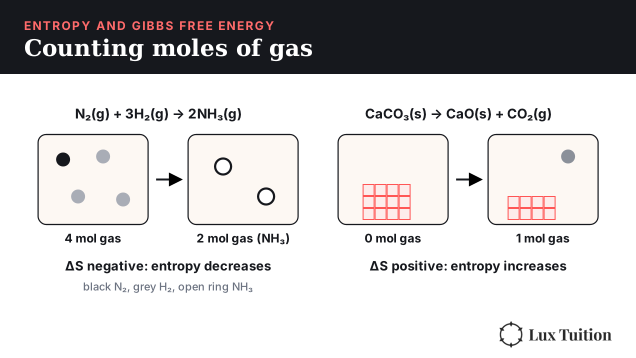
- Count the moles of gas on each side. More moles of gas in the products usually means ΔS is positive; fewer means ΔS is negative.
- If the gas count doesn’t change, compare the other states: solids turning into liquids or solutions increase entropy.
- State the sign of ΔS and justify it with the change that dominates.
For example, the synthesis of ammonia, N2(g) + 3H2(g) → 2NH3(g), turns 4 moles of gas into 2, so entropy decreases. The thermal decomposition of calcium carbonate, CaCO3(s) → CaO(s) + CO2(g), makes a gas from solids, so entropy increases.
When standard entropies are given, ΔS° can be calculated just like ΔH°:
ΔS° = ΣnS°(products) − ΣnS°(reactants)
Unlike enthalpies of formation, the standard entropies of elements are not zero.
What makes a reaction spontaneous?
A spontaneous process is one that happens on its own once started, without a continuous input of energy. Iron rusting, ice melting above 0 °C and zinc displacing copper from solution are all spontaneous.
Two factors push a reaction towards being spontaneous:
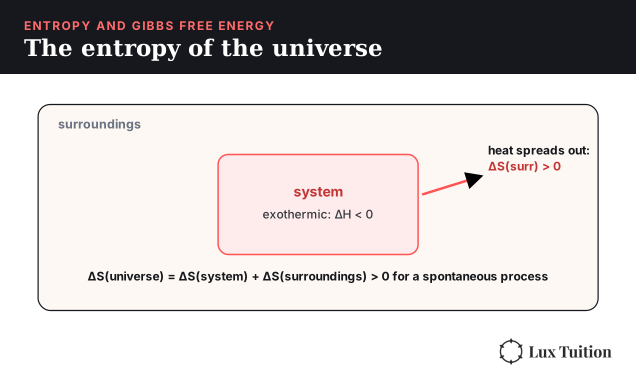
- a decrease in enthalpy (ΔH negative): exothermic reactions release energy, which spreads into the surroundings and increases their entropy (endothermic processes decrease it)
- an increase in entropy of the system (ΔS positive).
Neither factor decides on its own. Ice melting is endothermic, yet it’s spontaneous above 0 °C because the entropy increase wins. What matters is the total entropy change of the universe:
ΔSuniverse = ΔSsystem + ΔSsurroundings, where ΔSsurroundings = −ΔHsystem ÷ T
A process is spontaneous if ΔSuniverse is positive.
Gibbs free energy
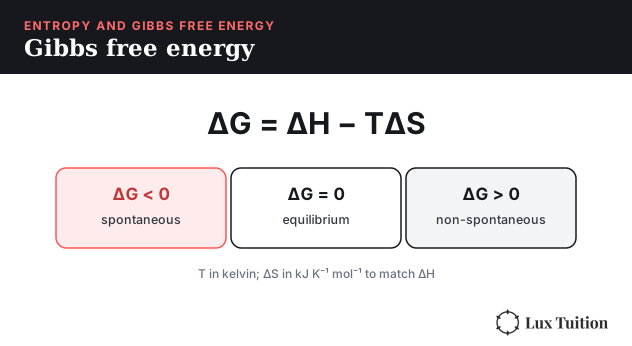
The Gibbs free energy change (ΔG) combines both factors into a single number for the system:
ΔG = ΔH − TΔS
- If ΔG < 0, the reaction is spontaneous.
- If ΔG > 0, the reaction is non-spontaneous, although the reverse reaction is spontaneous.
- If ΔG = 0, the system is at equilibrium.
A negative ΔG is the same condition as a positive ΔSuniverse, written in terms of the system alone.
predict the effect of temperature changes on spontaneity (ACSCH070)
Using ΔG° = ΔH° − TΔS°
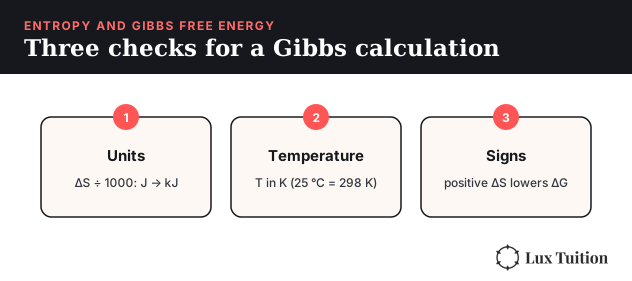
Under standard conditions, ΔG° is calculated from standard enthalpy and entropy data. Three checks avoid most errors:
- Units: convert ΔS° from J K−1 mol−1 to kJ K−1 mol−1 by dividing by 1000, so it matches ΔH° in kJ mol−1.
- Temperature: T must be in kelvin. Data tables are usually quoted at 298 K (25 °C), but use the temperature the question gives.
- Signs: keep the signs of ΔH° and ΔS°; the minus in front of TΔS° flips the sign of that term.
How temperature affects spontaneity
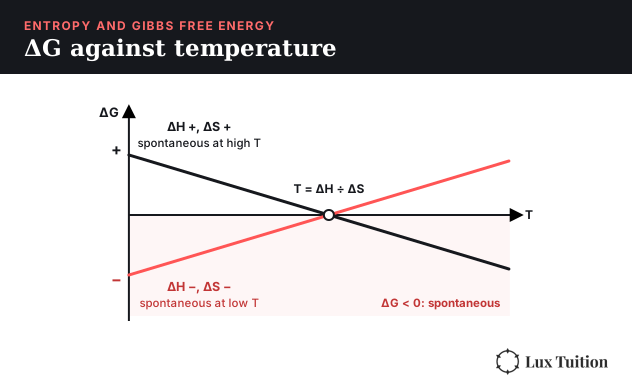
Because TΔS is multiplied by temperature, the entropy term matters more at high temperature. The signs of ΔH and ΔS give four cases:
| ΔH | ΔS | ΔG = ΔH − TΔS | Spontaneous? |
|---|---|---|---|
| Negative | Positive | Always negative | At all temperatures |
| Positive | Negative | Always positive | Never |
| Negative | Negative | Negative only when TΔS is small | At low temperatures |
| Positive | Positive | Negative only when TΔS is large | At high temperatures |
In the last two cases, the reaction switches between spontaneous and non-spontaneous at the temperature where ΔG = 0, which is T = ΔH ÷ ΔS (with both in the same energy units). Ice melting is the everyday example: ΔH and ΔS are both positive, so melting is spontaneous above 0 °C and not below it.
Spontaneous doesn’t mean fast
A negative ΔG says a reaction can happen, but not how quickly. Spontaneity is thermodynamics; speed is kinetics, controlled by the activation energy. Diamond turning into graphite has a negative ΔG° at room temperature, but its activation energy is so large that the change is effectively zero. Likewise, petrol and oxygen react spontaneously but need a spark to get past the activation energy barrier.
Year 11 Chemistry Module 4 Revision Summary
What Comes After Module 4 in Year 11 Chemistry?
Module 4 finishes the Year 11 course, and its ideas run right through Year 12:
- Module 5: Equilibrium and Acid Reactions uses enthalpy, entropy and collision theory to explain why reactions reach equilibrium and how temperature shifts it.
- Module 6: Acid/Base Reactions measures the enthalpy of neutralisation with the same calorimetry methods.
- Module 7: Organic Chemistry measures and compares the heats of combustion of alcohols with the same calorimetry methods.
The earlier Year 11 modules are in our Module 1, Module 2 and Module 3 notes. For the bigger picture, our ultimate guide to scoring Band 6 in Chemistry covers the HSC course and how to study it, and a spaced-repetition guide to Anki is a good way to memorise the sign rules for ΔH, ΔS and ΔG.
Year 11 Chemistry Tutoring in Blacktown
Module 4 is heavy on calculations where a single sign or unit error costs the whole answer. In our Year 11 Chemistry tutoring in Blacktown, theory is broken down by our tutors into the smallest possible parts and practised in classes of 1 to 5 students, a few minutes from Blacktown Station. Check our pricing page, or book a free trial with no obligations.
Frequently Asked Questions
What is Module 4 in Year 11 Chemistry?
Module 4 is Drivers of Reactions, the last of four Year 11 modules in the NSW Chemistry Stage 6 Syllabus. It covers energy changes in reactions and calorimetry, bond energies and Hess's law, and how entropy and Gibbs free energy decide whether a reaction is spontaneous.
What is the difference between enthalpy and entropy?
Enthalpy is the heat energy stored in a system, and its change, ΔH, tells you whether a reaction releases or absorbs heat. Entropy measures how many ways the particles and energy can be arranged, and its change, ΔS, tells you whether a reaction becomes more or less disordered. Enthalpy is usually given in kJ mol−1 and entropy in J K−1 mol−1.
Why is a calorimetry result usually lower than the data book value?
A simple calorimeter assumes all the heat from the reaction goes into the water. In practice, heat escapes to the air, warms the container and thermometer, and some fuel burns incompletely, so the measured temperature rise is too small and the calculated ΔH is smaller in magnitude than the reliable value.
What does Hess's law state?
Hess's law states that the enthalpy change of a reaction is the same whatever route is taken from reactants to products. It follows from the law of conservation of energy, and it lets you calculate enthalpy changes that can't be measured directly by adding the ΔH values of other reactions.
How do you know if a reaction is spontaneous?
Calculate ΔG = ΔH − TΔS, with ΔS converted to kJ and T in kelvin. If ΔG is negative, the reaction is spontaneous at that temperature; if it's positive, it isn't. A spontaneous reaction can still be very slow if its activation energy is high.
Is breaking a bond exothermic or endothermic?
Breaking a bond is always endothermic, because energy must be absorbed to pull bonded atoms apart. Forming a bond is always exothermic. A reaction is exothermic overall when the bonds formed release more energy than the bonds broken absorb.
Learn it properly with a specialist tutor at Blacktown or online across NSW. Enquire about a free trial — no cost, no obligation. See online formats and class sizes.
Realistic study tips to help you prepare better for assessments with less stress, plus a printable study planner