
Organic chemistry is the study of building powerful molecules that have revolutionised society. Before antibiotics, a scratch or a sore throat could turn fatal, and infection after childbirth killed many mothers. The sulfonamide drugs of the mid-1930s and penicillin, discovered by Alexander Fleming in 1928 and mass produced during the Second World War, made those infections routinely treatable and, with better medical care, drastically cut deaths from childbirth and disease. Aspirin, first made in 1897 by chemists at the German firm Bayer and sold from 1899, became one of the most widely used medicines in the world for pain, fever and inflammation, and in low doses it helps prevent heart attacks and strokes in people at risk. The plastics in medical equipment, the fibres in our clothes and the fuels that move us are organic molecules too, and so are the building blocks of the mRNA vaccines given in billions of doses during the COVID-19 pandemic. This page is part of our HSC Chemistry notes, which summarise all four Year 12 modules in one place.
These HSC Chemistry Module 7 notes follow the six inquiry questions of Module 7: Organic Chemistry in the NSW Chemistry Stage 6 Syllabus. They’re written from the lessons our tutors teach in class, and each topic opens with the exact syllabus dot point it covers. Module 7 relies on the bonding and intermolecular forces from our Year 11 Chemistry Module 1 notes and the acid/base ideas from our HSC Chemistry Module 6 notes.
These are theory and revision notes. Reading notes doesn’t replace the practical investigations the syllabus asks you to do in class.
Key Takeaways
- Organic chemistry is carbon chemistry. Carbon forms four bonds, including double and triple bonds, so it can build chains, branches and rings.
- IUPAC names (from the International Union of Pure and Applied Chemistry) are built from the longest chain (meth-, eth-, prop-, but-…), a suffix for the functional group (the reactive part of the molecule; -ane, -ene, -yne, -ol, -al, -one, -oic acid, -amine, -amide) and numbered branches.
- Structural isomers share a molecular formula but differ in their chain, the position of a group, or the functional group itself.
- Alkenes undergo addition reactions (with H₂, X₂, HX and H₂O); alkanes undergo substitution with halogens in UV light.
- Alcohols combust, dehydrate to alkenes, substitute with HX and oxidise: primary alcohols (1°, where the carbon holding the –OH is bonded to one other carbon) to aldehydes then carboxylic acids, secondary alcohols to ketones. Oxidation here means gaining bonds to oxygen. (Primary, secondary and tertiary are defined in the naming section.)
- Esters form from a carboxylic acid and an alcohol with a concentrated sulfuric acid catalyst (it speeds up the reaction without being used up), heated under reflux (boiled with a condenser on top so the vapour drips back).
- Addition polymers (PE, PVC, PS, PTFE) form from alkene monomers (small molecules that join to make the polymer); condensation polymers (nylon, polyesters) release a small molecule such as water each time a link forms.
For how to study all this effectively, see how to actually understand HSC Chemistry.
What Does HSC Chemistry Module 7 Cover?
Module 7 is the third of four Year 12 modules in the NESA Chemistry Stage 6 Syllabus (2017). It’s organised around six inquiry questions, and these notes follow the same order:
| Syllabus section | Inquiry question |
|---|---|
| Nomenclature | How do we systematically name organic chemical compounds? |
| Hydrocarbons | How can hydrocarbons be classified based on their structure and reactivity? |
| Products of Reactions Involving Hydrocarbons | What are the products of reactions of hydrocarbons and how do they react? |
| Alcohols | How can alcohols be produced and what are their properties? |
| Reactions of Organic Acids and Bases | What are the properties of organic acids and bases? |
| Polymers | What are the properties and uses of polymers? |
How Do We Systematically Name Organic Chemical Compounds?
Organic chemistry is carbon chemistry
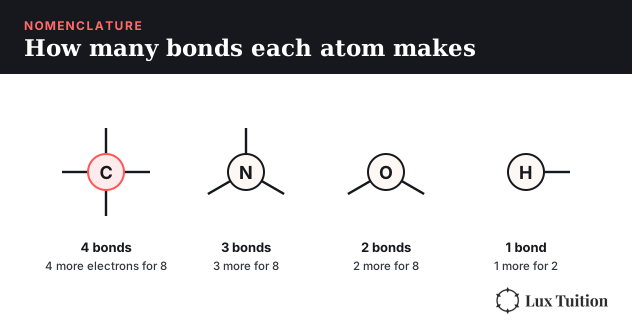
H, C, N and O are the most common elements in organic chemistry. H needs its outer shell to have 2 electrons in total to be stable, while C, N and O need 8. They get there by sharing electrons in covalent bonds, where each bond is a pair of electrons shared between two atoms. That sets how many bonds each one makes:
- Carbons must have four bonds
- Hydrogens must have one bond
- Oxygens must have two bonds
- Nitrogens must have three bonds when neutral (four bonds when it carries a + charge, as in the methylammonium ion drawn in Module 7 Figure 53)
Atoms can share more than one pair with the same neighbour:
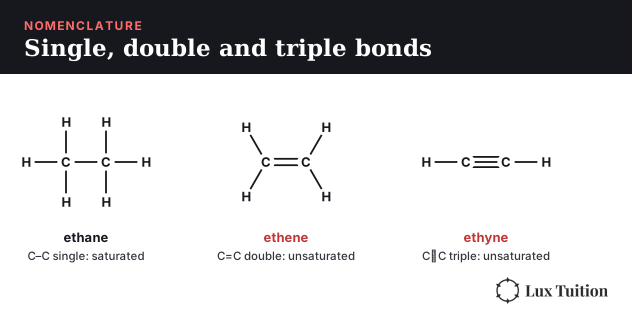
- A single bond shares one pair of electrons and is drawn as one line, C–C.
- A double bond shares two pairs and is drawn as two lines, C=C.
- A triple bond shares three pairs and is drawn as three lines, C≡C.
Each line counts towards an atom’s total, so a carbon with a double bond has room for only two more bonds (lines), and a carbon with a triple bond for only one more. Because carbon can form so many stable bonds, including to other carbons, it is the “backbone” of organic chemistry.
How to draw organic molecules
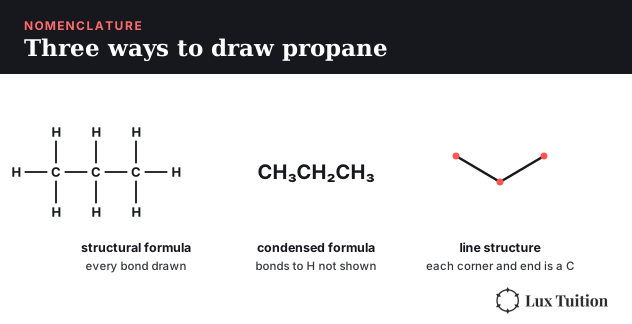
Consider propane (C3H8). There are three common ways to draw it:
- Structural formula: all bonds are drawn out, and lines represent shared pairs of electrons.
- Condensed formula: CH3CH2CH3. The bonds to hydrogen aren’t shown.
- Line (skeletal) structure: carbon–hydrogen bonds aren’t shown, and each carbon–carbon bond is drawn with a zig-zag angle. Every unlabelled corner and line end is a carbon; heteroatoms (atoms other than C and H, such as O, N and Cl) are written explicitly.
Saturated and unsaturated hydrocarbons
Hydrocarbons are compounds made of only carbon and hydrogen. Single bonds are less reactive than double or triple bonds, and hydrocarbons with only single bonds are classified as saturated. Hydrocarbons with double or triple bonds are unsaturated. They’re more reactive, which makes them more useful for certain applications: ethylene (ethene) is used to make polyethylene, the plastic in food packaging, water pipes and medical tubing.
How to name simple hydrocarbons
Historically, chemicals were discovered at different times and known by many names: mercury, quicksilver and hydrargyrum all refer to the same element. IUPAC is an international chemistry organisation that set a systematic way of naming organic molecules, so the precise structure can be worked out just from the name. Common names often differ from IUPAC names because IUPAC was only founded in 1919, and many chemicals were in use before that. Chemists still say ethylene (IUPAC: ethene) and formic acid (IUPAC: methanoic acid). Even water has a systematic name, oxidane, but nobody says oxidane, and familiar names like water stay in everyday use.
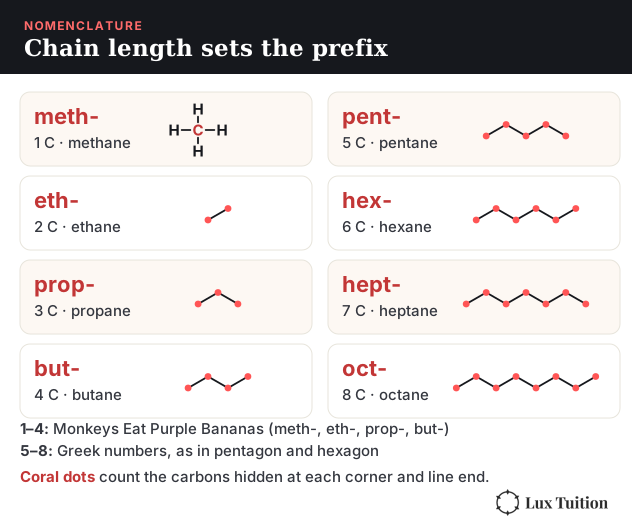
For saturated molecules, the name is based on the length of the carbon chain, with -ane on the end. In methane, “meth” tells us there is one carbon, and “ane” tells us there are only single bonds. For 1 to 4 carbons, remember “Monkeys Eat Purple Bananas”: meth-, eth-, prop-, but-. From 5 carbons, the prefixes are Greek number prefixes, like the shapes pentagon and hexagon: pent-, hex-, hept-, oct-.
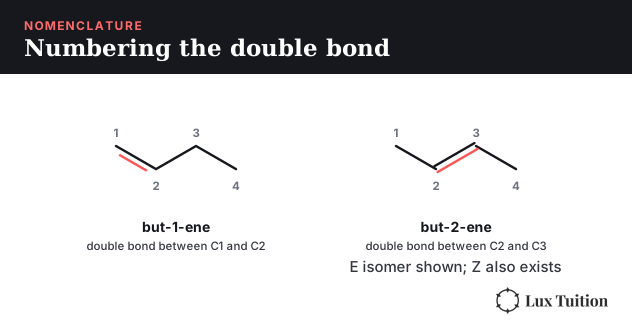
If there is a carbon–carbon double bond, the ending becomes -ene (ethene, propene); a triple bond gives -yne (ethyne, propyne). From four carbons up, the position of the multiple bond matters. Butene could be either of two molecules, so we number the carbons so that the double bond gets the lowest number possible, and put that number before the suffix with hyphens: but-1-ene or but-2-ene (1-butene and 2-butene are also accepted).
How to name compounds with functional groups and branches
A functional group is the atom or group of atoms that gives a molecule its characteristic reactions.
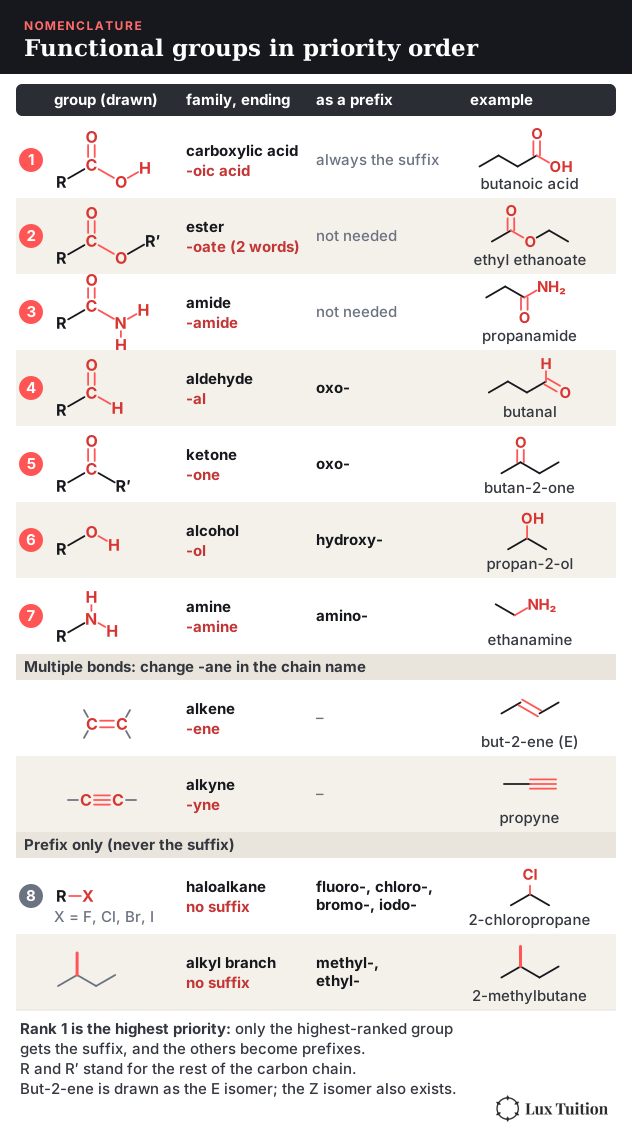
The main functional groups in this module are:
- Alkenes (C=C) and alkynes (C≡C).
- Haloalkanes, with a halogen (F, Cl, Br or I) in place of a hydrogen.
- Alcohols, with an –OH (hydroxyl) group.
- Aldehydes and ketones, both with a C=O (carbonyl) group: at the end of the chain in an aldehyde, in the middle in a ketone (both drawn in Module 7 Figure 7).
- Carboxylic acids, with a C=O and an –OH on the same end carbon (the carboxyl group).
- Esters, with a C=O bonded to an O that links to a second carbon chain (the ester group), formed from an acid and an alcohol (see esterification below).
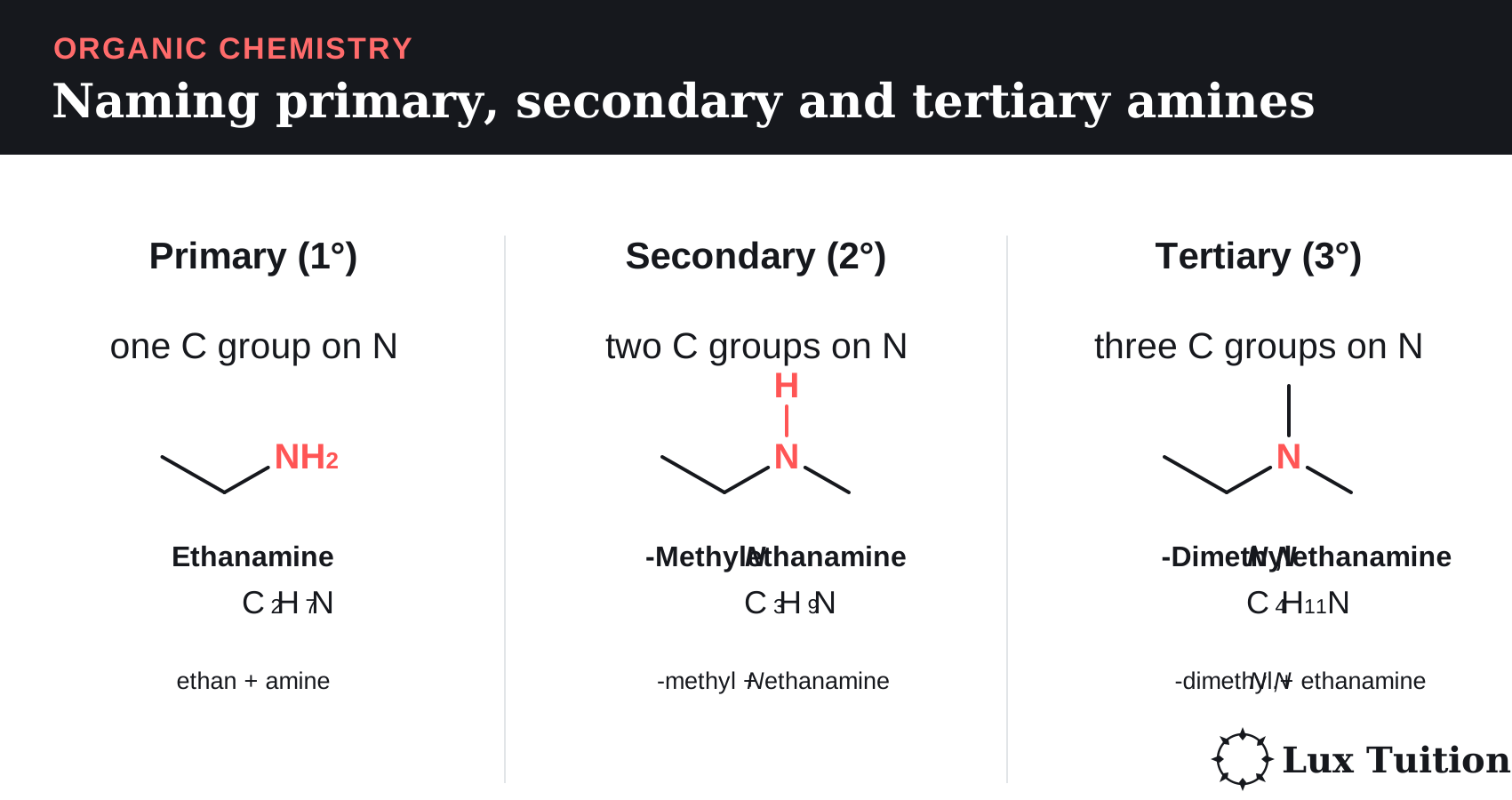
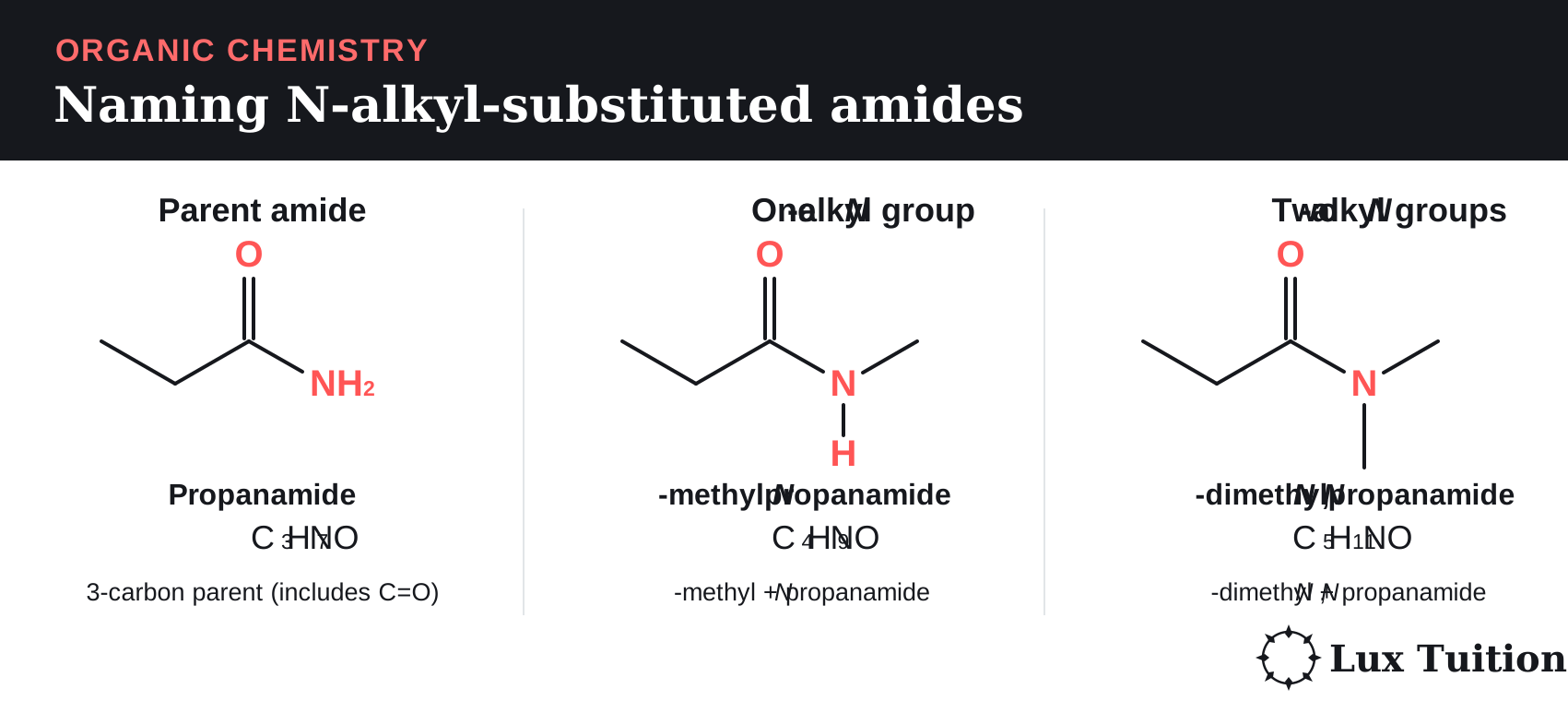
- Amines, with a nitrogen bonded to carbon (–NH2 for primary amines), and amides, with a C=O bonded to nitrogen (with an –NH2 on the carbonyl carbon for primary amides).
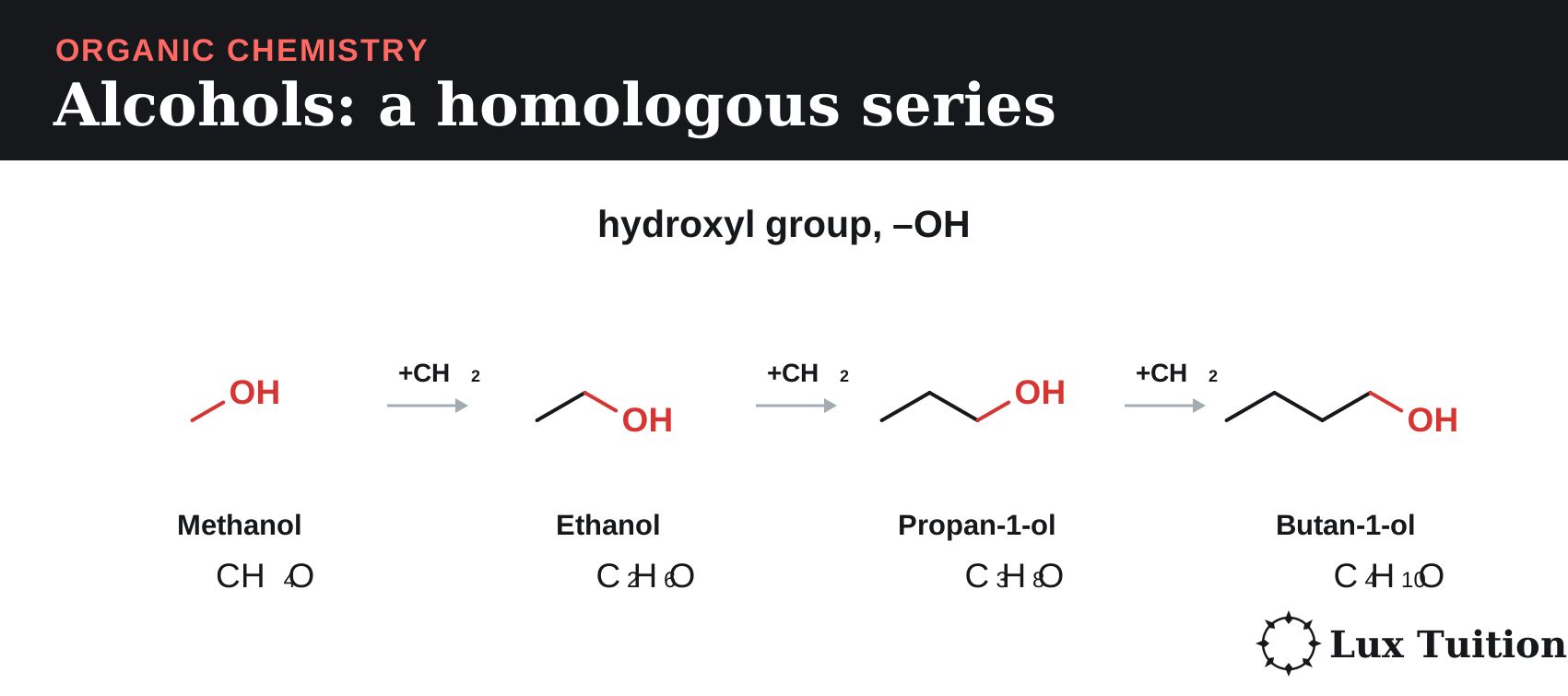
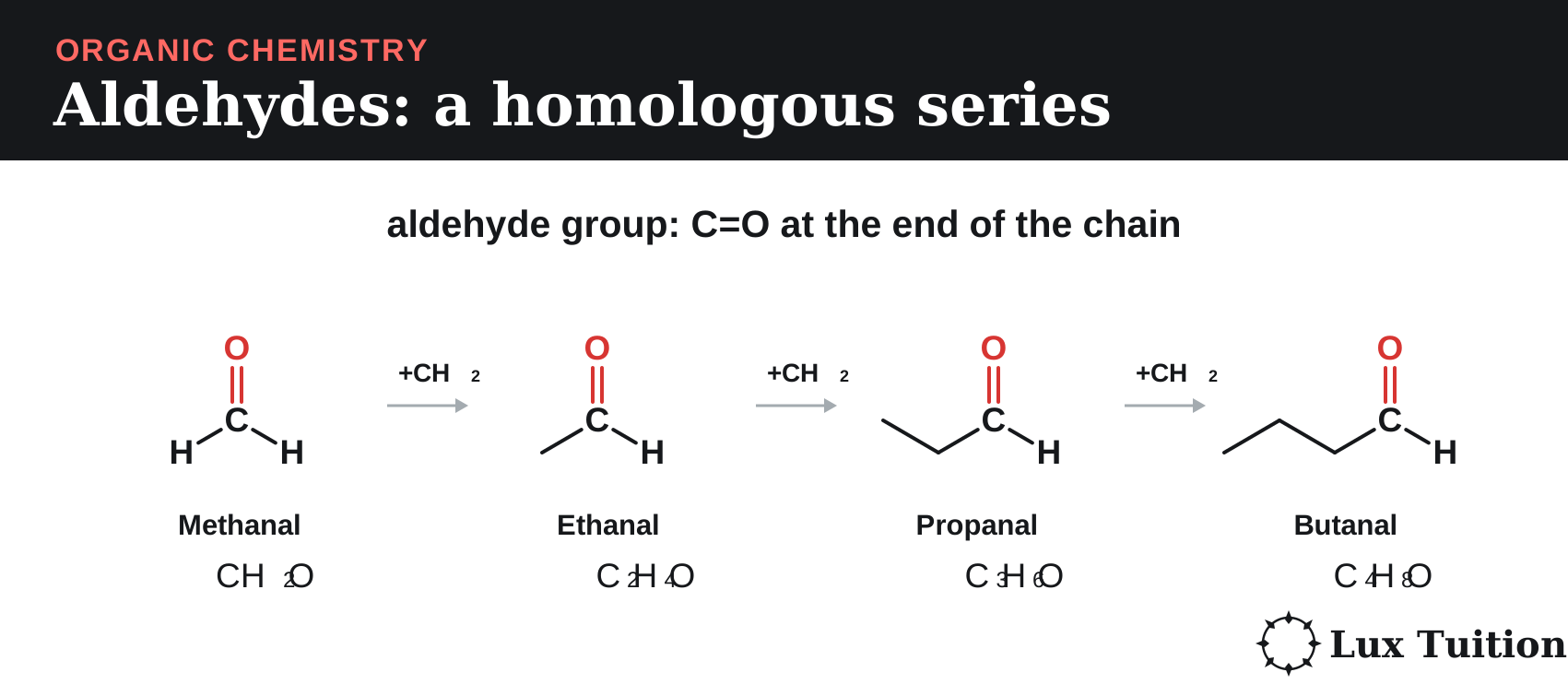
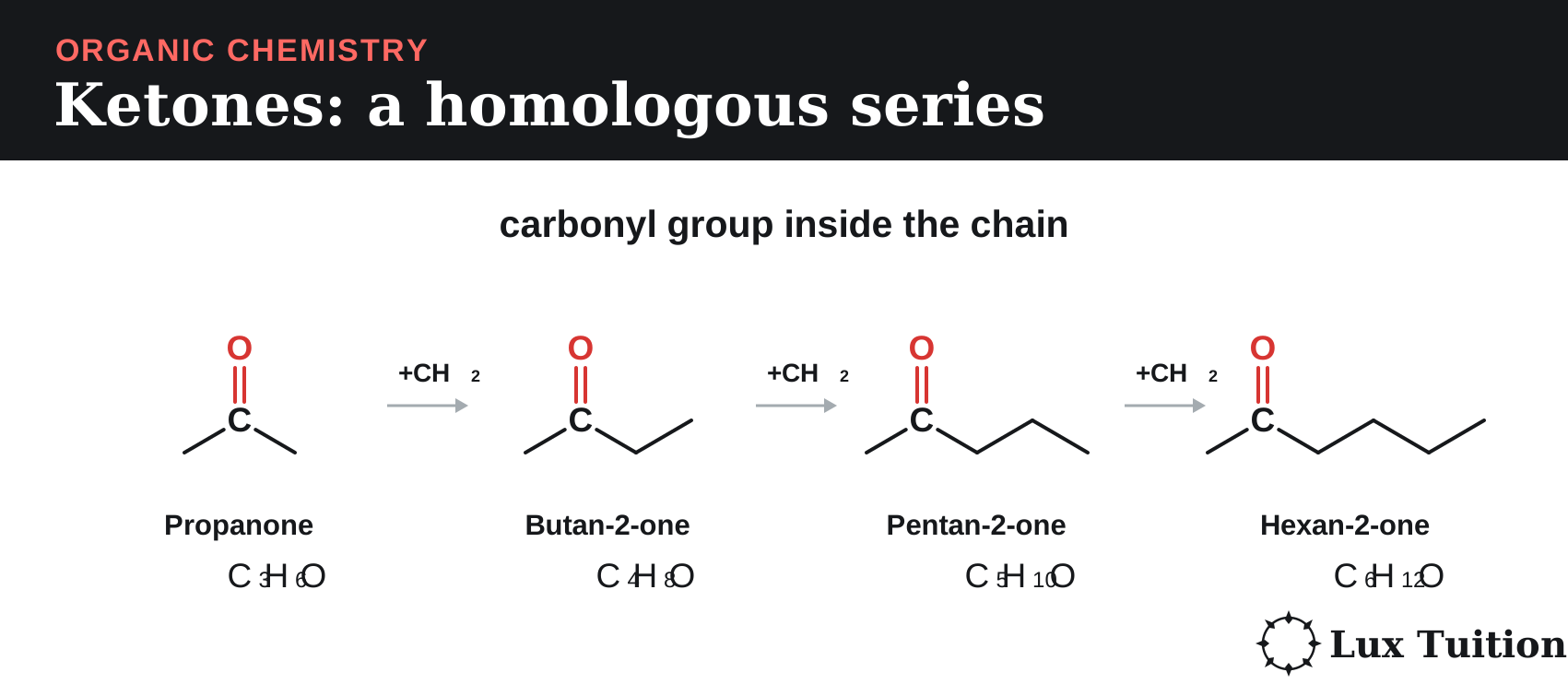
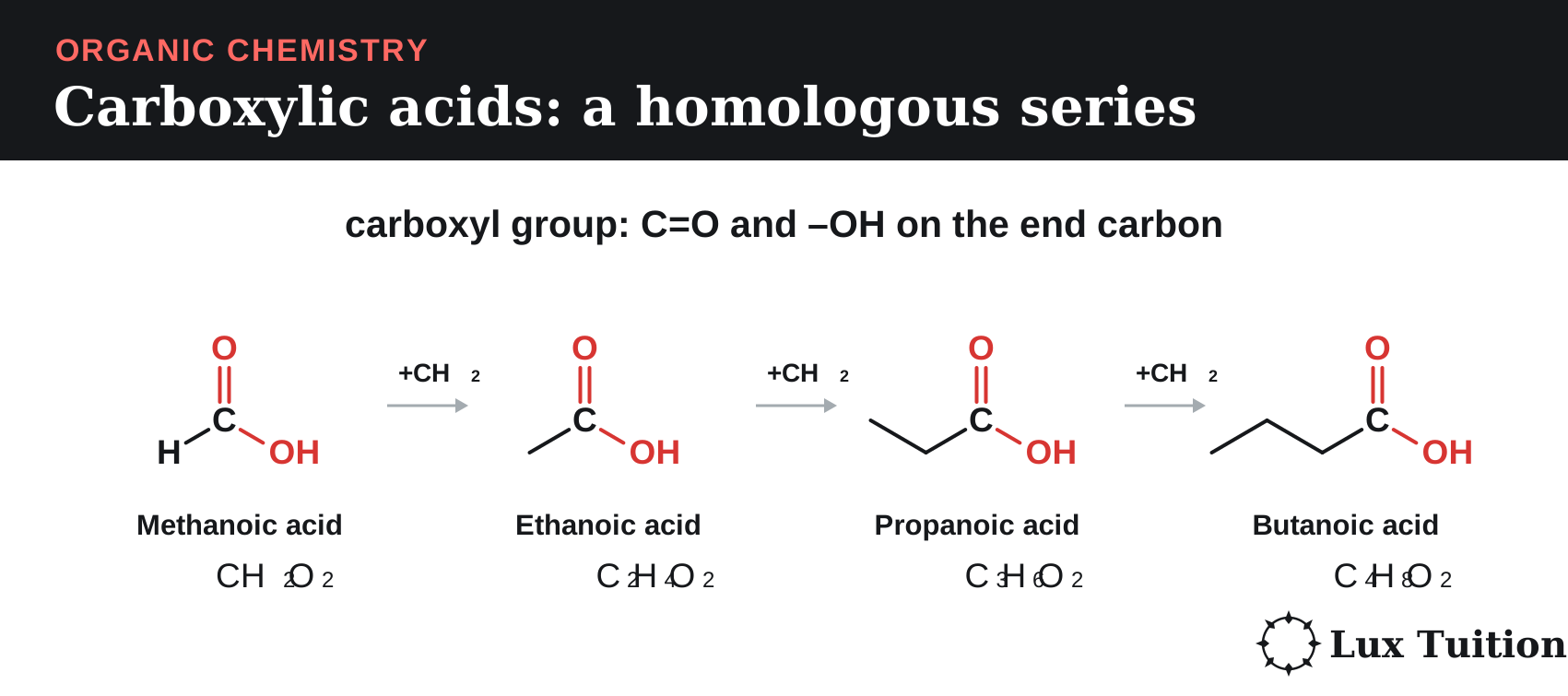
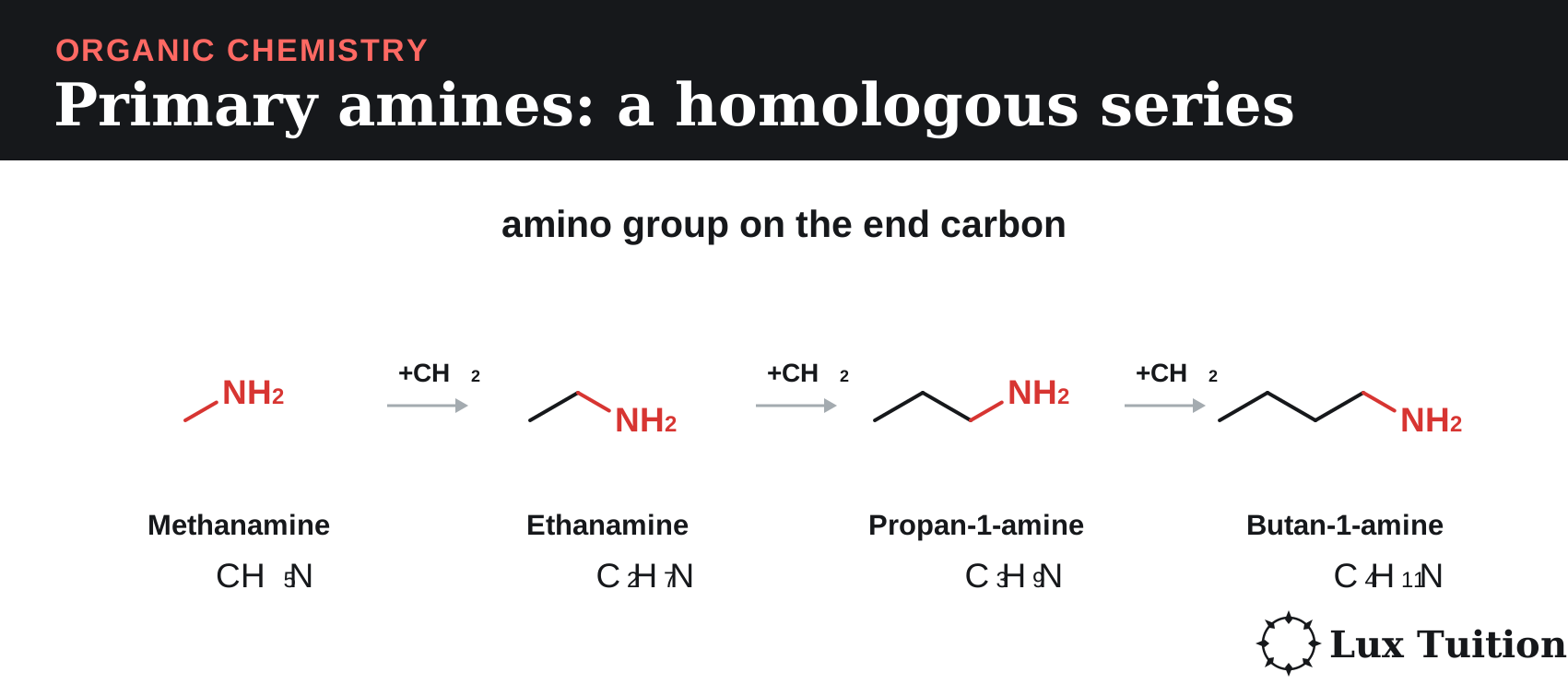
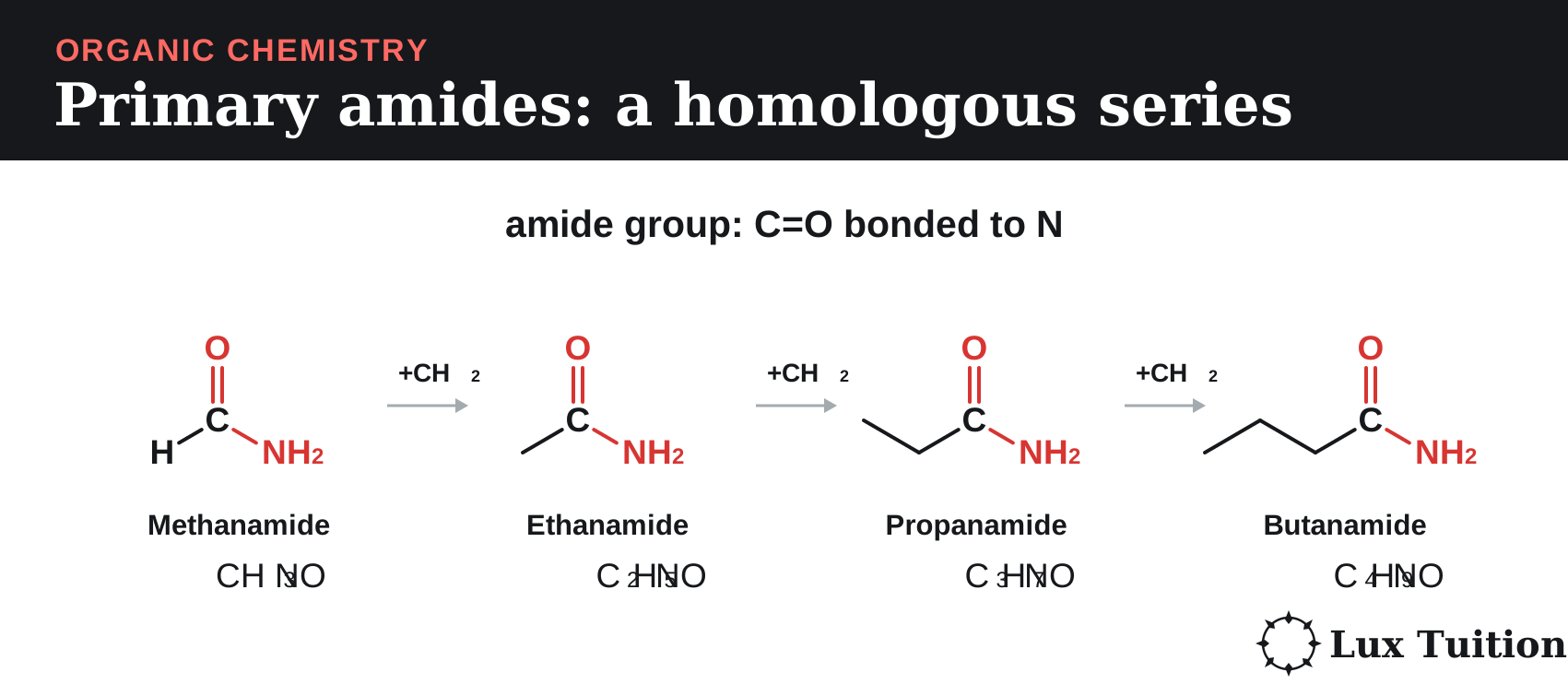
The steps for naming are the same for every family:
- Find the longest carbon chain that contains the functional group. That chain sets the prefix.
- Number the chain from the end that gives the functional group the lowest number. If there’s no functional group other than C–C single bonds, give the branches the lowest numbers.
- Name the branches (methyl-, ethyl-) and halogens (chloro-, bromo-…) as prefixes with their position numbers, in alphabetical order. Use di-, tri- for repeats, e.g. 2,2-dimethylpropane.
- Add the functional group suffix with its position number: -ol, -al, -one, -oic acid, -amine, -amide.
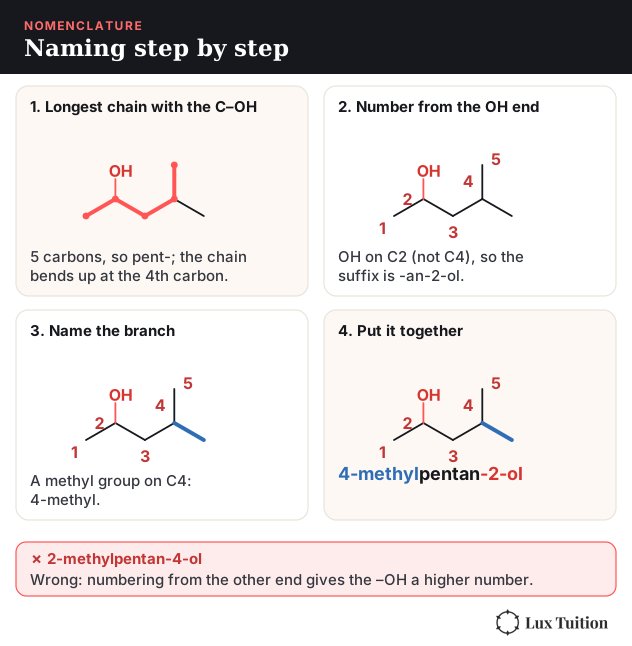
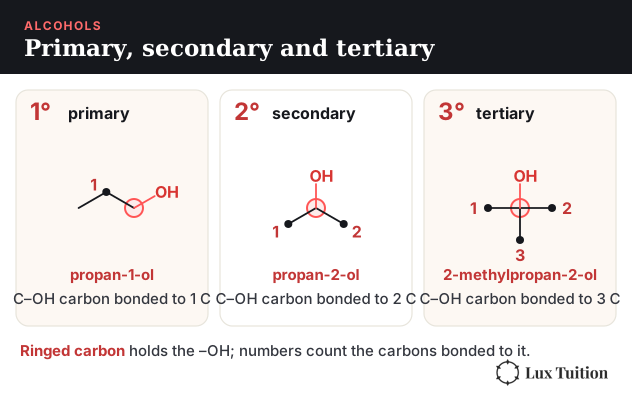
Some position numbers are never needed. An aldehyde group and a carboxyl group are always on carbon 1, so the names are just butanal and butanoic acid. The carbon in the functional group counts in the chain length. For alcohols there are three classes:
- Primary (1°): the carbon with the –OH is bonded to one other carbon, e.g. propan-1-ol.
- Secondary (2°): that carbon is bonded to two other carbons, e.g. propan-2-ol.
- Tertiary (3°): that carbon is bonded to three other carbons, e.g. 2-methylpropan-2-ol.
The series figures above (Module 7 Figures 11, 13 and 14) show examples of ketones, amines and amides.
Groups on the nitrogen. When a carbon group is attached to the nitrogen of an amine or amide, its position is written as N- instead of a number. For an amine, the parent is the longest carbon chain bonded to the nitrogen, and any other groups on the N get N- prefixes. For an amide, the parent is the chain that contains the C=O. The following figures show how the N- prefix identifies these substituents.
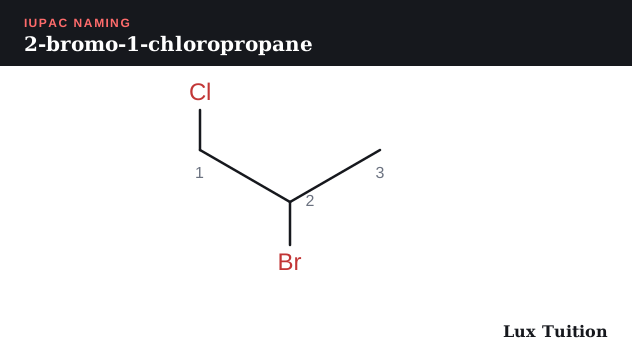
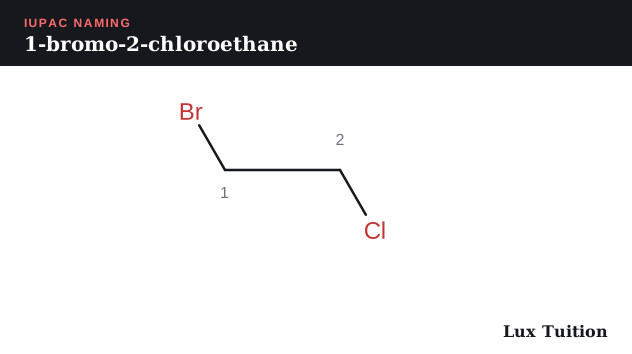
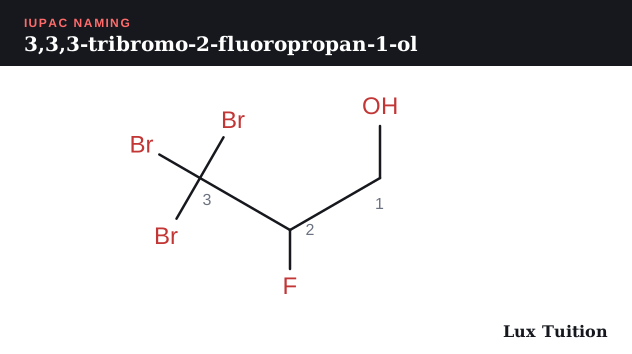
More than one halogen. Halogens are always named as prefixes (fluoro-, chloro-, bromo-, iodo-), and they have no priority order among themselves. Number the chain so the halogens get the lowest set of numbers, then list the prefixes in alphabetical order, ignoring multipliers like di- and tri-. If the numbering is a tie either way, the prefix that comes first alphabetically gets the lower number. Alkyl branches follow the same rules as halogens.
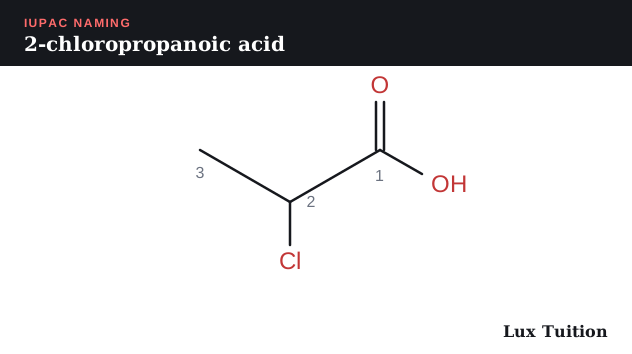
Halogens with other functional groups. When a molecule has several functional groups, only the highest-priority one gets the suffix. For HSC compounds the priority order is carboxylic acid > ester > amide > aldehyde > ketone > alcohol > amine > halogen. Halogens rank lowest, so they never take the suffix: number the chain so the suffix group gets the lowest number, then list the halogen prefixes (and any alkyl branches) alphabetically.
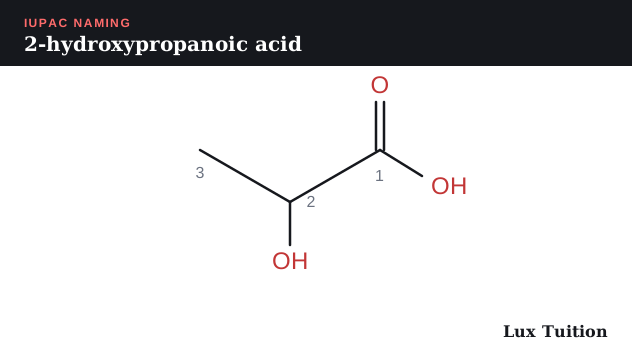
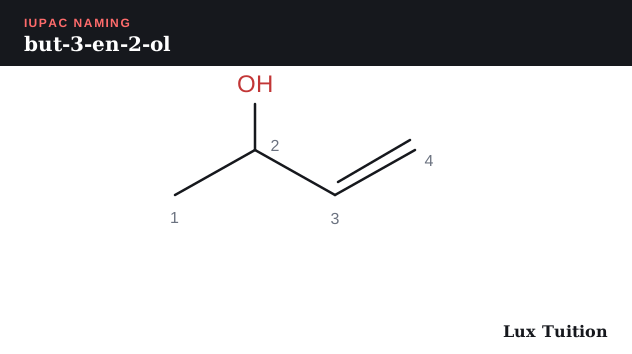
More than one of the other functional groups. The same priority order decides the suffix. A lower-priority –OH becomes the prefix hydroxy- and –NH2 becomes amino-.
What are structural isomers?
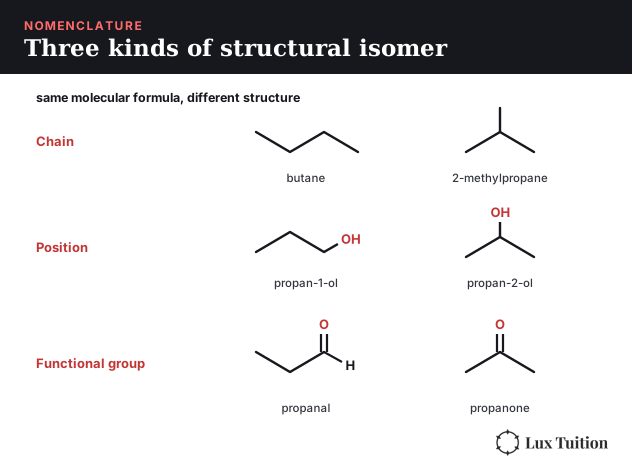
Structural isomers have the same molecular formula but a different arrangement of atoms, so they are different compounds with different properties. There are three types:
- Chain isomers: the carbon skeleton is arranged differently. Butane and 2-methylpropane are both C4H10.
- Position isomers: the same functional group sits in a different position. But-1-ene and but-2-ene, or propan-1-ol and propan-2-ol.
- Functional group isomers: the atoms form a different functional group. Propanal and propanone are both C3H6O; ethanol and methoxymethane (an ether, where one O atom is bonded to two carbon atoms, C–O–C; the ether methoxyethane is drawn in Module 7 Figure 59) are both C2H6O.
How Can Hydrocarbons Be Classified Based on Their Structure and Reactivity?
What is a homologous series?
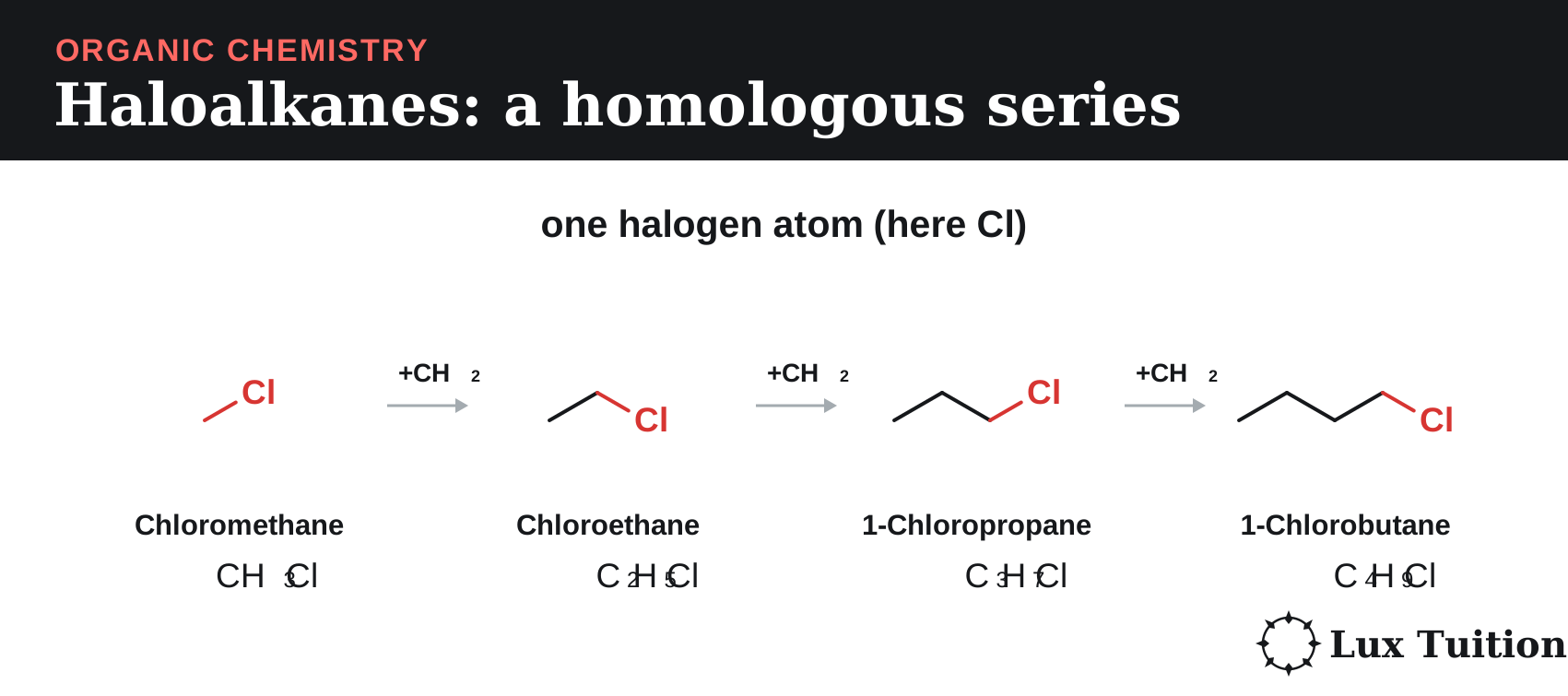
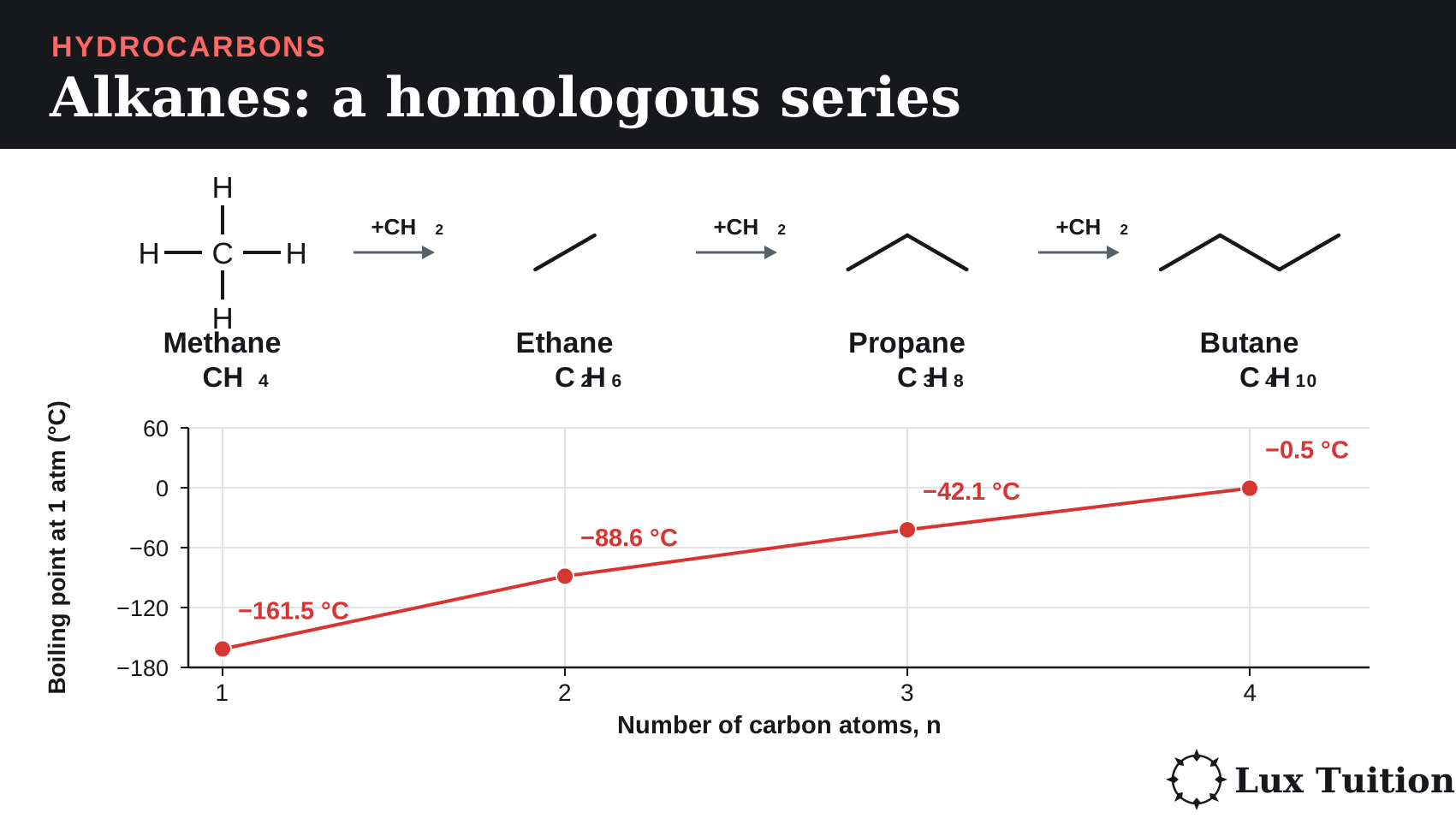
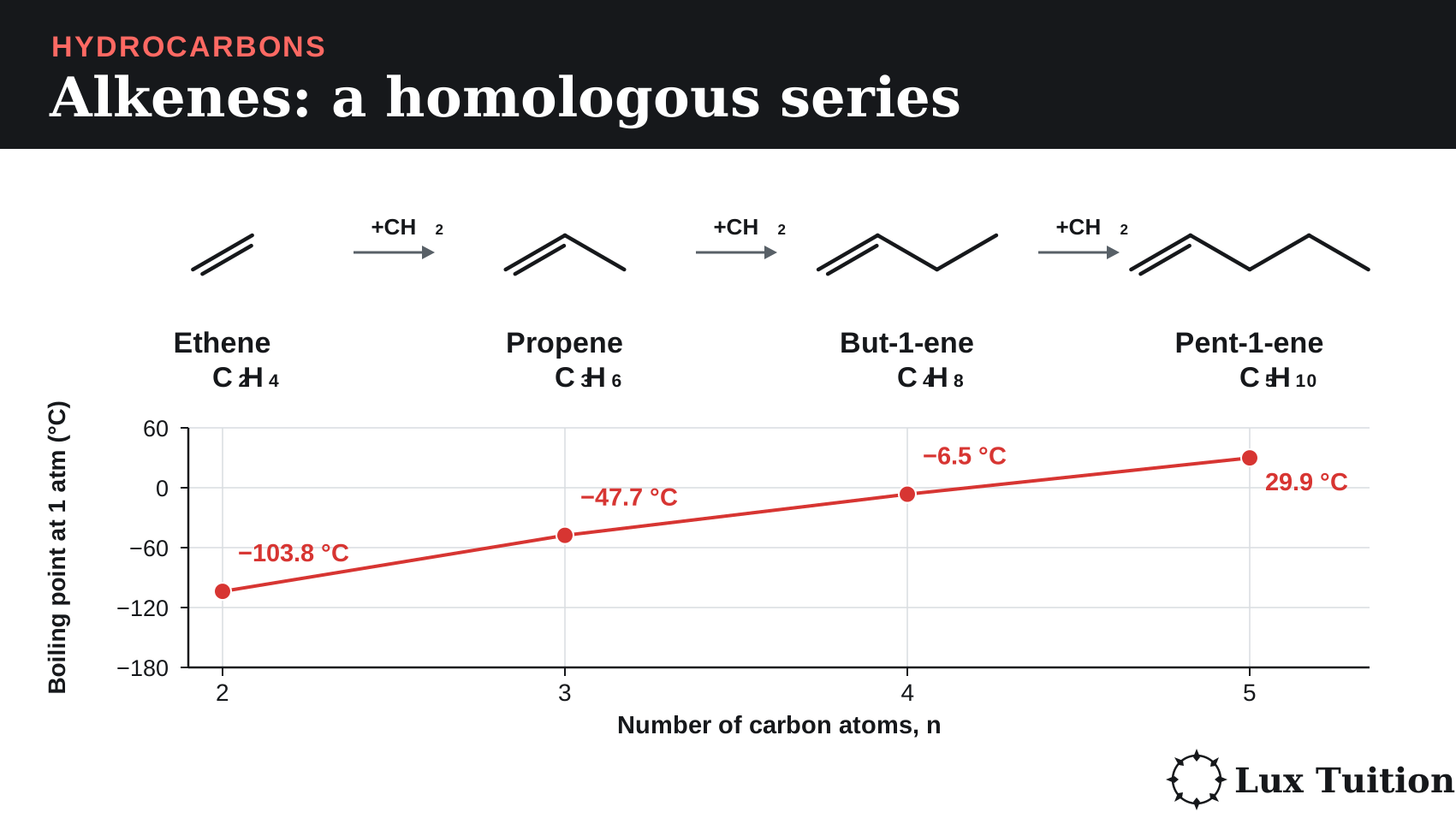
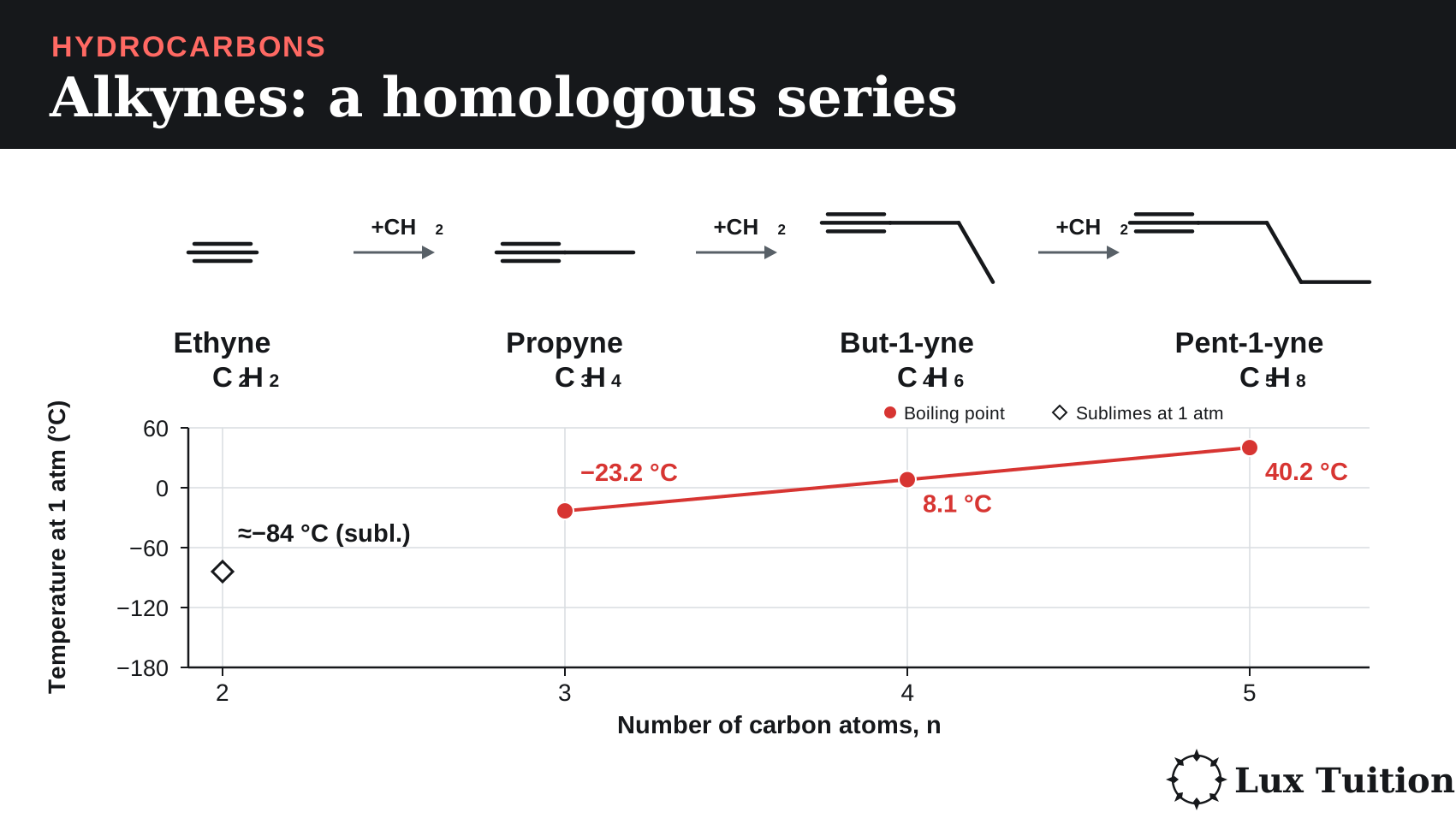
A homologous series is a family of compounds with the same functional group and the same general formula, where each member differs from the next by a CH2 unit. Members have similar chemical properties and physical properties that change gradually with chain length.
For these general formulas, the chains are without rings; the alkenes and alkynes have one double or triple bond respectively.
- Alkanes: CnH2n+2, only C–C single bonds (methane, ethane, propane…)
- Alkenes: CnH2n, one C=C double bond (ethene, propene, but-1-ene…)
- Alkynes: CnH2n−2, one C≡C triple bond (ethyne, propyne…)
What shape are molecules around single, double and triple bonds?
The electron groups around a carbon repel each other and spread out as far as possible (VSEPR, covered in our Year 11 Module 1 notes on VSEPR theory):
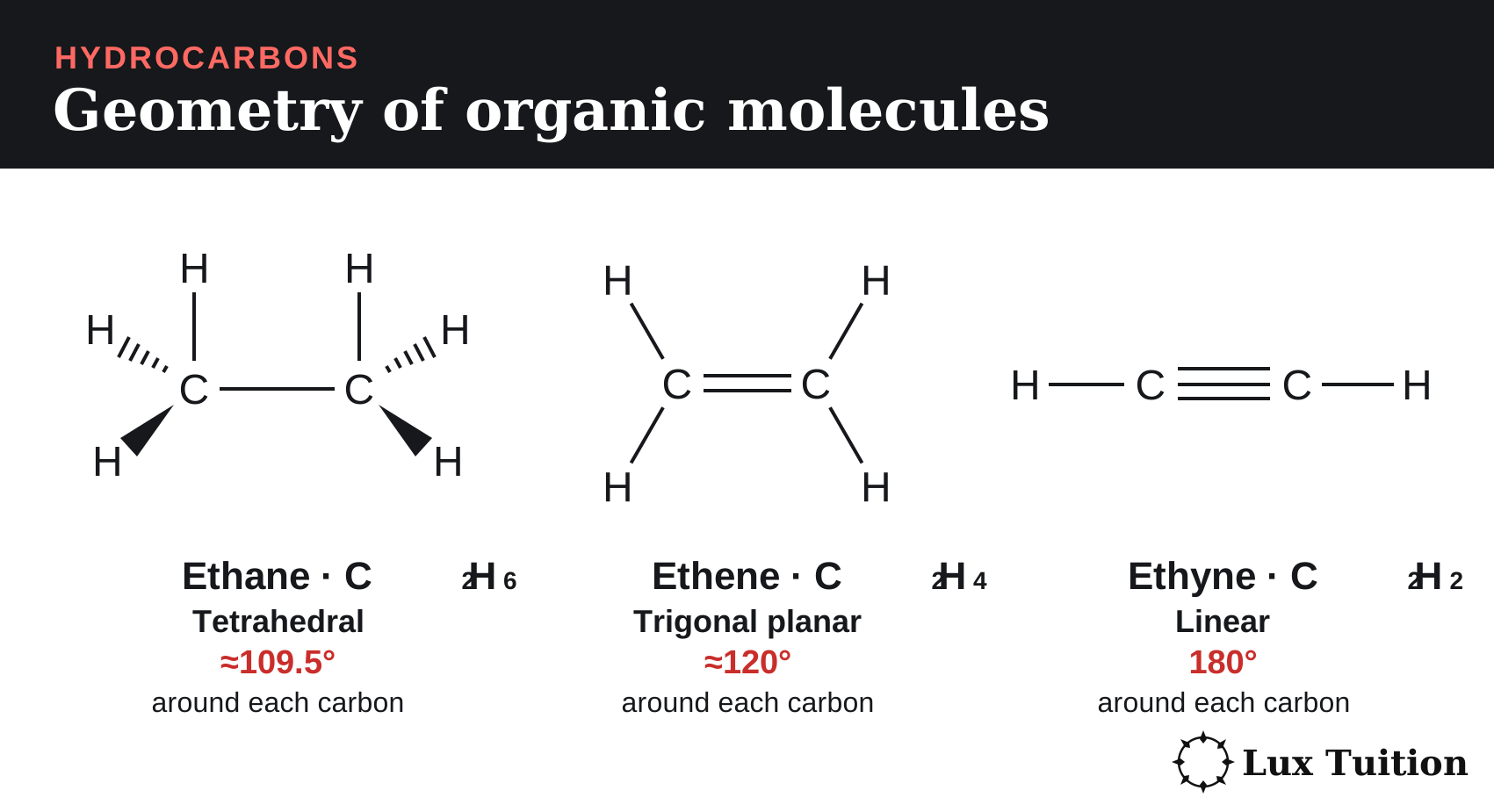
- Single bonds only: four electron groups, tetrahedral, about 109.5°. Alkane chains zig-zag because of this angle. To show 3D shape on paper, a wedge bond points out of the page towards you and a hashed bond points behind it.
- Double bond: three electron groups, trigonal planar, about 120°. The double bond can’t rotate, so the atoms around it are locked in one plane.
- Triple bond: two electron groups, linear, 180°.
Why do boiling points rise along the alkane series?
Within a hydrocarbon molecule, the atoms are held by strong covalent (intramolecular) bonds. Intermolecular forces are covered in full in our Year 11 Module 1 notes on intermolecular forces; here is what you need for boiling points. A bond is polar when one atom is more electronegative (pulls the shared electrons harder) than the atom it’s bonded to. O, N and Cl are all more electronegative than C or H. The more electronegative atom gets a small negative charge (δ−) and the other a small positive charge (δ+). C–H bonds are almost non-polar, so between hydrocarbon molecules there are only weak dispersion forces: attractions caused by the temporary, shifting electron clouds of neighbouring molecules, present between all molecules. Dispersion forces get stronger as molecules get bigger, with more electrons and more surface contact. So:
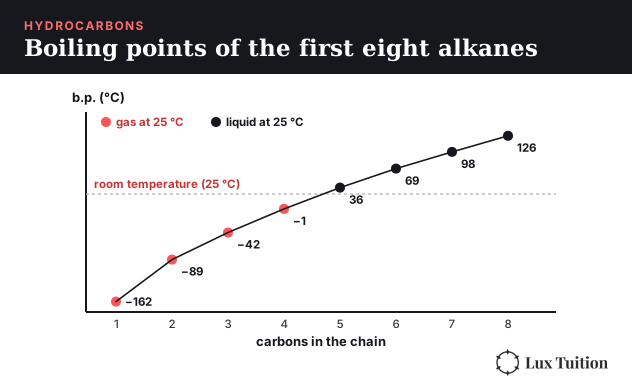
- Boiling point rises with chain length: methane to butane are gases at room temperature, pentane to octane are liquids.
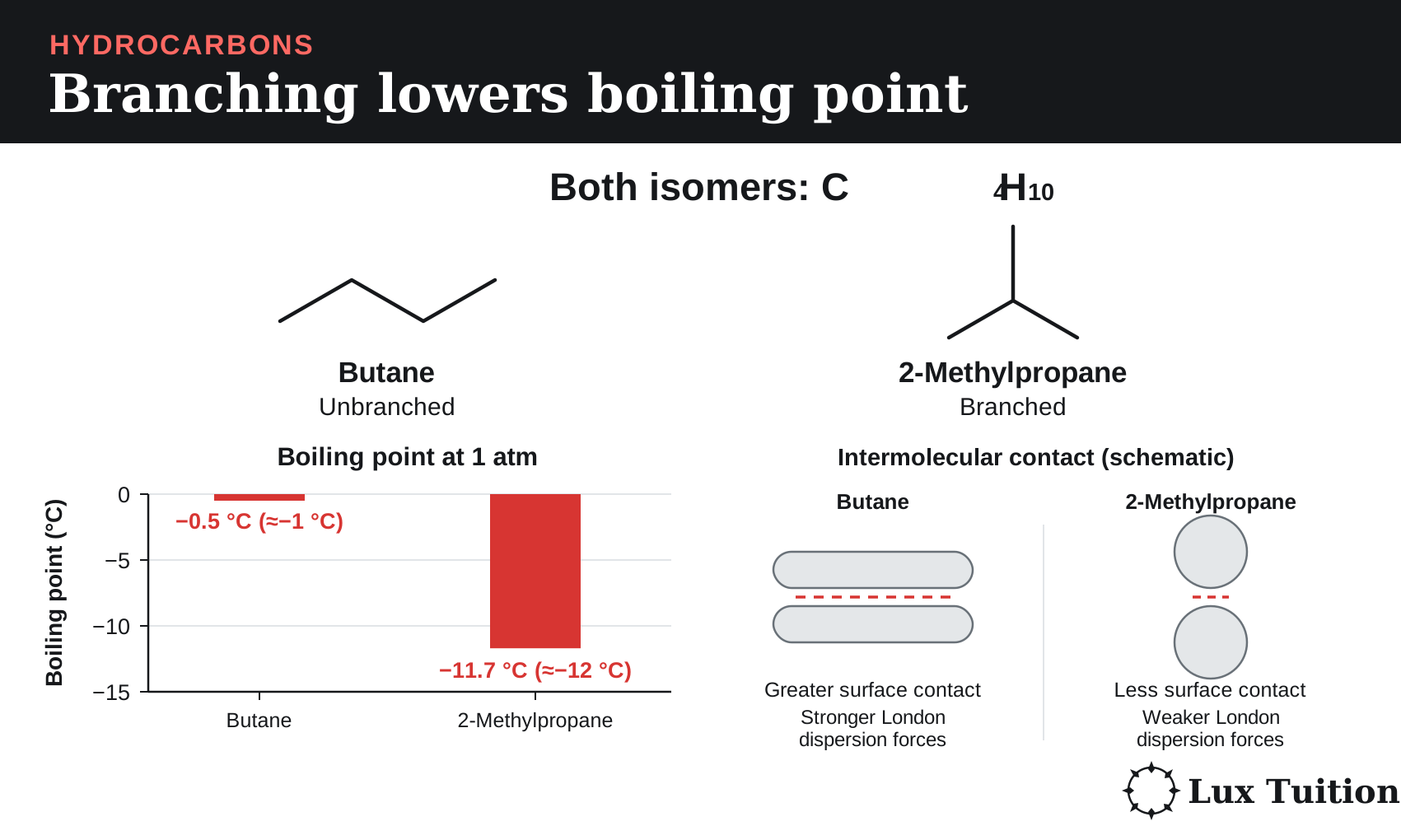
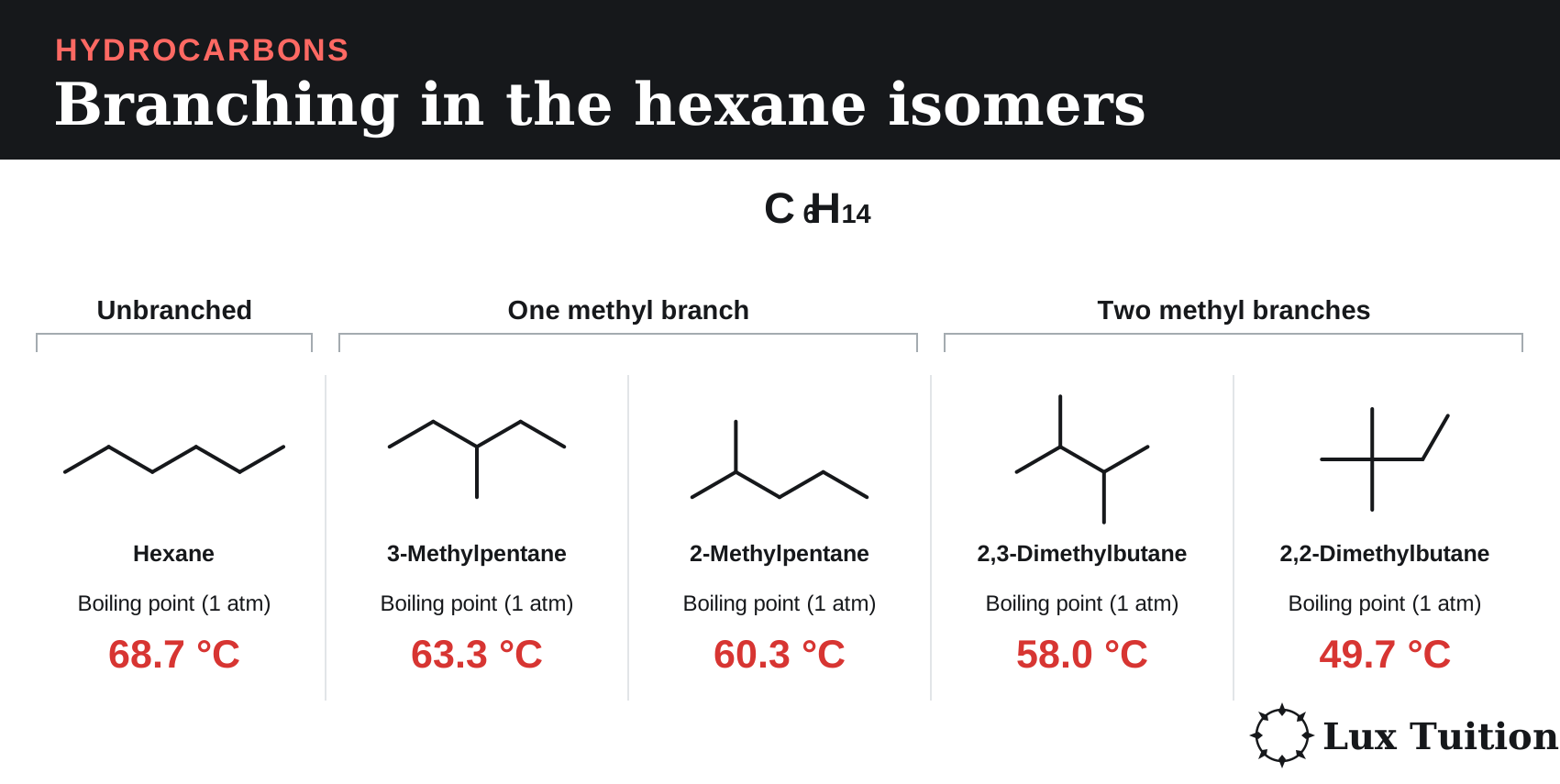
- Branching lowers boiling point: a branched isomer is more compact, so it has less surface contact than its straight-chain isomer. 2-methylpropane boils at about −12 °C, butane at about −1 °C.
- Insoluble in water: water molecules are held together by hydrogen bonds: attractions between an H bonded to O, N or F and a lone pair (an unshared pair of outer-shell electrons) on a neighbouring O, N or F. They are the strongest intermolecular force in this module, though still much weaker than a covalent bond. Hydrocarbons can’t form hydrogen bonds with water, so they don’t dissolve in it and float on top, being less dense.
Alkenes and alkynes with the same number of carbons have similar boiling points to the matching alkane, since the same dispersion forces dominate.
How to compare properties within a homologous series
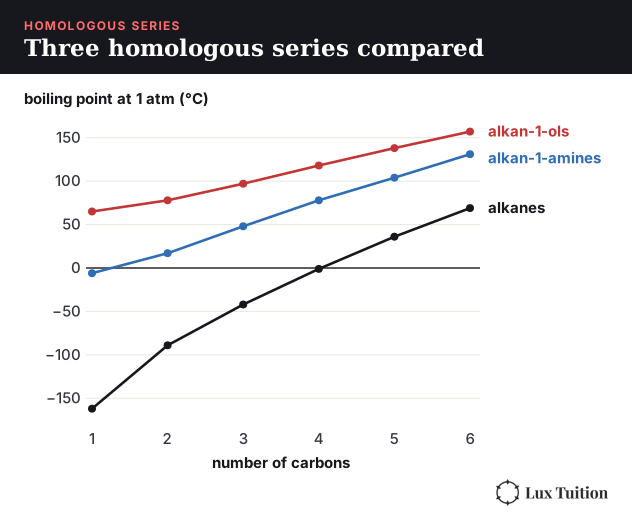
The investigation compares the first members of one series, such as the first six alkanes (methane to hexane) or the first six alkan-1-ols (methanol to hexan-1-ol). Look up or measure the boiling point of each, test how well each one mixes with water, and plot boiling point against the number of carbons. Then do the same for a second series so you can compare them.
The results show three patterns, and exam questions usually ask you to explain each:
- Within a series, boiling point rises steadily with chain length. Each extra CH2 adds electrons and surface area, so the dispersion forces get stronger. The functional group stays the same, so its contribution doesn’t change.
- Between series, the functional group sets the level. Molecules with the same number of carbons boil much higher if they can hydrogen bond: alkan-1-ols are highest, amines (weaker N–H hydrogen bonds) sit in between, and alkanes (dispersion only) are lowest.
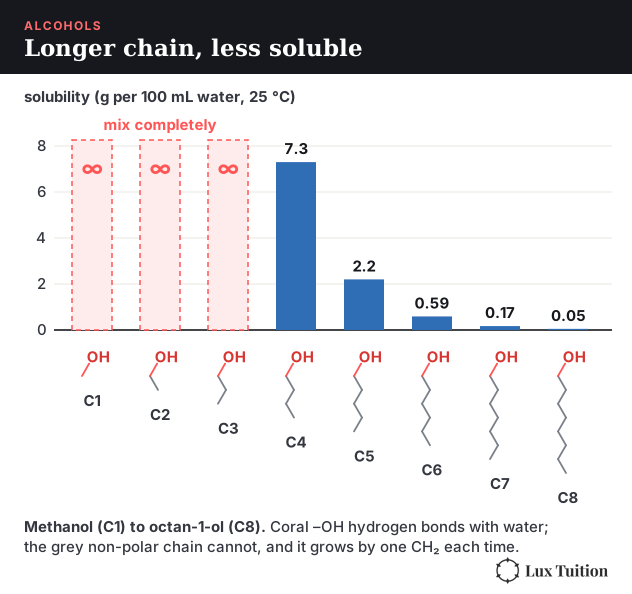
- Solubility in water falls as the chain grows. Methanol, ethanol and propan-1-ol mix completely with water, because their –OH hydrogen bonds with water. From butan-1-ol onwards the non-polar chain takes over and solubility drops sharply (graphed in the Properties of alcohols section).
Boiling a liquid only separates the molecules. The covalent bonds inside each molecule (the intramolecular bonds) stay intact, so only the intermolecular forces matter for boiling point.
How to handle organic substances safely
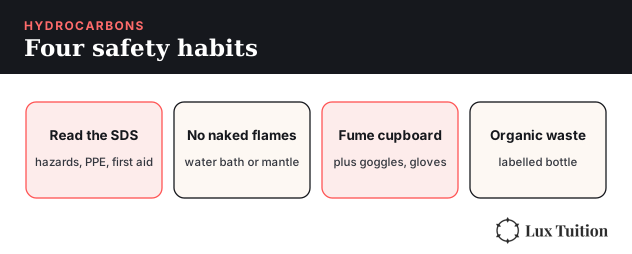
Many organic liquids are flammable and give off vapours that are harmful to breathe. The standard procedures are:
- Check the Safety Data Sheet (SDS) for each chemical before using it.
- Keep flammable liquids away from naked flames. Heat them with a water bath or heating mantle, not a Bunsen burner.
- Work in a fume cupboard or well-ventilated area, and wear safety glasses and gloves.
- Treat concentrated sulfuric acid and pure (liquid) carboxylic acids as corrosive: they burn skin and eyes. Use small amounts, wear safety glasses and gloves, and add acid slowly (never water into concentrated acid).
- Never pour organic waste down the sink. Collect it in a labelled organic waste container, with halogenated waste kept separate.
What are the implications of using hydrocarbons?
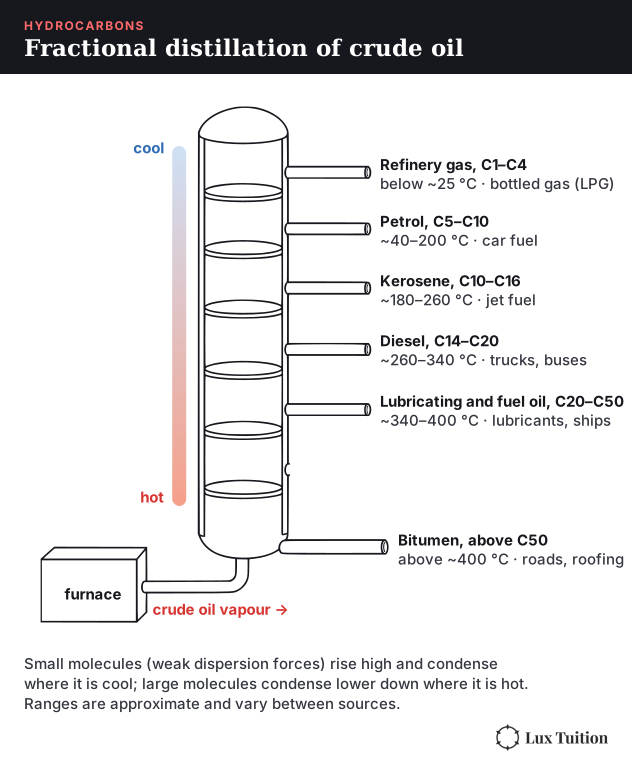
Crude oil is separated into fractions by fractional distillation (separating a mixture of liquids by their different boiling points). These fractions, along with natural gas and coal, are used as fuels and as the raw material for plastics, solvents and medicines.
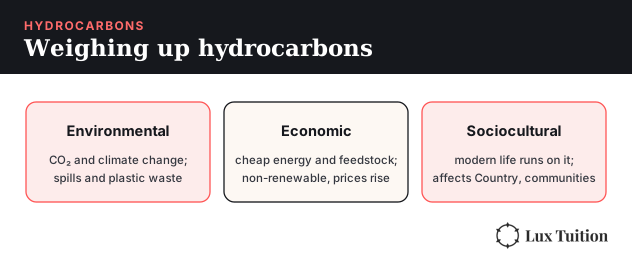
- Environmental: burning fossil fuels releases CO2, a greenhouse gas, and incomplete combustion releases CO and soot. Extraction risks oil spills and habitat damage, and plastics persist as pollution.
- Economic: hydrocarbons supply cheap, energy-dense fuel and feedstock and support jobs and export income, but they are non-renewable, so prices rise as reserves shrink.
- Sociocultural: access to energy shapes modern life, but extraction can affect communities and land, including Country of cultural significance to Aboriginal and Torres Strait Islander Peoples, and climate change affects everyone.
What Are the Products of Reactions of Hydrocarbons and How Do They React?
Addition reactions of alkenes
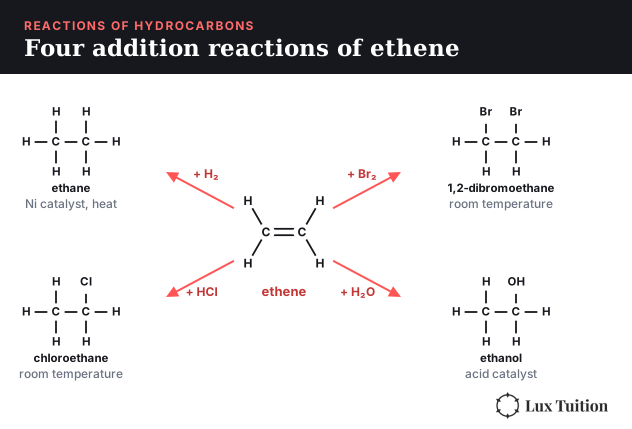
The double bond is where the reactivity is. In an addition reaction, the double bond breaks and a new atom attaches to each of the two carbons, so the alkene becomes saturated. Using ethene:
- Hydrogenation (+ H2): ethene + H2 → ethane, with a nickel or platinum catalyst (a substance that speeds up a reaction without being used up) and heat.
- Halogenation (+ X2): ethene + Br2 → 1,2-dibromoethane. This happens readily at room temperature.
- Hydrohalogenation (+ HX): ethene + HCl → chloroethane.
- Hydration (+ H2O): ethene + H2O → ethanol, with a dilute acid catalyst (industrially, phosphoric acid at about 300 °C and high pressure).
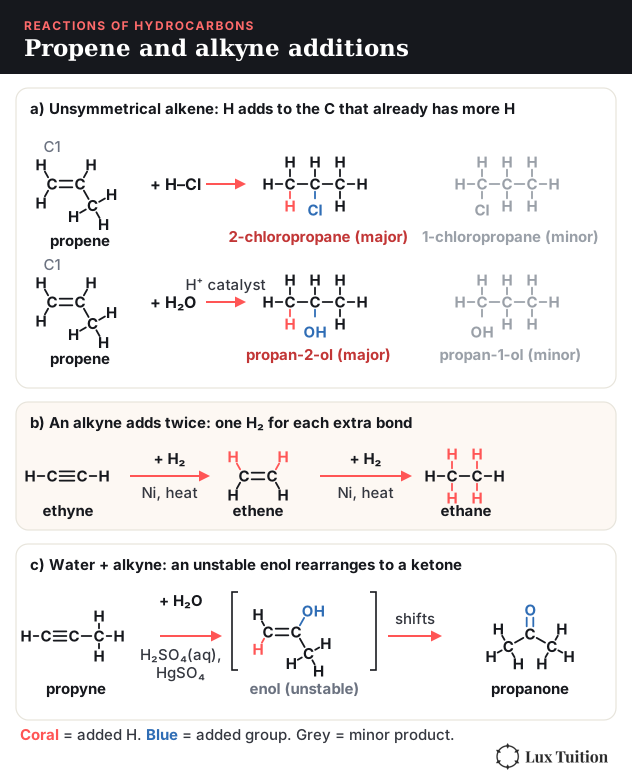
For an unsymmetrical alkene like propene, adding HX or H2O can give two different products, e.g. 1-chloropropane and 2-chloropropane. The main product has the H added to the carbon that already had more hydrogens (Markovnikov’s rule), so 2-chloropropane is the major product.
Alkynes add H2, X2 and HX in the same way, but they can add two molecules, one for each of the two extra bonds: ethyne + 2H2 → ethane. Adding water to an alkyne is different: it gives an aldehyde or a ketone, not an alcohol. For example, propyne with aqueous sulfuric acid and a mercury(II) sulfate catalyst gives propanone: propyne + water → propanone. The water first adds to give an unstable enol (prop-1-en-2-ol, with its –OH on a C=C carbon), which rearranges (tautomerises) to the ketone, so the product is propanone and not an alcohol.
Substitution reactions of alkanes
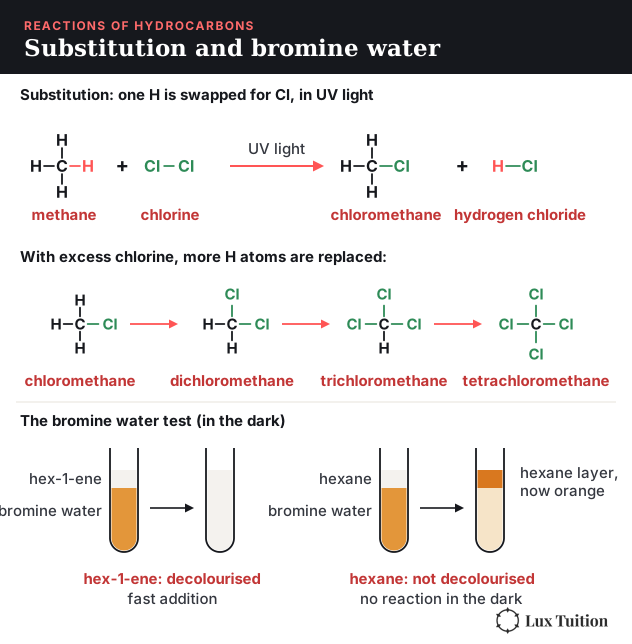
Alkanes have no double bond to open, so they react much less readily. With a halogen in ultraviolet light, one hydrogen is swapped for a halogen atom in a substitution reaction, and a hydrogen halide is produced:
CH4 + Cl2 → CH3Cl + HCl (UV light)
With excess chlorine, the substitution keeps going to CH2Cl2, CHCl3 and CCl4.
This difference gives the standard test that tells the two apart. Bromine water (orange-brown) is decolourised immediately by an alkene through addition. An alkane does not react with it in the dark, so the colour stays: the non-polar alkane forms a separate layer on top of the water, and the bromine, which dissolves better in non-polar liquids, moves into that layer and turns it orange. (In UV light an alkane would slowly undergo substitution with the bromine, as with chlorine above, but that is slow compared with the alkene test.)
How Can Alcohols Be Produced and What Are Their Properties?
Properties of alcohols
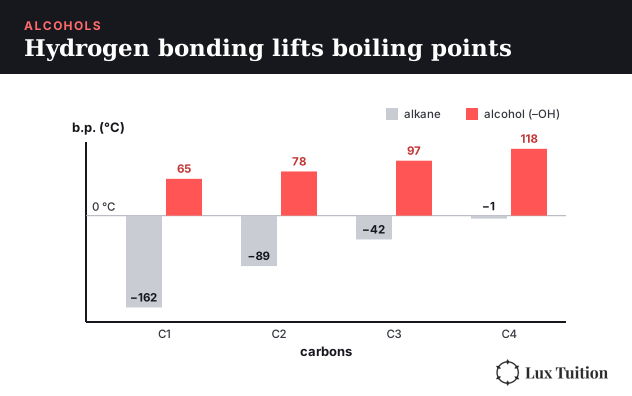
As introduced above, the alcohol functional group is the hydroxyl group (–OH). The O–H bond is very polar, so alcohols form hydrogen bonds with each other and with water, on top of dispersion forces.
- Higher boiling points than alkanes of similar size: ethanol (46 g mol−1) boils at 78 °C, but propane (44 g mol−1) boils at −42 °C.
- Boiling point rises along the series as dispersion forces grow with chain length.
- Solubility in water falls as the chain gets longer. Methanol, ethanol and propanol mix with water completely, but longer alcohols become less soluble, because the non-polar chain can’t hydrogen bond with water.
Enthalpy of combustion of alcohols
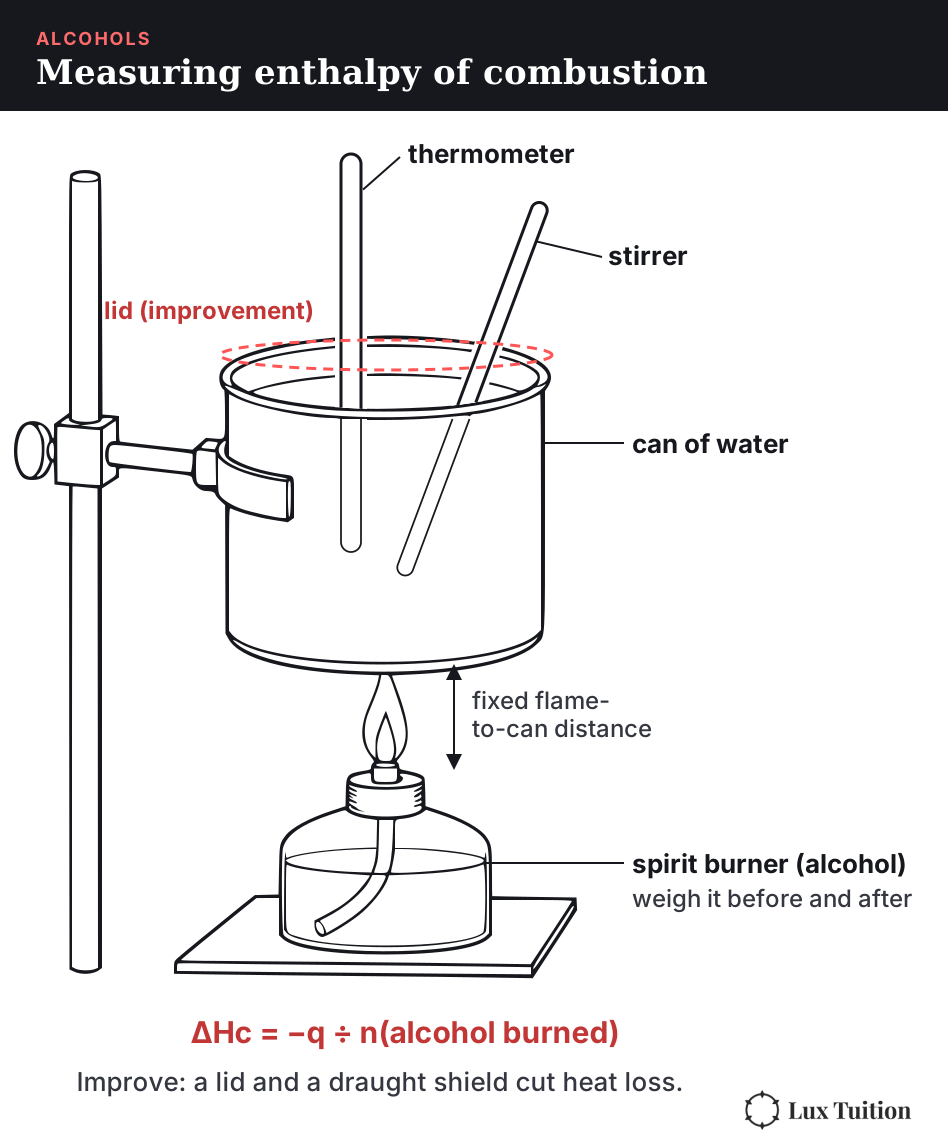
Alcohols burn in a spirit burner under a can of water, and the heat absorbed by the water is found with q = mcΔT. Dividing by the moles of alcohol burned (from the burner’s mass loss) gives ΔHc = −q/n. The same calorimetry is covered in our Year 11 Chemistry Module 4 notes.
Worked example. Burning 0.460 g of ethanol raises the temperature of 200 g of water from 20.0 °C to 31.5 °C.
- q = mcΔT = 200 × 4.18 × 11.5 = 9614 J = 9.61 kJ. Use the mass of the water, not the alcohol.
- n(ethanol) = 0.460 ÷ 46.07 = 9.98 × 10⁻³ mol.
- ΔHc = −q ÷ n = −9.61 ÷ (9.98 × 10⁻³) = −963 kJ mol−1. The sign is negative because combustion releases heat.
- Per gram: 9.61 ÷ 0.460 = 20.9 kJ g−1 of heat released.
The data value is −1367 kJ mol−1 (29.7 kJ g−1), so only about 70% of the heat reached the water.
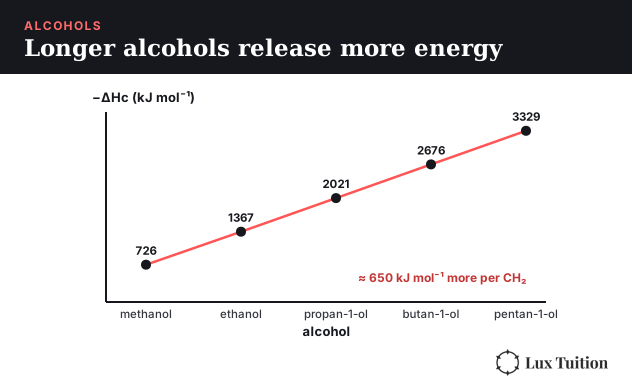
The molar enthalpy of combustion becomes more negative by roughly 650 kJ mol−1 for each extra CH2, because each longer alcohol has more bonds to break and form into CO2 and H2O. Experimental values are less negative than the data values (less heat is measured) because heat is lost to the air and the can, and because of incomplete combustion (soot). To compare alcohols reliably, keep the water mass, the distance between flame and can, and the temperature rise the same, and repeat each trial.
Reactions of alcohols
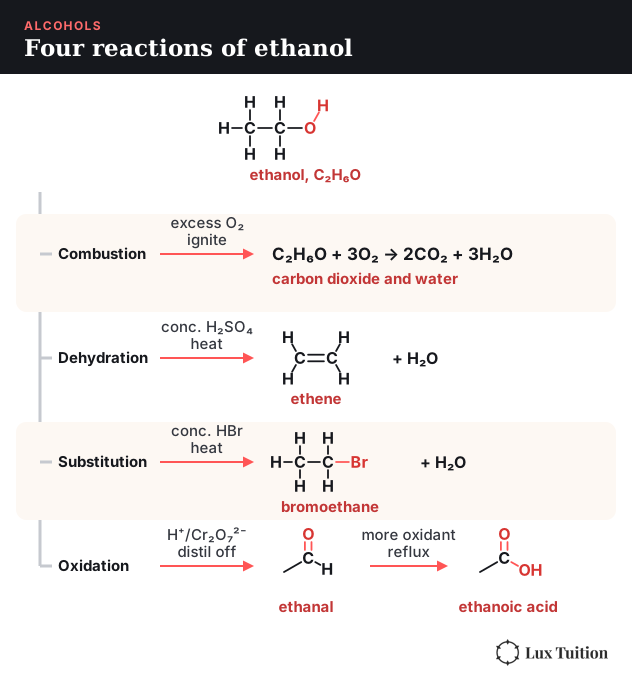
- Combustion: C2H6O + 3O2 → 2CO2 + 3H2O. Complete combustion needs excess oxygen.
- Dehydration: heating with concentrated sulfuric (or phosphoric) acid removes water to form an alkene. ethanol → ethene + water. It’s the reverse of hydration.
- Substitution with HX: the –OH is replaced by a halogen. ethanol + HBr → bromoethane + water. The alcohol is heated with concentrated HBr (or with NaBr and concentrated H2SO4, which makes HBr in the flask). Tertiary alcohols react fastest.
- Oxidation: heating with acidified potassium dichromate (orange Cr2O72− turns green Cr3+) or acidified potassium permanganate (purple MnO4− turns colourless Mn2+). Equations can use [O] for the oxygen supplied by the oxidant (the structures are drawn in Module 7 Figures 44 and 46):
- ethanol + [O] → ethanal + H2O
- ethanal + [O] → ethanoic acid
- propan-2-ol + [O] → propanone + H2O
What does oxidation mean in organic chemistry?
In Module 3 you met oxidation as a loss of electrons. Organic molecules rarely lose whole electrons, so organic chemistry uses a simpler test: a carbon is oxidised when it gains bonds to oxygen or loses bonds to hydrogen. Reduction is the reverse: fewer bonds to oxygen, or more bonds to hydrogen.
Both tests match the electron idea. Oxygen is more electronegative than carbon, so every C–O bond pulls electron density away from the carbon. Each time a C–H bond is swapped for a bond to oxygen, the oxidation state of that carbon rises by 2.
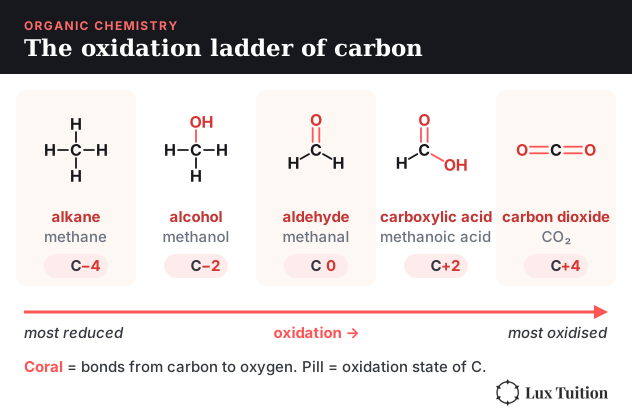
Line up the one-carbon compounds and they form a ladder (Module 7 Figure 45):
- Alkane: methane, CH4. No bonds to oxygen, so carbon is at −4, the most reduced it can be.
- Alcohol: methanol. One bond to oxygen, carbon at −2.
- Aldehyde: methanal. A C=O counts as two bonds to oxygen, carbon at 0.
- Carboxylic acid: methanoic acid. Three bonds to oxygen, carbon at +2.
- Carbon dioxide: four bonds to oxygen, carbon at +4, the most oxidised it can be.
These numbers are for the one-carbon compounds. In larger molecules the exact values differ (the carbon holding the –OH in ethanol is at −1, for example), but each step up still raises that carbon’s oxidation state by 2.
This ladder explains the alcohol oxidations above. An oxidant such as acidified dichromate moves a primary alcohol up one step to an aldehyde, then another to a carboxylic acid; a secondary alcohol goes up one step to a ketone. The oxidant is reduced at the same time, which is why its colour changes. Complete combustion is the extreme case: it takes every carbon all the way to CO2.
What do primary, secondary and tertiary alcohols oxidise to?
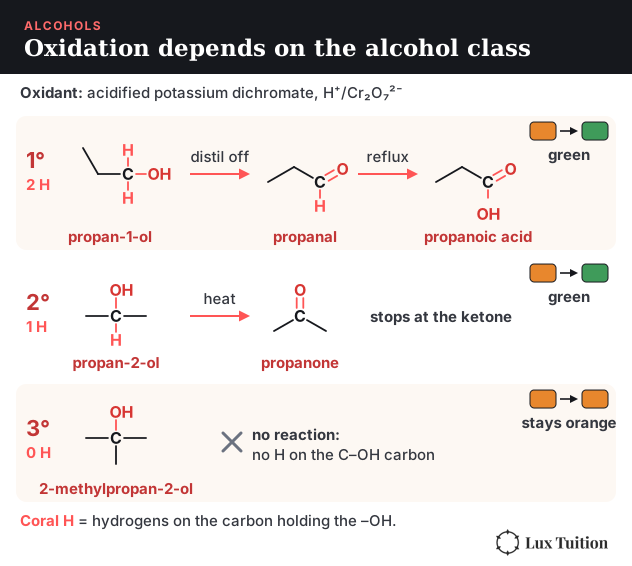
Remember that in organic chemistry, oxidation means a carbon gains bonds to oxygen or loses bonds to hydrogen. For an alcohol, what it oxidises to depends on how many hydrogens are on the carbon holding the –OH:
- Primary alcohols oxidise first to an aldehyde, then further to a carboxylic acid. Ethanol → ethanal → ethanoic acid. To stop at the aldehyde, distil it off as it forms (it has a lower boiling point); to get the acid, heat under reflux (boiling with a vertical condenser above the flask, so vapours condense and drip back instead of escaping).
- Secondary alcohols oxidise to a ketone, and stop there. Propan-2-ol → propanone.
- Tertiary alcohols have no hydrogen on that carbon, so they don’t oxidise under these conditions. The dichromate stays orange.
That colour change makes oxidation a practical way to tell tertiary alcohols from the other two.
How are alcohols produced?
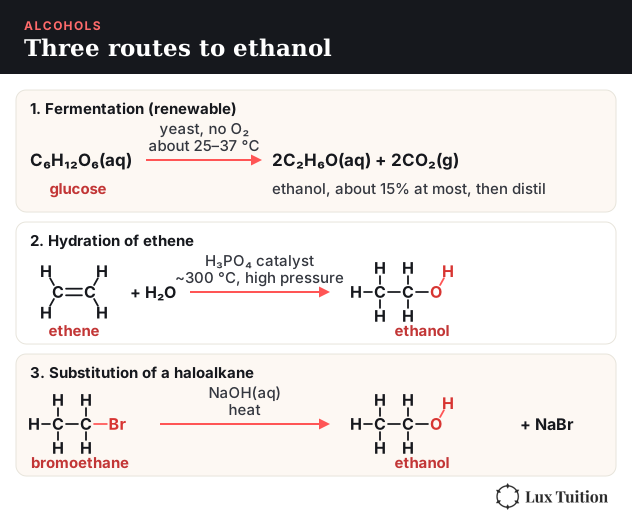
- From haloalkanes: heating a haloalkane with aqueous sodium hydroxide substitutes the halogen with –OH. bromoethane + NaOH → ethanol + NaBr.
- From alkenes: hydration of ethene with an acid catalyst (above).
- Fermentation: enzymes in yeast convert glucose into ethanol and carbon dioxide in the absence of oxygen, at about 25–37 °C: C6H12O6(aq) → 2C2H6O(aq) + 2CO2(g). Fermentation stops at around 15% ethanol, when the alcohol kills the yeast, so higher concentrations need distillation.
Fossil fuels vs biofuels
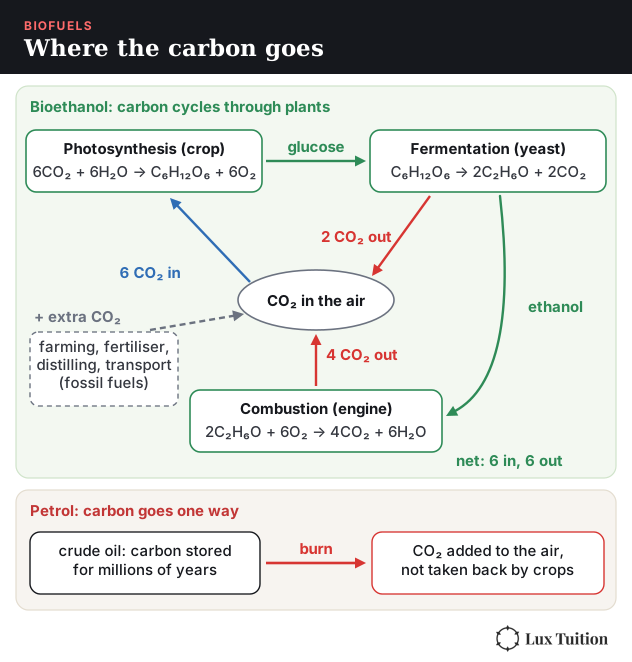
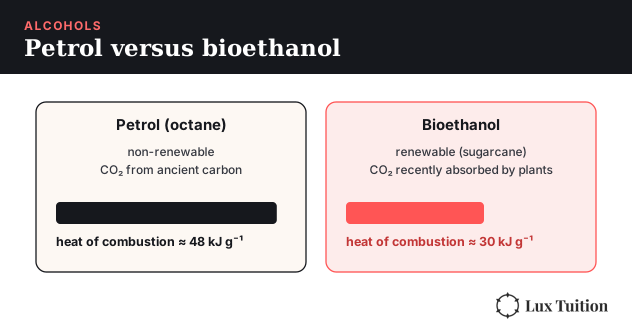
Fossil fuels such as petrol are made from crude oil formed over millions of years, so they’re non-renewable. Bioethanol is made by fermenting sugars from crops like sugarcane, so it’s renewable, and the CO2 released on burning was recently absorbed by the plants during photosynthesis.
- Ethanol’s advantages: renewable, burns more cleanly (it already contains oxygen), and can be blended with petrol (E10).
- Ethanol’s disadvantages: it releases less energy per gram than petrol (about 30 kJ g−1 vs about 48 kJ g−1 for octane), growing the crops uses farmland, water and fertiliser, and producing it (farming, distilling, transport) still uses fossil fuel energy, so it isn’t truly carbon neutral.
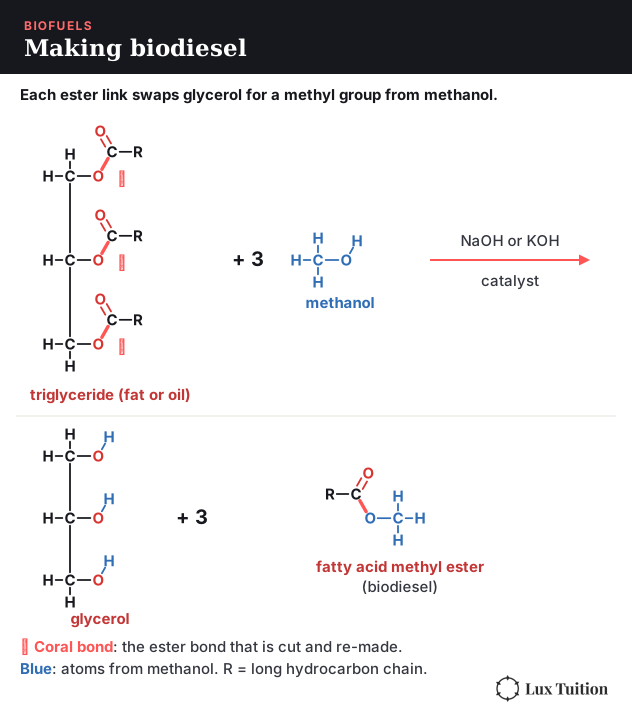
Biodiesel is the renewable replacement for diesel. An ester forms when a carboxylic acid reacts with an alcohol (see esterification below). Fats and vegetable oils are triglycerides: esters of glycerol (an alcohol with three –OH groups) with three fatty acids (long-chain carboxylic acids). Biodiesel is made by transesterification: a triglyceride reacts with methanol, using a base such as NaOH or KOH as a catalyst. Each ester group swaps its glycerol for a methyl group:
triglyceride + 3 methanol → glycerol + 3 fatty acid methyl esters (biodiesel)
- Advantages: renewable, biodegradable, and it can use waste cooking oil. Biodiesel molecules already contain oxygen, so combustion is more complete and produces less soot (unburnt carbon) and carbon monoxide than petrodiesel.
- Disadvantages: it releases less energy per gram (about 37 kJ g−1 vs about 45 kJ g−1 for petrodiesel), it thickens in cold weather, and oil crops compete with food crops for land.
What Are the Properties of Organic Acids and Bases?
Functional groups and their properties
Each functional group changes the forces between molecules. Two terms appear in Module 7 Figures 51 and 52 below: dipole–dipole forces are attractions between the δ+ end of one polar molecule and the δ− end of the next, and a dimer is two molecules held together, here by two hydrogen bonds.
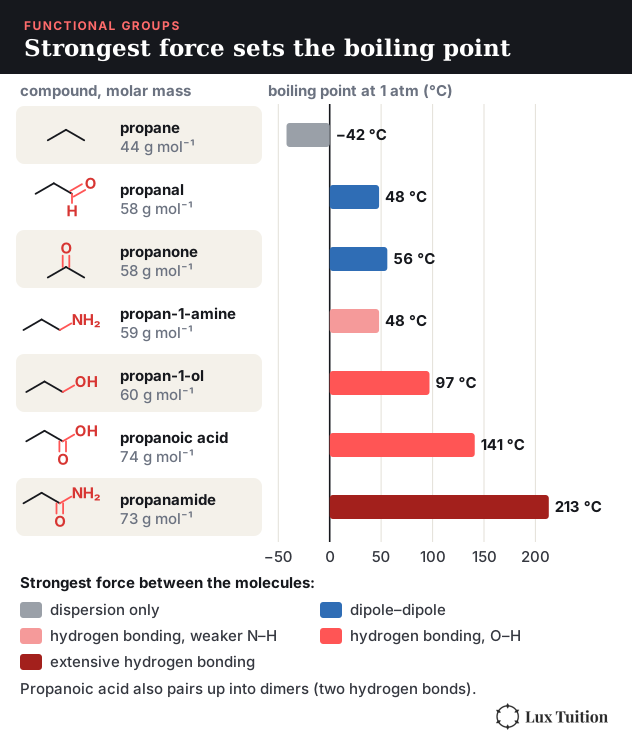
- Aldehydes and ketones contain the polar carbonyl group, C=O. They have dipole–dipole forces but no O–H, so they can’t hydrogen bond to each other. Their boiling points sit between alkanes and alcohols of similar size. The small ones dissolve in water because water can hydrogen bond to the carbonyl oxygen.
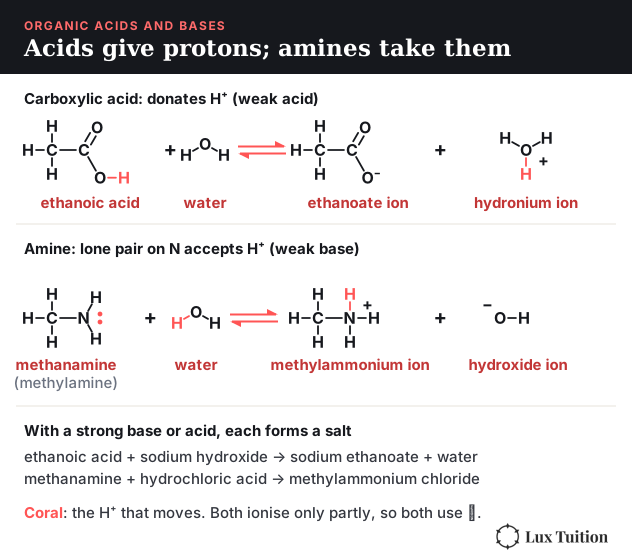
- Carboxylic acids (carboxyl group) hydrogen bond so strongly that pairs of molecules form dimers, giving them higher boiling points than alcohols of similar size (only amides are higher). They are weak acids: ethanoic acid only partly ionises, giving the ethanoate ion and H+ (drawn in the acids-and-bases figure further down).
- Amines (–NH2) hydrogen bond through N–H, which is less polar than O–H, so their boiling points are lower than the matching alcohols. They are weak bases, because the lone pair on nitrogen accepts a proton: methanamine + water ⇌ methylammonium ion + hydroxide ion. Primary and secondary amines have an N–H, but tertiary amines have none, so their molecules cannot hydrogen bond to each other and their boiling points are lower still. They can still accept hydrogen bonds from water through the nitrogen’s lone pair, so the small ones dissolve.
- Amides (amide group) hydrogen bond extensively, so they have very high boiling points. They are essentially neutral, because the C=O pulls the nitrogen’s lone pair away. Amides with no N–H (N,N-disubstituted amides, where both hydrogens on the nitrogen are replaced by carbon groups) cannot hydrogen bond to each other either, so their boiling points are lower, but they can still accept hydrogen bonds from water.

Trends within each series. The same patterns apply to acids, amines and amides as to alcohols:
- Boiling point rises with chain length in every series, because the dispersion forces grow while the hydrogen bonding from the functional group stays about the same.
- Water solubility falls with chain length. The short members mix with water because their functional group hydrogen bonds with water molecules: methanoic to butanoic acid and methanamine to butan-1-amine all dissolve completely. Longer members are only slightly soluble, because the growing non-polar chain can’t hydrogen bond with water, the same pattern as the alcohol solubility graph.
- Amides are so strongly hydrogen bonded that all unsubstituted amides except methanamide are solids at room temperature, while the small ones are still very soluble in water.
Between the series, compare molecules of similar size: amide > carboxylic acid > alcohol > alkane, with amines, aldehydes and ketones of similar size boiling at similar temperatures in between (see the boiling-point chart, Module 7 Figure 51).
Organic acids vs organic bases
An organic acid (carboxylic acid) donates a proton from the –OH of its carboxyl group, turns blue litmus red, and reacts with bases, carbonates and reactive metals just like the inorganic acids in Module 6, forming salts called carboxylates (e.g. sodium ethanoate). An organic base (amine) accepts a proton on its nitrogen, turns red litmus blue, and reacts with acids to form ammonium salts (e.g. methylammonium chloride). Both are weak, so they only partly ionise in water.
What is esterification?
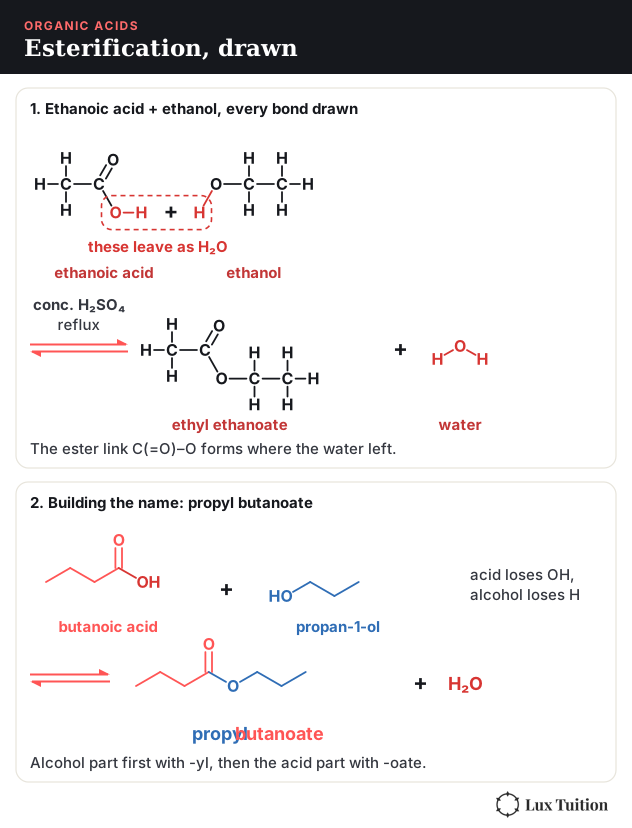
Esterification is the reaction of a carboxylic acid with an alcohol to form an ester and water:
ethanoic acid + ethanol ⇌ ethyl ethanoate + water. The name takes the alcohol’s chain first (ethyl) and the acid’s chain second with -oate (ethanoate). Esters have fruity smells and are used in flavourings and perfumes.
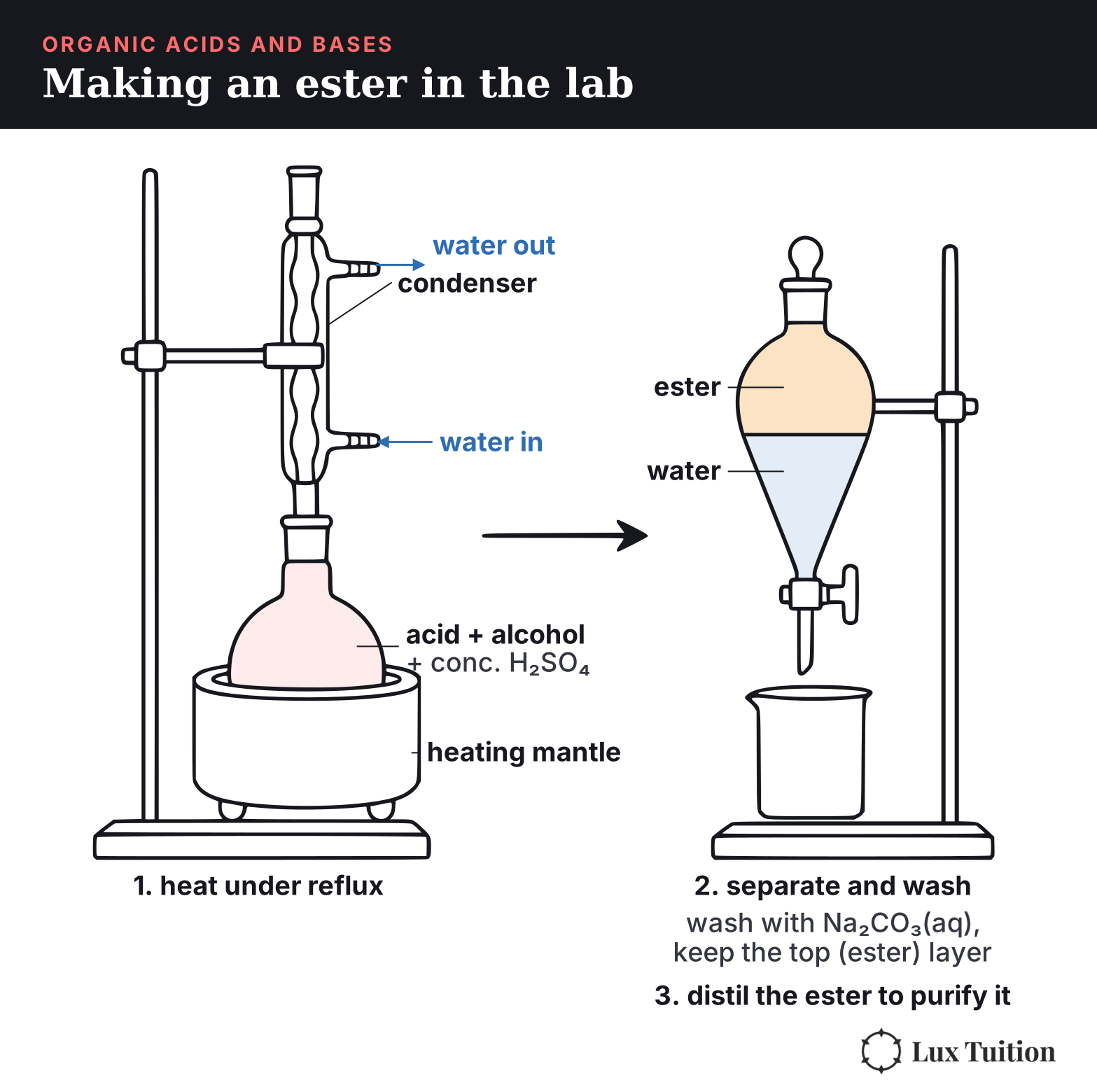
The reaction is slow and reaches equilibrium, so in the lab:
- Concentrated sulfuric acid is added as a catalyst. It also absorbs water, which shifts the equilibrium right (Module 5 thinking).
- The mixture is heated under reflux (see alcohol oxidation above), so the reaction can be heated for a long time without losing the volatile reactants or products.
- Hazards and precautions: the alcohol is flammable, so heat with a heating mantle or water bath, not a Bunsen burner; the liquid carboxylic acid and the concentrated sulfuric acid are corrosive, so use small quantities and wear safety glasses and gloves.
- The ester is then purified: washed with sodium carbonate solution in a separating funnel to remove leftover acid, separated from the water layer, then distilled.
Calculating percentage yield
The percentage yield compares what you actually made with the most you could have made. The most you could have made is the theoretical yield, and it is set by the limiting reagent (the reactant that runs out first; see the Year 11 Module 2 notes). The steps:
- Divide each reactant’s moles by its coefficient in the balanced equation. The smaller answer is the limiting reagent, and it sets the theoretical yield of ester in moles.
- Find the mass of ester actually collected. If you are given a volume, use mass = density × volume.
- Convert that mass to moles: n = mass ÷ molar mass.
- Percentage yield = (actual moles ÷ theoretical moles) × 100%.
Keep every digit on your calculator and round only at the end, to the same number of significant figures as the data.
Worked example (2025 HSC Q25, 3 marks). A student refluxed 0.267 mol of propan-1-ol with 0.298 mol of butanoic acid and a catalyst. They collected 12.2 mL of propyl butanoate (density 0.873 g mL−1, molar mass 130.2 g mol−1).
- The equation is 1 : 1, so propan-1-ol (0.267 mol) is limiting and butanoic acid (0.298 mol) is in excess. The theoretical yield is 0.267 mol of ester.
- Mass of ester = 12.2 × 0.873 = 10.65 g.
- Moles of ester = 10.65 ÷ 130.2 = 0.0818 mol.
- Percentage yield = 0.0818 ÷ 0.267 × 100% = 30.6%.
The marking guideline gives credit for correct calculations and correct significant figures (three here, matching the data). The yield is low because esterification is an equilibrium reaction and some ester is lost when it is washed, separated and distilled.
How do soaps and detergents work?
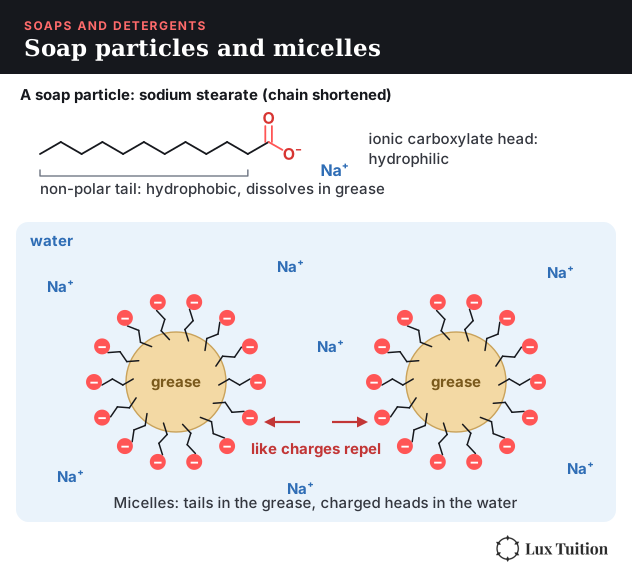
Soaps are the sodium or potassium salts of long-chain fatty acids, made by heating fats or oils with sodium hydroxide (saponification). Each soap particle has two ends:
- a long, non-polar hydrocarbon tail that is hydrophobic (“water-fearing”) and dissolves in grease
- an ionic carboxylate head (–COO−) that is hydrophilic (“water-loving”) and dissolves in water
In water, the tails bury themselves in a grease droplet while the heads stay in the water, forming a micelle. The negatively charged micelles repel each other, so the grease stays suspended and is rinsed away. This is called emulsification.
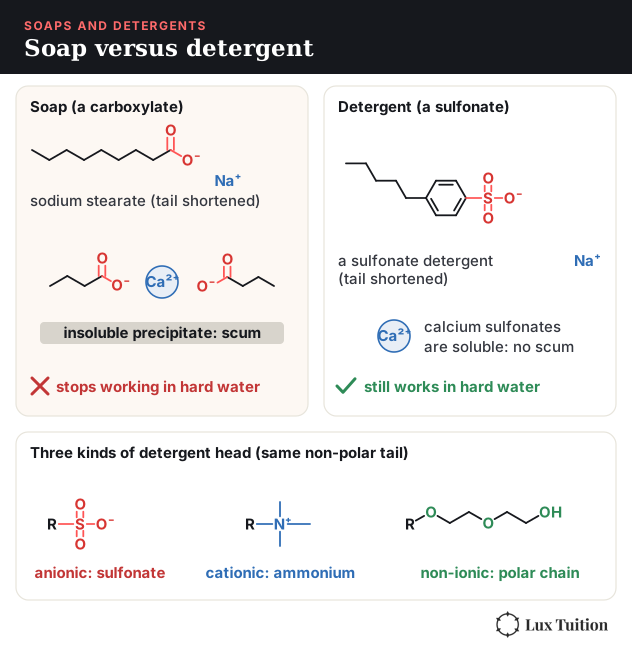
Soaps form scum in hard water, because Ca2+ and Mg2+ ions precipitate the carboxylate. Synthetic detergents have a similar tail but a different head, such as a sulfonate (–SO3−) whose calcium and magnesium salts are soluble, so they still work in hard water. Detergents can be anionic (sulfonate head), cationic (ammonium head, used in fabric softeners) or non-ionic (a polar chain with no charge, used in low-foam products).
Reaction pathways and multi-step synthesis
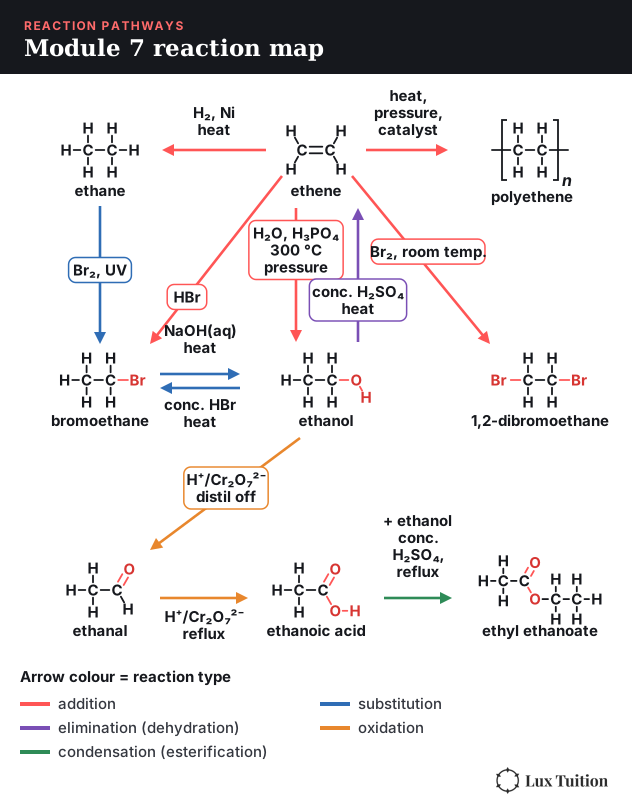
Reactions can be chained to turn one compound into another. From ethene:
- ethene → (H2O, acid catalyst) → ethanol → (acidified dichromate, reflux) → ethanoic acid
- ethanoic acid + ethanol → (conc. H2SO4, reflux) → ethyl ethanoate
- ethene → (HBr) → bromoethane → (NaOH(aq), heat) → ethanol
- ethanol → (conc. H2SO4, heat) → ethene
Each arrow should be labelled with the reagent and conditions. Exam questions often give a start and end molecule and ask for the intermediate.
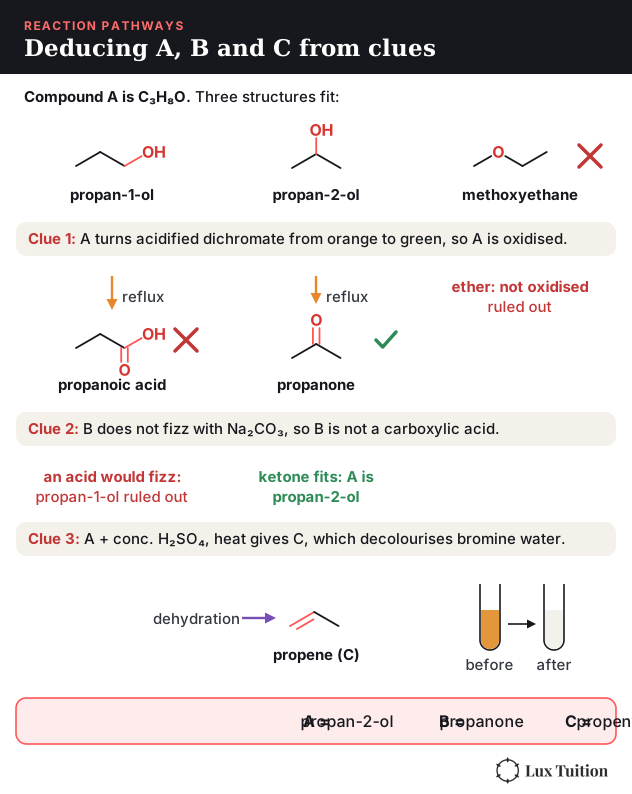
Worked example: deducing structures from reactions. Compound A (C3H8O) is heated under reflux with excess acidified dichromate, which turns from orange to green, forming B. B does not fizz with sodium carbonate. Heating A with concentrated sulfuric acid gives C, which decolourises bromine water.
- C3H8O that is oxidised by dichromate is a primary or secondary alcohol, so A is propan-1-ol or propan-2-ol.
- B doesn’t fizz with Na2CO3, so it isn’t a carboxylic acid. A secondary alcohol oxidises to a ketone and stops there, so A is propan-2-ol and B is propanone.
- Dehydration of propan-2-ol gives an alkene, so C is propene, which the bromine water test confirms.
If B had fizzed, A would have been propan-1-ol, oxidised under reflux to propanoic acid. Work from each test result, and check your final answer against every clue.
What Are the Properties and Uses of Polymers?
What are addition polymers?
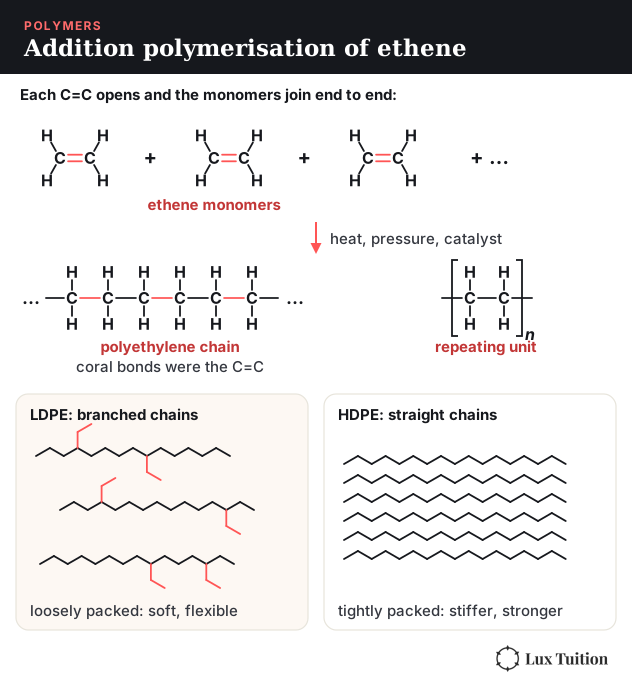
A polymer is a very long molecule made by joining many small molecules called monomers. In addition polymerisation, the double bond in each alkene monomer opens and the monomers link end to end, with no other product formed. The repeating unit is the section of chain that repeats along the polymer; it is written in brackets with an n (the number of units, often thousands).
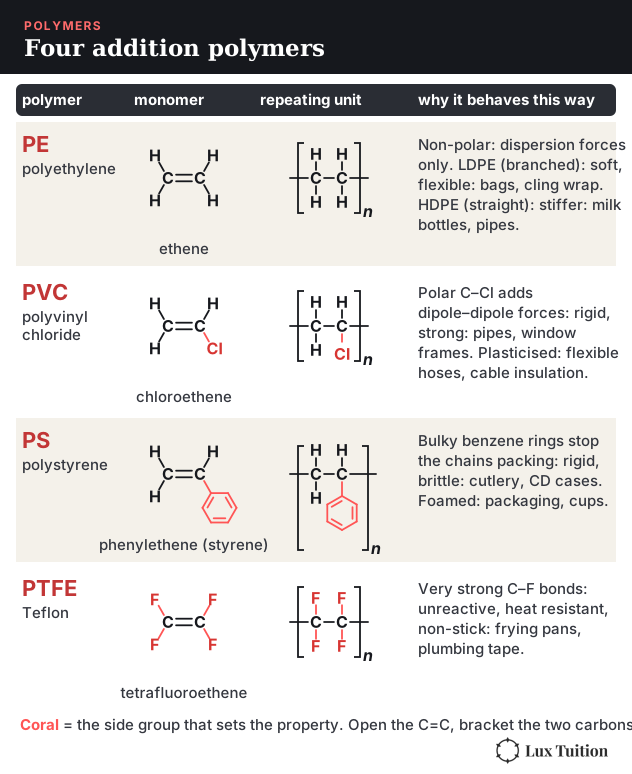
- Polyethylene (PE), from ethene. Low-density PE (LDPE) has lots of branching, so the chains can’t pack closely: it’s soft and flexible (plastic bags, cling wrap). High-density PE (HDPE) has straight chains that pack tightly with stronger dispersion forces: it’s stiffer and stronger (milk bottles, pipes).
- Polyvinyl chloride (PVC), from chloroethene. The polar C–Cl bonds add dipole–dipole forces, making it rigid and strong (pipes, window frames). Plasticisers make it flexible (hoses, cable insulation).
- Polystyrene (PS), from styrene (phenylethene). The bulky benzene rings (flat six-carbon rings) stop the chains packing, making it rigid but brittle (disposable cutlery, CD cases). Expanded with gas, it becomes the foam used in packaging and cups.
- Polytetrafluoroethylene (PTFE, Teflon), from tetrafluoroethene. Very strong C–F bonds make it chemically unreactive, heat resistant and non-stick (frying pans, plumbing tape).
What are condensation polymers?
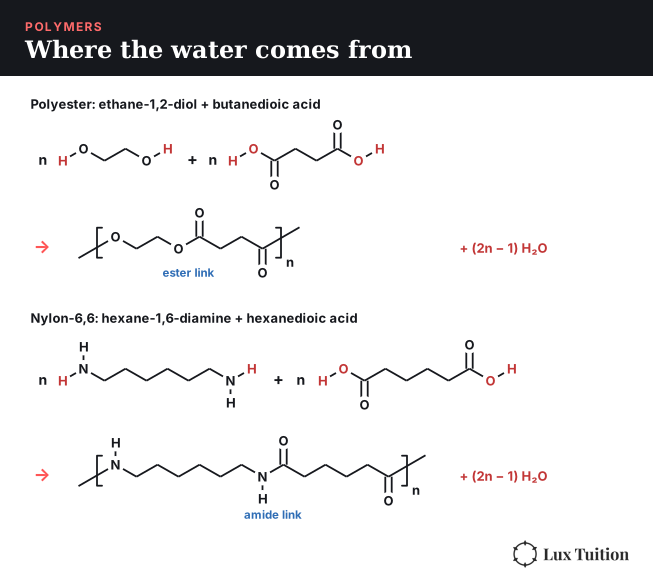
In condensation polymerisation, each monomer has two functional groups, and every time two monomers join, a small molecule (usually water) is released.
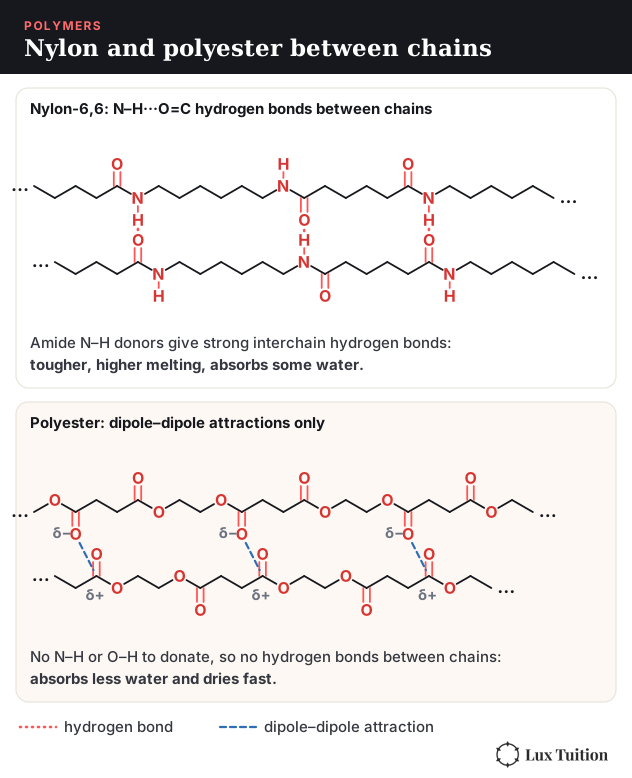
- Polyesters form from a diol (two –OH groups) and a dicarboxylic acid (two carboxyl groups), joined by ester links (ester bonds). PET, made from ethane-1,2-diol and terephthalic (benzene-1,4-dicarboxylic) acid, is used for drink bottles and clothing fibres. Module 7 Figures 62 and 63 use ethane-1,2-diol and butanedioic acid instead, to keep the structures short; the chemistry is the same.
- Nylon (a polyamide) forms from a diamine and a dicarboxylic acid, joined by amide links (amide bonds). Nylon-6,6 is made from hexane-1,6-diamine and hexanedioic acid. Hydrogen bonds between the amide groups on neighbouring chains make it strong, so it’s used for ropes, fishing line and clothing.
Both are strong fibres, but they differ. In nylon, N–H···O=C hydrogen bonds between chains make it tougher and higher-melting, and let it absorb some water. Polyester chains experience dispersion forces and dipole–dipole attractions between ester groups, but their ester linkages cannot donate hydrogen bonds, so they absorb less water, dry fast and resist creasing, which is why they suit sports clothing.
Addition polymers keep every atom of the monomer. Condensation polymers lose a small molecule at every link.
Condensation polymers can be broken down again by hydrolysis at those ester or amide links (the reverse of condensation: water reacts with each link and splits it back into –OH or –NH2 groups and carboxyl groups), which makes some of them more biodegradable than addition polymers, whose all-carbon backbones persist for centuries.
Working Scientifically skills for Module 7
The syllabus has a skills strand called Working Scientifically: asking questions and making predictions, planning and conducting investigations, processing and analysing data, and communicating results. Module 7 gives you good practice material, because the standard practicals are burning alcohols to measure heat, making an ester under reflux, and testing for functional groups. The blocks below use those practicals and real HSC questions. Numbers marked illustrative are made up to show a method.
Hypotheses and predictions
A hypothesis is a testable statement that predicts how one thing affects another. It can be directional (“more…”, “less…”) and doesn’t need a mechanism, although “because…” is a useful way to build a stronger one. Example: the more carbons in a straight-chain alcohol, the more heat is released per mole when it burns. It is testable and it matches the range you test (methanol to pentan-1-ol). A prediction outside the tested range could never be contradicted by your results.
Modify a hypothesis with evidence, not with hope. If class results show the same upward trend but every measured enthalpy is less negative than the published value, the trend is supported, and the thing to revise is your explanation of the size (heat loss), not the trend.
Common mistake: a vague claim such as “alcohols burn differently”, which no result could contradict.
Variables, controls and repeats
The independent variable is the one thing you change (which alcohol). The dependent variable is what you measure (for the fixed temperature-rise method used in the worked example: heat the water through the same temperature rise, measure the burner’s mass loss, and calculate ΔcH = −mcΔT ÷ n for each alcohol). Controlled variables are everything else you keep the same: mass of water, starting temperature, can, flame-to-can distance, stirring. These are the same controls listed in the calorimetry worked example above.
An experimental control is a comparison set-up where the independent variable is not applied, so you can see what happens anyway. In esterification, a mixture refluxed without the sulfuric acid catalyst shows the catalyst’s effect, as long as both mixtures have equal amounts, reaction times and heating conditions. Catalysis changes the rate, not the equilibrium yield.
Repeats and replicates both give more data, but replicates are fully independent runs (fresh sample, fresh set-up), which is what lets you judge how consistent the method really is. Use at least three and average them.
Planning: risk, ethics and materials
For a risk, name the hazard, the harm it could cause, and a specific precaution. “Be careful” earns nothing. This is the exact shape rewarded in 2022 Q33 (8 marks, designing a school synthesis), and it connects to the safe-handling section earlier on this page.
| Hazard | Possible harm | Precaution |
|---|---|---|
| Alcohol is flammable | Fire or burns | Heating mantle or water bath, no Bunsen burner |
| Concentrated sulfuric acid is corrosive | Burns to skin and eyes | Small quantity, safety glasses and gloves, add slowly |
| Liquid carboxylic acid is corrosive | Eye damage | Safety glasses, gloves |
| Organic waste | Harm to water and wildlife | Labelled waste container, never down the sink |
Also choose materials sensibly: the marking guideline prefers a relatively non-toxic, readily available alcohol and acid (ethanol with ethanoic acid; methanol is toxic and can cause blindness, so avoid it where a safer alcohol will do), and a condenser so volatile vapours are not released. Students should never be exposed to hazardous agents when a safer alternative or a teacher demonstration works. For ethics, think about who or what could be harmed, including the environment (waste) and other people in the room.
Accuracy, precision, validity and reliability
- Accuracy: how close a measurement is to the true (accepted) value.
- Precision: how close repeated measurements are to each other.
- Reliability: results are consistent when the investigation is repeated.
- Validity: the investigation answers the question it claims to answer.
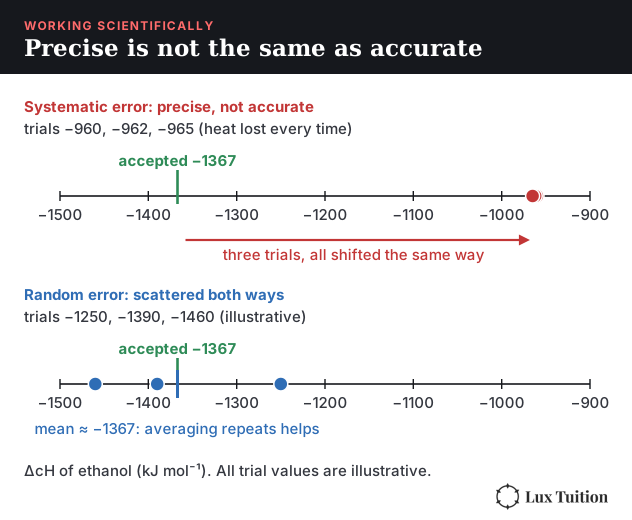
The calorimetry example shows why they are separate. Suppose three trials for ethanol give ΔcH of −960, −965 and −962 kJ mol⁻¹ (illustrative). They are precise, but the accepted value is −1367, so they are not accurate: heat loss pushes every result in the same direction. That is a systematic error (it shifts results the same way every time, so averaging more trials cannot remove it). A random error scatters results both ways (for example, reading a thermometer slightly differently each time), and averaging independent repeats reduces it.
Calibration means checking an instrument against a known standard so a systematic offset can be corrected. For example, put the thermometer in melting ice and check it reads 0 °C. Uncertainty is the range a measurement could reasonably be in. With a thermometer read to ±0.5 °C, the temperature rise of 11.5 °C in the worked example has an uncertainty of about ±1 °C (two readings), or roughly 9% (illustrative). A small temperature rise carries a large percentage uncertainty, which is one reason to use a bigger rise or more fuel.
Evaluating and improving an investigation
To evaluate, pick a real source of error, say which way it pushes the result, and give a matching improvement. 2022 Q29(b) asked for one reason the school’s enthalpy values differ from published values, and rewarded a justified reason such as heat loss to the surroundings or incomplete combustion. A full answer: heat is lost to the air and the can, so less heat is measured, so the ΔcH is less negative than the published value. A lid and draught shield around the can and a flame close to the can would reduce the loss. The same approach explains a low percentage yield in esterification (equilibrium, and ester lost during washing and distillation).
Representing data: graph-construction method
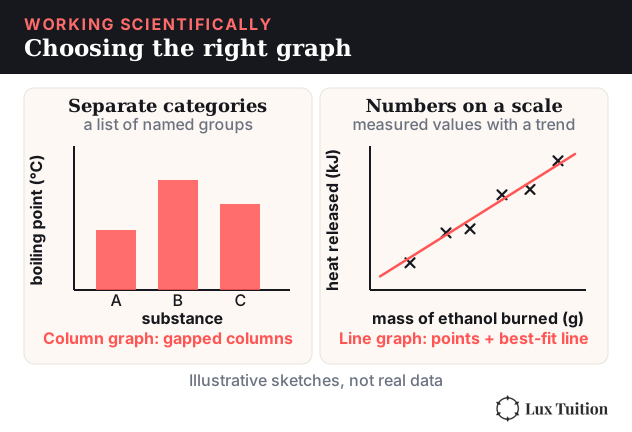
First choose the graph type (see Module 7 Figure 65). Use a column graph when one axis is a list of separate categories (boiling point of different substances). Use a line graph when both axes are numbers on a scale (heat released against mass of ethanol burned). Then work through this checklist, which the marking guidelines reward in graph questions:
- Axes: independent variable on the horizontal axis, dependent variable on the vertical axis.
- Labels: each axis labelled with the quantity and its unit, such as ΔcH (kJ mol⁻¹).
- Scale: equal steps, using most of the grid, with the zero or negative values placed correctly.
- Plot: mark each point accurately with a small cross or dot.
- Key and symbols: if there are two data sets, use different symbols and add a key.
- Line of best fit: draw one smooth line (straight or curved to match the trend) through the overall pattern, with points on both sides. Do not join the dots when asked for a best-fit line; it needn’t touch every point.
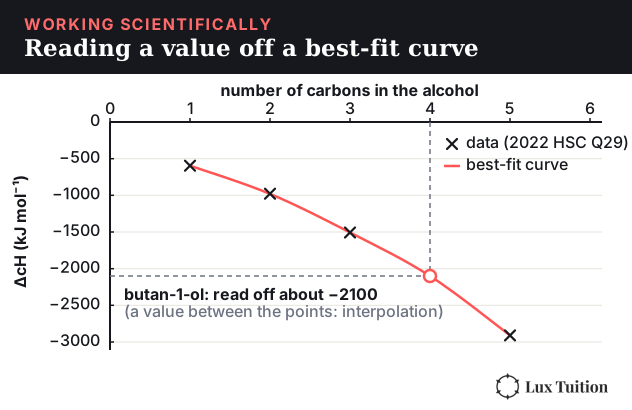
Worked example (2022 Q29(a), 3 marks). The paper gave school results for methanol (−596), ethanol (−978), propan-1-ol (−1507) and pentan-1-ol (−2910 kJ mol⁻¹) and asked students to plot them with a curved line of best fit and estimate butan-1-ol. The guideline rewards correct plotting, a curved best-fit line, and an estimate with units and the negative sign: about −2100 kJ mol⁻¹. Reading a value between your data points is interpolation, which is reasonably safe. Reading beyond the last point is extrapolation, which assumes the trend continues and is much less certain.
A column-graph question (2025 Q26(a)) rewards accurate scales, axis labels and column heights, and a two-series graph question in another module (2019 Q29(c)) adds a key and a line of best fit for each set. The checklist covers both.
Quantitative methods
Use the units to check your working (kJ mol⁻¹ means kJ divided by moles) and keep the sign of ΔcH. Round only at the end, to the same significant figures as the data. The percentage-yield example above is a model answer: 2025 Q25 gave marks for correct calculations and for correct significant figures.
Models
Structural formulae, line structures and ball-and-stick models are models. They show how atoms are joined and arranged, which makes the shape and the hydrogen bonding visible, but they don’t show real sizes, electron clouds or movement. In a micelle diagram the tails and heads are drawn separate and still, while in reality the molecules constantly move. State what a model shows and one thing it leaves out.
Secondary sources
The published value for an enthalpy of combustion or a boiling point comes from a secondary source (a data book or database). Reference it in an accepted style (author or organisation, title, year, link), cited consistently. Judge it by whether the author is an expert, whether it is recent and referenced, and whether at least two independent sources agree. Be more cautious with claims from a company selling a fuel, such as a biofuel’s “clean” label: look for the data behind the claim and compare it with a neutral source (see fossil fuels versus biofuels above).
Arguing from evidence, and command words
An evidence-based argument has a claim, the evidence for it, the reasoning that links them, and a fair comment on the other side or on limits, then a conclusion. Ask a classmate to check it: can they find the claim, the evidence and the reasoning without help? A “fossil fuels versus biofuels” answer might claim that bioethanol is lower in net CO₂, support it with data on carbon from growing plants, and note the land and energy used to make it.
Command words are guides, not formulas; what a question needs depends on the question and the evidence. Typical shapes (see the NESA glossary):
- Identify / describe: name it, or give its features.
- Explain: give the reason, linking cause to effect (hydrogen bonding, so higher boiling point).
- Analyse: break something into parts and show the relationships or trends, with evidence from the data.
- Discuss: give considerations for and against, with evidence and implications, and reach a conclusion.
- Compare: state similarities and differences, in the same terms for each.
- Justify: support a choice or claim with reasons or evidence (2022 Q29(b) asked for this).
- Assess / evaluate: make a judgement supported by evidence, normally weighing strengths and limitations where both exist.
HSC Chemistry Module 7 Revision Summary
What Comes After Module 7 in HSC Chemistry?
- Module 8: Applying Chemical Ideas tests for the functional groups in this module (bromine water, oxidation, sodium carbonate) and identifies organic molecules with infrared spectroscopy, mass spectrometry and NMR. Mixed exam questions often combine the reactions in this module with IR, MS and NMR evidence to work out an unknown structure, so use Module 8 to interpret every supplied spectrum, then check the proposed structure against every reaction clue. Our HSC Chemistry Module 8 notes pick up from here.
For the earlier Year 12 modules, see our HSC Chemistry Module 5 notes and Module 6 notes. For the bigger picture, our ultimate guide to scoring Band 6 in Chemistry covers how to study the HSC course, and a spaced-repetition guide to Anki is a good way to lock in naming rules and reaction conditions.
HSC Chemistry Tutoring in Blacktown
Module 7 is a module of patterns: once the naming rules and the handful of reaction types click, most questions become predictable. In our HSC Chemistry tutoring in Blacktown, theory is broken down by our tutors into the smallest possible parts and practised in classes of 1 to 5 students, a few minutes from Blacktown Station. Check our pricing page, or book a free trial with no obligations.
Frequently Asked Questions
What is Module 7 in HSC Chemistry?
Module 7 is Organic Chemistry, the third of four Year 12 modules in the NSW Chemistry Stage 6 Syllabus. It covers IUPAC naming and isomers, hydrocarbons and their reactions, alcohols, organic acids and bases including esters and soaps, and addition and condensation polymers.
How do you name organic compounds in HSC Chemistry?
Find the longest carbon chain containing the functional group, number it so the functional group gets the lowest number, add any methyl or ethyl branches and halogens as prefixes in alphabetical order, then add the functional group suffix such as -ene, -ol, -al, -one or -oic acid with its position number.
What are the three types of structural isomers?
Chain isomers have a different carbon skeleton, such as butane and 2-methylpropane. Position isomers have the same functional group in a different place, such as propan-1-ol and propan-2-ol. Functional group isomers have a different functional group, such as propanal and propanone.
What do primary, secondary and tertiary alcohols oxidise to?
With acidified potassium dichromate or permanganate, primary alcohols oxidise to aldehydes and then carboxylic acids, and secondary alcohols oxidise to ketones. Tertiary alcohols have no hydrogen on the carbon holding the OH group, so they don't oxidise and the dichromate stays orange.
Why is esterification heated under reflux?
The reaction is slow and the reactants and products are volatile. Reflux lets the mixture be heated for a long time while a condenser returns the vapours to the flask, so nothing escapes. Concentrated sulfuric acid is added as a catalyst and absorbs water, pushing the equilibrium towards the ester.
What is the difference between addition and condensation polymers?
Addition polymers form when the double bonds in alkene monomers open and join, with no other product, as in polyethylene and PVC. Condensation polymers form from monomers with two functional groups that release a small molecule, usually water, at every link, as in polyesters and nylon.
Learn it properly with a specialist tutor at Blacktown or online across NSW. Enquire about a free trial — no cost, no obligation. See online formats and class sizes.
Realistic study tips to help you prepare better for assessments with less stress, plus a printable study planner